Note
Go to the end to download the full example code.
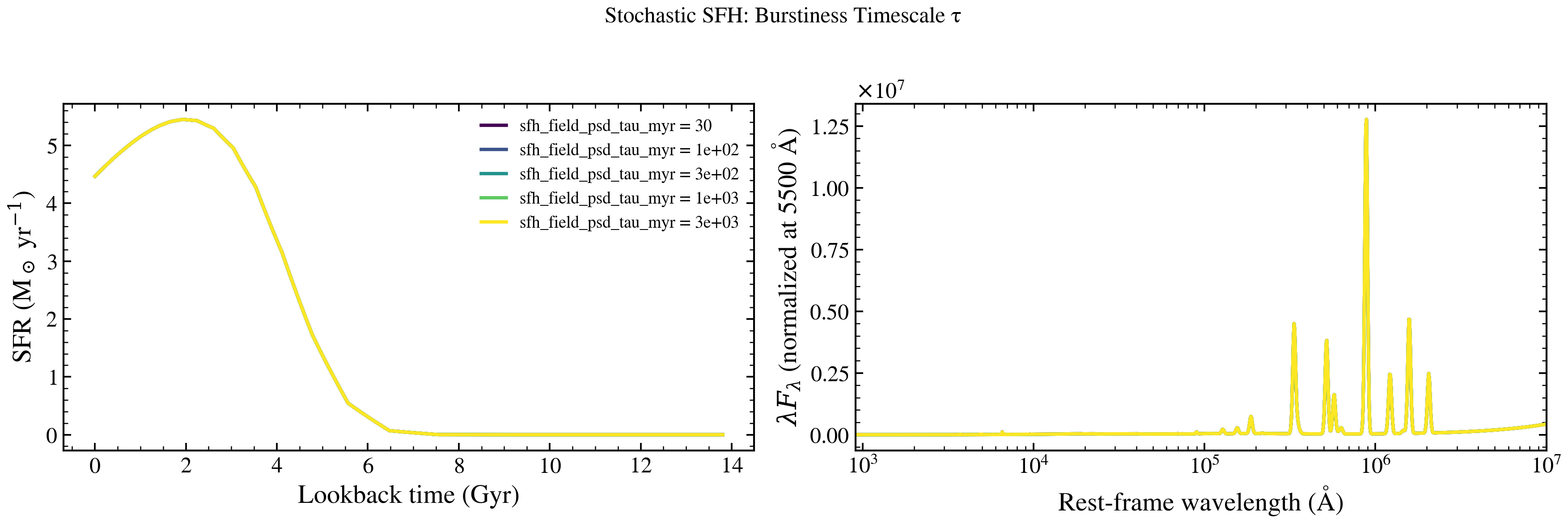
Stochastic SFH: Burstiness Timescale τ
τ (in Myr) controls how long bursts last. Short τ = fast flickering; long τ = sustained episodes.
from pathlib import Path

import jax
import matplotlib.pyplot as plt

jax.config.update("jax_enable_x64", True)

from tengri import Fixed, Parameters, SEDModel, Uniform, load_ssp_data, setup_style
from tengri.analysis.plotting import sfh_sed_comparison

setup_style()


def _find_ssp():
    name = "ssp_prsc_miles_chabrier_wNE_logGasU-3.0_logGasZ0.0.h5"
    for p in [
        Path("data") / name,
        Path("../data") / name,
        Path("../../data") / name,
        Path("../../../data") / name,
    ]:
        if p.exists():
            return str(p)
    return None


SSP_PATH = _find_ssp()
if SSP_PATH is None:
    raise FileNotFoundError("SSP data not found — skipping example")

ssp = load_ssp_data(SSP_PATH)

# Build Parameters with tsnorm + GP field for stochastic SFH
spec = Parameters(
    mean_sfh_type=["tsnorm", "field"],
    sfh_tsnorm_log_peak_sfr=Fixed(1.0),
    sfh_tsnorm_peak_lbt_gyr=Fixed(3.0),
    sfh_tsnorm_width_gyr=Fixed(2.0),
    sfh_tsnorm_skew=Fixed(0.3),
    sfh_tsnorm_trunc=Fixed(2.0),
    sfh_field_psd_sigma=Fixed(1.0),
    sfh_field_psd_tau_myr=Uniform(30, 3000),  # will be overridden
    met_logzsol=Fixed(-0.3),
    dust_tau_bc=Fixed(0.3),
    dust_tau_diff=Fixed(0.2),
    dust_slope=Fixed(-0.7),
    redshift=Fixed(0.1),
)

model = SEDModel(spec, ssp)

# Sweep parameter with stochastic samples
key = jax.random.PRNGKey(42)
values = [30, 100, 300, 1000, 3000]

# # The sweep_parameter helper creates a single SEDModel instance and calls
# # model.predict_rest_sed(...) in a loop. JAX JIT compilation is cached
# # automatically via tengri's persistent compilation cache (enabled at
# # import time), so repeated forward model calls reuse the compiled kernel.
fig = sfh_sed_comparison(
    model, "sfh_field_psd_tau_myr", values, cmap="viridis", n_stochastic=5, key=key
)
fig.suptitle("Stochastic SFH: Burstiness Timescale τ", fontsize=12, y=1.00)
plt.tight_layout()
plt.savefig("plot_psd_tau_sweep.png", dpi=150, bbox_inches="tight")
plt.show()