Note
Go to the end to download the full example code.
Dust Geometry: Screen vs Mixed vs Clumpy
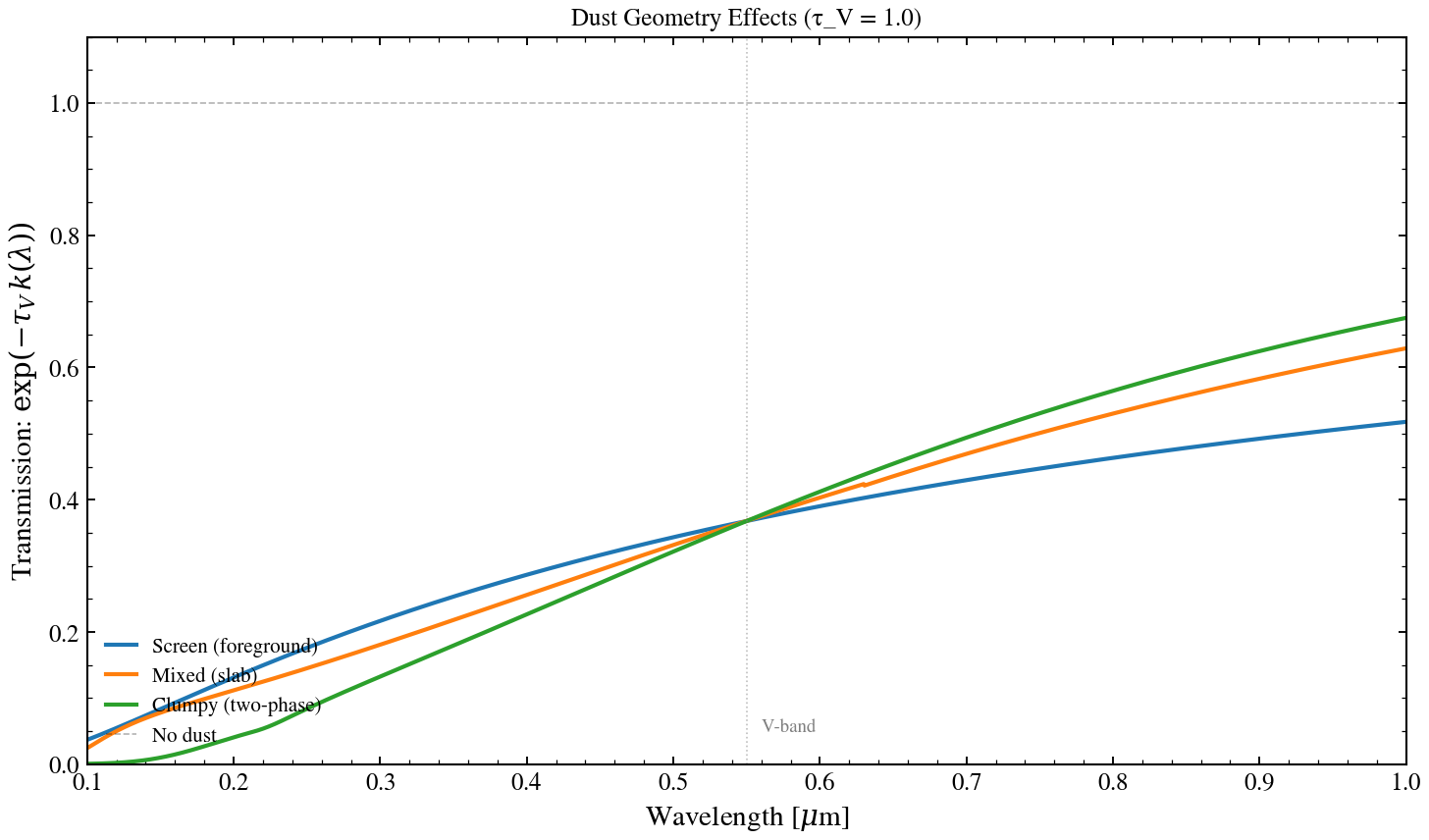
Compare transmission curves for three dust geometries (Witt & Gordon 2000): screen (foreground), mixed (slab), and clumpy (two-phase medium). At fixed optical depth τ_V = 1.0, geometry controls the spectral shape: screens are reddest, mixed intermediate, clumpy greyest.
import jax.numpy as jnp
import matplotlib.pyplot as plt
import numpy as np

from tengri.analysis.plotting import setup_style
from tengri.dust import resolve_dust_law

setup_style()

wavelength = jnp.linspace(1000.0, 10000.0, 2000)
wave_um = np.array(wavelength) / 1e4

tau_v = 1.0

# --- Geometries via dust law proxies ---
# Screen (power_law): minimal wavelength dependence, k(λ) ∝ λ^(-0.7)
# Mixed (Calzetti): intermediate, smooth k(λ) curve
# Clumpy (SMC): greyest attenuation, flattest k(λ), no 2175 Å bump

geometries = [
    ("power_law", {"n_slope": -0.7}, "Screen (foreground)", "#1f77b4"),
    ("calzetti", {}, "Mixed (slab)", "#ff7f0e"),
    ("smc", {}, "Clumpy (two-phase)", "#2ca02c"),
]

fig, ax = plt.subplots(figsize=(10, 6))

for law_name, kwargs, label, color in geometries:
    dust_fn = resolve_dust_law(law_name)
    k = dust_fn(wavelength, **kwargs)
    # Transmission = exp(-tau_v * k)
    transmission = np.exp(-tau_v * np.array(k))
    ax.plot(wave_um, transmission, lw=2.0, color=color, label=label)

ax.axhline(1.0, ls="--", color="black", lw=0.8, alpha=0.3, label="No dust")
ax.axvline(0.55, ls=":", color="grey", lw=0.8, alpha=0.5)
ax.text(0.56, 0.05, "V-band", fontsize=9, color="grey")

ax.set_xlabel(r"Wavelength [$\mu$m]")
ax.set_ylabel(r"Transmission: $\exp(-\tau_V \, k(\lambda))$")
ax.set_title(f"Dust Geometry Effects (τ_V = {tau_v:.1f})", fontsize=12)
ax.set_xlim(0.1, 1.0)
ax.set_ylim(0, 1.1)
ax.legend(fontsize=10, frameon=False, loc="lower left")
fig.tight_layout()
plt.savefig("plot_dust_geometry_sweep.png", dpi=150, bbox_inches="tight")
plt.show()