Note
Go to the end to download the full example code.
Population VI scaling: time, memory, and convergence
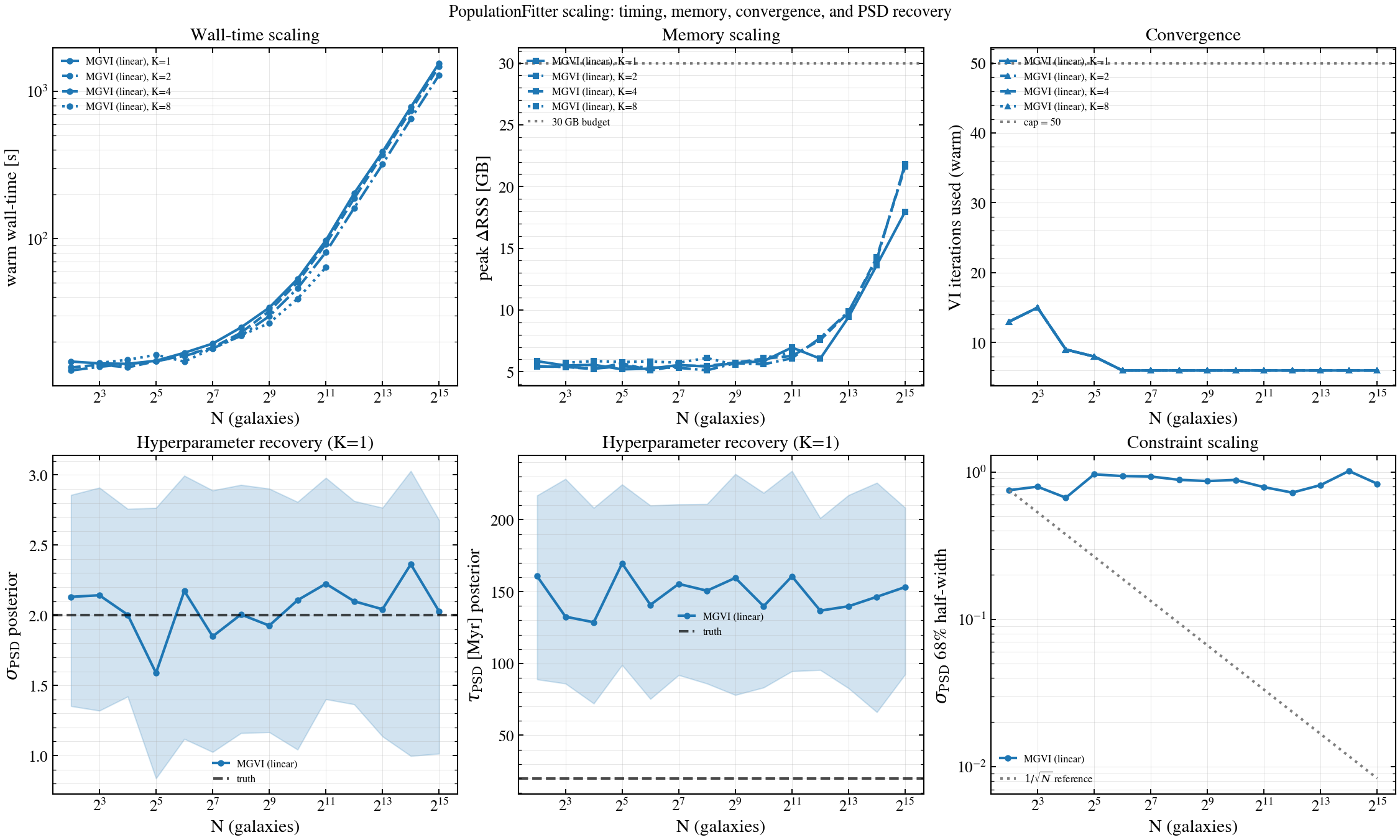
Renders the wall-time / peak-memory / iteration scaling of tengri’s two pure-JAX population variational engines on a 5-band SDSS photometry catalog with a stochastic-SFH forward model:
native_vi_linear— linearised geometric VI (MGVI).native_vi_nonlinear— full geometric VI (geoVI).
The grid scans N ∈ {4, …, 8192} galaxies × K ∈ {1, 2, 4, 8} forward chunks. Each cell is run in a fresh Python subprocess so the peak-RSS reading is clean.
This script is render-only: it loads results from
bench/results/vi_scaling_benchmark.json produced by
JAX_PLATFORMS=cpu python bench/scripts/benchmark_vi_xlarge.py
If the JSON is absent, the script prints instructions and exits.
Convergence policy
Both engines stop early via kl_rtol=1e-2. The benchmark uses an
iteration cap of 50 (retry 100); a row is converged iff
iters_used < cap. Non-converged rows are flagged on the iteration
panel.
Memory policy
Each run is bounded to ≤ 30 GB peak per worker. Columns abort once a row exceeds the budget — those (N, K) cells are absent from the plot.
from __future__ import annotations

import json
from pathlib import Path

import matplotlib.pyplot as plt
import numpy as np

from tengri import setup_style

setup_style()


def _find_results() -> Path | None:
    """Locate the benchmark JSON from project root or docs build cwd."""
    name = "vi_scaling_benchmark.json"
    for p in [
        Path("data") / name,
        Path("../data") / name,
        Path("../../data") / name,
        Path("../../../data") / name,
    ]:
        if p.exists():
            return p
    return None


RESULTS = _find_results()
if RESULTS is None:
    # Render-only example: never run the benchmark from a docs build.
    # If the cached JSON is absent, emit a placeholder figure with
    # instructions so the gallery still renders cleanly.
    fig, ax = plt.subplots(figsize=(8, 4))
    ax.axis("off")
    ax.text(
        0.5,
        0.5,
        "Population VI scaling benchmark not yet generated.\n\n"
        "Produce the cached results once with:\n\n"
        "    JAX_PLATFORMS=cpu python bench/scripts/benchmark_vi_xlarge.py\n\n"
        "It writes bench/results/vi_scaling_benchmark.json, which this gallery\n"
        "script then renders without re-running the benchmark.",
        ha="center",
        va="center",
        fontsize=11,
        family="monospace",
        bbox=dict(boxstyle="round,pad=0.7", fc="#f6f6f6", ec="#999"),
    )
    plt.show()
    raise SystemExit(0)

with RESULTS.open() as f:
    rows = json.load(f)

# Drop error rows and TIMEOUTs from the plot grid.
rows = [r for r in rows if not r.get("error") and r.get("wall_s_warm", -1) > 0]

methods = ("native_vi_linear", "native_vi_nonlinear")
labels = {"native_vi_linear": "MGVI (linear)", "native_vi_nonlinear": "geoVI (nonlinear)"}
colors = {"native_vi_linear": "#1f77b4", "native_vi_nonlinear": "#d62728"}
ks = sorted({r["forward_chunk_size"] for r in rows})
linestyles = {1: "-", 2: "--", 4: "-.", 8: ":"}


def _series(method: str, k: int, key: str) -> tuple[np.ndarray, np.ndarray]:
    sel = [r for r in rows if r["method"] == method and r["forward_chunk_size"] == k]
    sel.sort(key=lambda r: r["n_gal"])
    if not sel:
        return np.array([]), np.array([])
    return (
        np.array([r["n_gal"] for r in sel]),
        np.array([r[key] for r in sel], dtype=float),
    )


fig, axes = plt.subplots(2, 3, figsize=(15, 9), constrained_layout=True)
ax_t, ax_m, ax_i = axes[0]
ax_sig, ax_tau, ax_sig_err = axes[1]

# --- Panel 1: warm wall-time vs N ---
for method in methods:
    for k in ks:
        n, t = _series(method, k, "wall_s_warm")
        if n.size == 0:
            continue
        ax_t.plot(
            n,
            t,
            color=colors[method],
            linestyle=linestyles.get(k, "-"),
            marker="o",
            markersize=4,
            label=f"{labels[method]}, K={k}",
        )
ax_t.set_xscale("log", base=2)
ax_t.set_yscale("log")
ax_t.set_xlabel("N (galaxies)")
ax_t.set_ylabel("warm wall-time [s]")
ax_t.set_title("Wall-time scaling")
ax_t.grid(True, which="both", alpha=0.3)
ax_t.legend(fontsize=8, loc="upper left")

# --- Panel 2: ΔRSS vs N ---
for method in methods:
    for k in ks:
        n, m = _series(method, k, "rss_delta_gb")
        if n.size == 0:
            continue
        ax_m.plot(
            n,
            m,
            color=colors[method],
            linestyle=linestyles.get(k, "-"),
            marker="s",
            markersize=4,
            label=f"{labels[method]}, K={k}",
        )
ax_m.axhline(30.0, color="k", linestyle=":", alpha=0.5, label="30 GB budget")
ax_m.set_xscale("log", base=2)
ax_m.set_xlabel("N (galaxies)")
ax_m.set_ylabel("peak ΔRSS [GB]")
ax_m.set_title("Memory scaling")
ax_m.grid(True, which="both", alpha=0.3)
ax_m.legend(fontsize=8, loc="upper left")

# --- Panel 3: VI iterations to convergence ---
for method in methods:
    for k in ks:
        n, it = _series(method, k, "n_iters_used_warm")
        if n.size == 0:
            continue
        ax_i.plot(
            n,
            it,
            color=colors[method],
            linestyle=linestyles.get(k, "-"),
            marker="^",
            markersize=4,
            label=f"{labels[method]}, K={k}",
        )

# Mark non-converged rows.
not_conv = [r for r in rows if not r.get("converged", False)]
if not_conv:
    ax_i.scatter(
        [r["n_gal"] for r in not_conv],
        [r["n_iters_used_warm"] for r in not_conv],
        marker="x",
        color="red",
        s=80,
        zorder=5,
        label="hit cap (NOT converged)",
    )

cap = max((r["n_iters_max"] for r in rows), default=50)
ax_i.axhline(cap, color="k", linestyle=":", alpha=0.5, label=f"cap = {cap}")
ax_i.set_xscale("log", base=2)
ax_i.set_xlabel("N (galaxies)")
ax_i.set_ylabel("VI iterations used (warm)")
ax_i.set_title("Convergence")
ax_i.grid(True, which="both", alpha=0.3)
ax_i.legend(fontsize=8, loc="upper left")

# --- Panels 4 & 5: σ_PSD and τ_PSD constraint vs N (K=1 only) ---
TRUTH_SIGMA = 2.0
TRUTH_TAU = 20.0


def _constraint_series(
    method: str, key: str
) -> tuple[np.ndarray, np.ndarray, np.ndarray, np.ndarray]:
    sel = [
        r for r in rows if r["method"] == method and r["forward_chunk_size"] == 1 and r.get(key)
    ]
    sel.sort(key=lambda r: r["n_gal"])
    if not sel:
        return (np.array([]),) * 4
    n = np.array([r["n_gal"] for r in sel])
    med = np.array([r[key]["median"] for r in sel])
    p16 = np.array([r[key]["p16"] for r in sel])
    p84 = np.array([r[key]["p84"] for r in sel])
    return n, med, p16, p84


for ax, (key, truth, ylabel) in zip(
    (ax_sig, ax_tau),
    (
        ("psd_sigma_summary", TRUTH_SIGMA, r"$\sigma_{\rm PSD}$ posterior"),
        ("psd_tau_summary", TRUTH_TAU, r"$\tau_{\rm PSD}$ [Myr] posterior"),
    ),
):
    for method in methods:
        n, med, p16, p84 = _constraint_series(method, key)
        if n.size == 0:
            continue
        ax.fill_between(n, p16, p84, color=colors[method], alpha=0.2)
        ax.plot(n, med, color=colors[method], marker="o", markersize=4, label=labels[method])
    ax.axhline(truth, color="k", linestyle="--", alpha=0.7, label="truth")
    ax.set_xscale("log", base=2)
    ax.set_xlabel("N (galaxies)")
    ax.set_ylabel(ylabel)
    ax.set_title("Hyperparameter recovery (K=1)")
    ax.grid(True, which="both", alpha=0.3)
    ax.legend(fontsize=8, loc="best")

# --- Panel 6: σ posterior std vs N (Cramér–Rao-like 1/sqrt(N) reference) ---
for method in methods:
    n, med, p16, p84 = _constraint_series(method, "psd_sigma_summary")
    if n.size == 0:
        continue
    width = (p84 - p16) / 2.0  # ~1σ half-width
    ax_sig_err.plot(
        n,
        width,
        color=colors[method],
        marker="o",
        markersize=4,
        label=f"{labels[method]}",
    )
# 1/sqrt(N) reference, normalized to first MGVI point if available.
ref_n, _, p16r, p84r = _constraint_series("native_vi_linear", "psd_sigma_summary")
if ref_n.size > 0:
    w0 = (p84r[0] - p16r[0]) / 2.0
    ref = w0 * np.sqrt(ref_n[0] / ref_n)
    ax_sig_err.plot(ref_n, ref, color="gray", linestyle=":", label=r"$1/\sqrt{N}$ reference")
ax_sig_err.set_xscale("log", base=2)
ax_sig_err.set_yscale("log")
ax_sig_err.set_xlabel("N (galaxies)")
ax_sig_err.set_ylabel(r"$\sigma_{\rm PSD}$ 68% half-width")
ax_sig_err.set_title("Constraint scaling")
ax_sig_err.grid(True, which="both", alpha=0.3)
ax_sig_err.legend(fontsize=8, loc="best")

fig.suptitle(
    "PopulationFitter scaling: timing, memory, convergence, and PSD recovery",
    fontsize=13,
)

plt.savefig("plot_population_scaling.png", dpi=150, bbox_inches="tight")
plt.show()