Note
Go to the end to download the full example code.
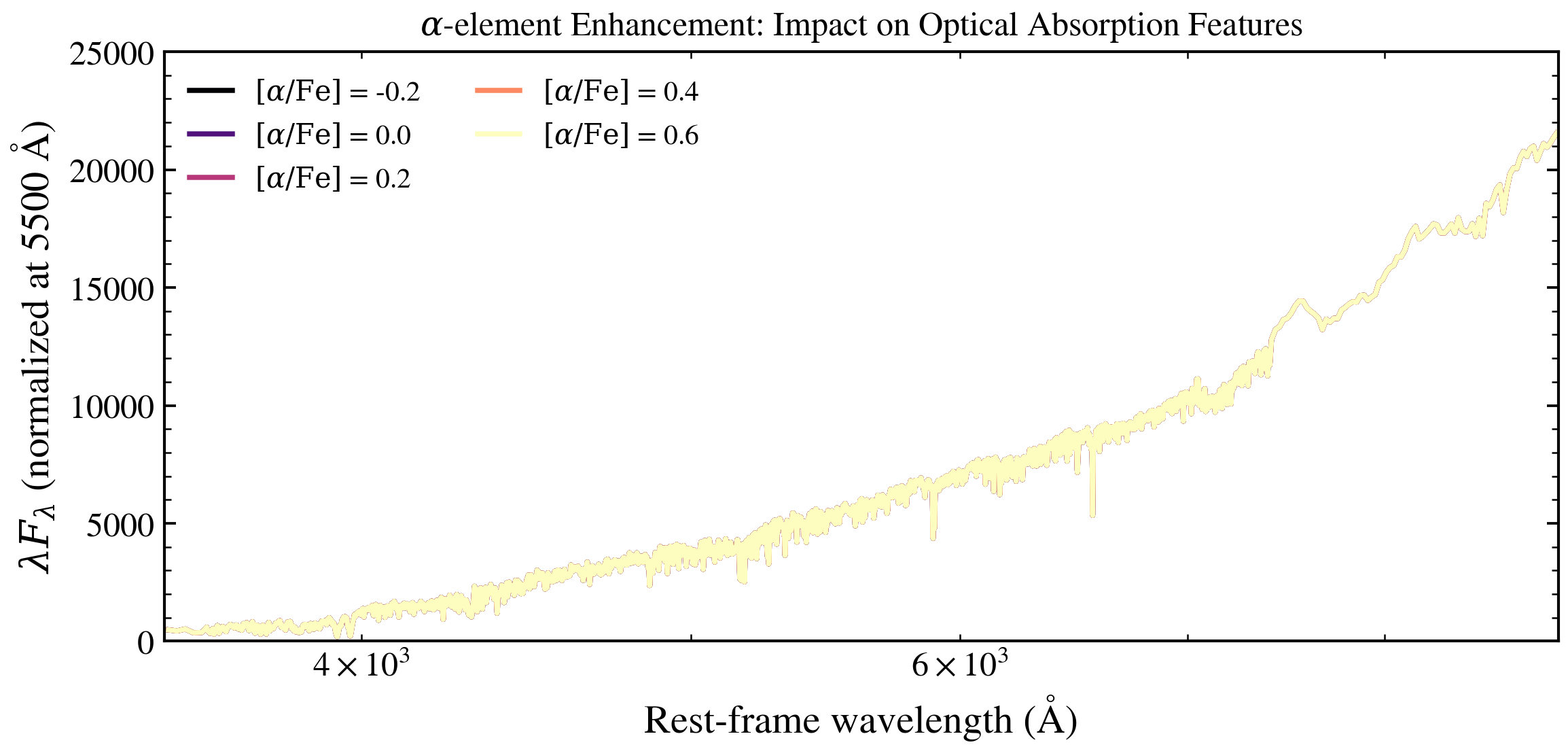
Alpha-element enhancement suppresses iron absorption features
The [α/Fe] abundance ratio encodes the chemical enrichment history: rapid enrichment by core-collapse supernovae before Type Ia SNe begin leads to high [α/Fe]. In the SED, enhanced alpha-elements suppress iron absorption lines in the optical (especially around 4000–5000 Å) because the higher abundance of alpha elements shifts the line-blanketing opacity. We sweep [α/Fe] on a quiescent passively evolving galaxy where iron features dominate the continuum absorption.
Reference: Thomas et al. 2003, MNRAS, 339, 897 (alpha-element effects).
import os

os.environ["TF_CPP_MIN_LOG_LEVEL"] = "2"  # suppress XLA/PjRt C++ INFO+WARNING logs

import warnings

import jax
import jax.numpy as jnp
import matplotlib as mpl
import matplotlib.pyplot as plt
import numpy as np

import tengri
from tengri.components.stellar.sps.dsps_wrapper import SSPData
from tengri.plot import setup_style
from tengri.utils.physics_constants import LOG10_ZSUN

setup_style()
warnings.filterwarnings("ignore", message=".*BakedInBackend.*")

# A [alpha/Fe] axis exists only on an alpha-enhanced (4-D) grid, and every
# shipped 3-D grid refuses a non-zero met_alpha_fe. This synthetic grid stands
# in for one: a Mg b-like absorption trough that deepens with [alpha/Fe], on the
# five [alpha/Fe] nodes of the hosted _afe grids. It is for illustration, not a
# stellar population model.
ALPHA_NODES = np.array([-0.2, 0.0, 0.2, 0.4, 0.6])
wave = jnp.linspace(3000.0, 10000.0, 600)
ages = jnp.linspace(-1.0, 1.14, 40)
continuum = 1e-3 * (1.0 + 0.2 * jnp.sin(jnp.linspace(0.0, 6.0, wave.size)))[None, :]
trough = jnp.exp(-0.5 * ((wave - 5175.0) / 40.0) ** 2)
flux = jnp.stack(
    [
        jnp.broadcast_to(continuum * (1.0 - 0.25 * (1.0 + a) * trough), (ages.size, wave.size))
        for a in ALPHA_NODES
    ],
    axis=0,
)  # (n_alpha, n_age, n_wave)
flux = jnp.broadcast_to(flux[None], (3, *flux.shape))  # (n_met, n_alpha, n_age, n_wave)
ssp = SSPData(
    ssp_wave=wave,
    ssp_flux=flux,
    ssp_lg_age_gyr=ages,
    ssp_lgmet=jnp.array([-1.5, -0.5, 0.0]) + LOG10_ZSUN,
    ssp_alpha_fe=jnp.asarray(ALPHA_NODES),
)
model = tengri.SEDModel.build(
    ssp,
    sfh={
        "type": "dpl",
        "all_params": tengri.Fixed(tengri.DEFAULT),
        "alpha": 2.0,
        "beta": 2.5,
        "tau_gyr": 8.0,
        "log_total_mass": 10.0,
    },
    dust_attenuation={
        "law": "power_law",
        "type": "two_component",
        "all_params": tengri.Fixed(tengri.DEFAULT),
        "tau_bc": 0.0,
        "tau_diff": 0.1,
    },
    # ``met_alpha_fe`` is swept below (#2296: a params-dict key the spec
    # declared Fixed is refused), so it must be free; no ``met=`` group was
    # declared before, defaulting the whole group to ``Fixed(DEFAULT)``.
    # Bounds exactly cover the sweep and match the grid-supported range.
    met={"alpha_fe": tengri.Uniform(-0.2, 0.6)},
    redshift=tengri.Fixed(0.05),
)
baseline = dict(model.spec.sample(jax.random.PRNGKey(0)))

met_alpha_fe_values = np.linspace(-0.2, 0.6, 7)
norm = mpl.colors.Normalize(vmin=met_alpha_fe_values.min(), vmax=met_alpha_fe_values.max())
cmap = plt.get_cmap("magma")

fig, ax = plt.subplots(figsize=(6.5, 4.2))
for met_alpha_fe in met_alpha_fe_values:
    params = {**baseline, "met_alpha_fe": jnp.float64(met_alpha_fe)}
    out = model.predict(params)
    wave = np.asarray(model.wavelengths)
    nu = 2.998e18 / wave  # Å/s -> Hz
    nu_l_nu = nu * np.asarray(out.rest_sed())
    ax.loglog(wave, nu_l_nu, color=cmap(norm(met_alpha_fe)), lw=1.4)

ax.set_xlim(3000, 1e4)
ax.set_xlabel(r"Rest-frame wavelength $\lambda$ [$\mathrm{\AA}$]")
ax.set_ylabel(r"$\nu L_\nu$  [erg s$^{-1}$]")

for wl in [4000, 5200, 8662]:
    ax.axvline(wl, color="gray", ls=":", lw=0.6, alpha=0.3)

cbar = fig.colorbar(plt.cm.ScalarMappable(norm=norm, cmap=cmap), ax=ax, pad=0.01)
cbar.set_label(r"[$\alpha$/Fe]")

fig.tight_layout()
plt.savefig("plot_alpha_fe_sweep.png", dpi=150, bbox_inches="tight")
Total running time of the script: (0 minutes 3.734 seconds)