Note
Go to the end to download the full example code.
AGN Contribution to Composite SEDs
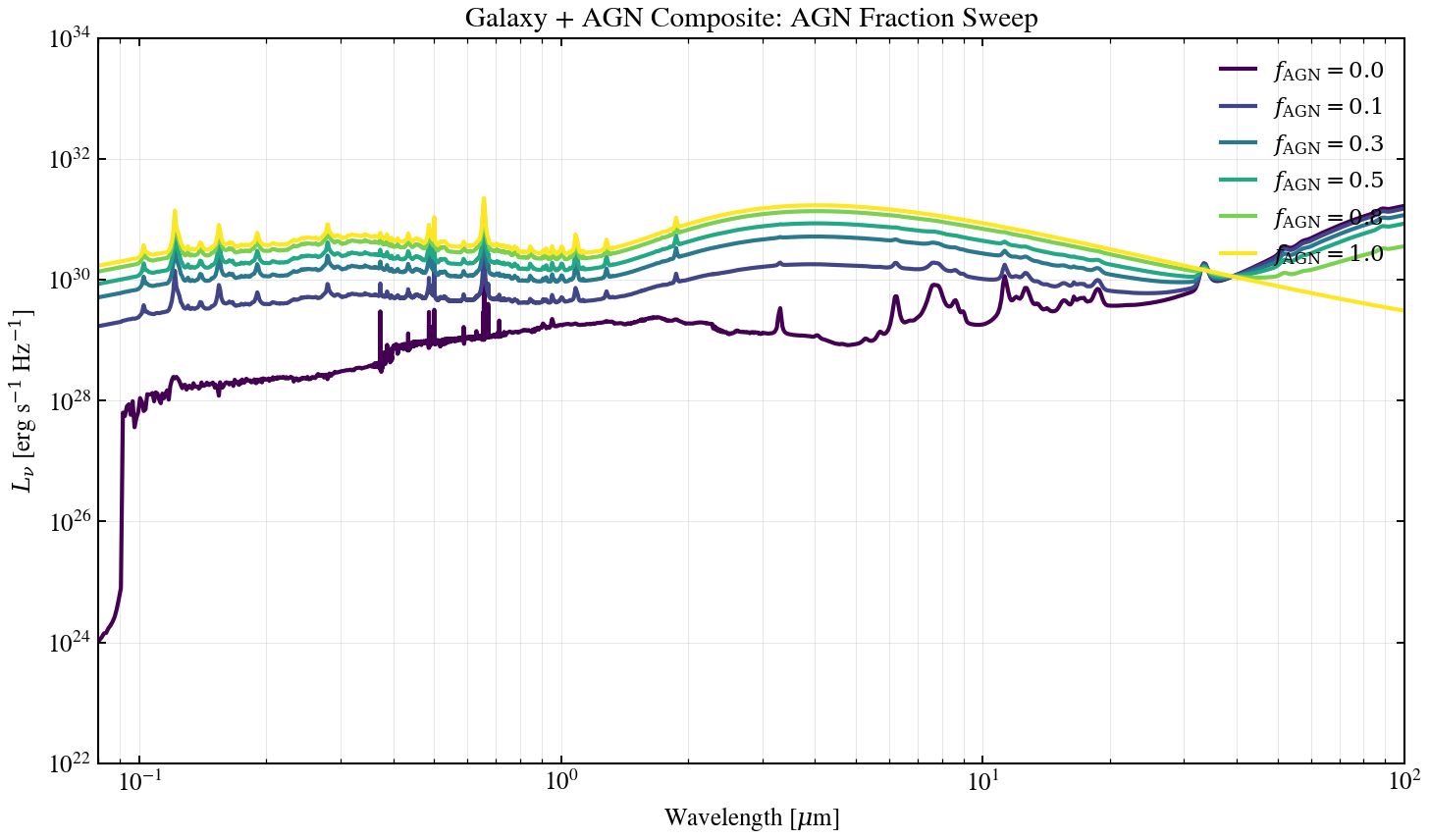
Active galactic nuclei (AGN) can dominate galaxy SEDs across UV to IR wavelengths. This script sweeps the AGN fraction f_AGN ∈ {0.0, 0.1, 0.3, 0.5, 0.8, 1.0} blending a star-forming galaxy stellar continuum with an AGN accretion disc spectrum. Shows the transition from star-formation-dominated to AGN-dominated SED morphology.
from pathlib import Path

import jax
import jax.numpy as jnp
import matplotlib

matplotlib.use("Agg")
import matplotlib.pyplot as plt
import numpy as np

jax.config.update("jax_enable_x64", True)

from tengri import (
    Fixed,
    Observation,
    Parameters,
    SEDModel,
    Spectroscopy,
    load_ssp_data,
    setup_style,
)
from tengri.components.agn import qsogen

setup_style()


def _find_ssp():
    """Find SSP data file in standard locations."""
    name = "ssp_prsc_miles_chabrier_wNE_logGasU-3.0_logGasZ0.0.h5"
    for p in [
        Path("data") / name,
        Path("../data") / name,
        Path("../../data") / name,
        Path("../../../data") / name,
    ]:
        if p.exists():
            return str(p)
    return None


ssp_path = _find_ssp()
if ssp_path is None:
    raise FileNotFoundError("SSP data not found — skipping example")

ssp = load_ssp_data(ssp_path)

# Wavelength grid: UV through near-IR
wave_sed = jnp.logspace(jnp.log10(1000.0), jnp.log10(1e6), 600)  # 0.1 µm – 100 µm [Å]
obs = Observation(spectroscopy=Spectroscopy(wave_obs=wave_sed))

# Base stellar SED (star-forming)
spec = Parameters(
    mean_sfh_type="tsnorm",
    dust_emission="draine_li2007",
    sfh_tsnorm_log_peak_sfr=Fixed(1.0),  # peak SFR ~ 10 Msun/yr
    sfh_tsnorm_peak_lbt_gyr=Fixed(2.0),
    sfh_tsnorm_width_gyr=Fixed(1.5),
    sfh_tsnorm_skew=Fixed(0.0),
    sfh_tsnorm_trunc=Fixed(2.0),
    met_logzsol=Fixed(0.0),
    dust_tau_bc=Fixed(0.3),
    dust_tau_diff=Fixed(0.2),
    dust_slope=Fixed(-0.7),
    dust_umin=Fixed(2.0),
    dust_qpah=Fixed(3.5),
    dust_gamma_dl=Fixed(0.02),
    redshift=Fixed(0.05),
)

model = SEDModel(spec, ssp, observation=obs)
key = jax.random.PRNGKey(42)
params = spec.sample(key)
pred_stellar = model.predict_rest_sed(params)

wave_rest_um = np.array(pred_stellar.wavelength) / 1e4
sed_stellar = np.array(pred_stellar.sed)
wave_rest_aa = np.array(pred_stellar.wavelength)  # Keep in Angstrom for AGN function

# AGN SED (QSOgen disc at moderate bolometric luminosity)
# Evaluate on the same wavelength grid as the stellar SED
log_lbol_agn = 11.0  # L_bol ~ 10^11 L_sun
wave_sed_agn = jnp.array(wave_rest_aa)  # Use stellar wavelength grid
sed_agn = np.array(qsogen(wave_sed_agn, agn_log_lbol=log_lbol_agn))

# AGN fractions to sweep
agn_fracs = [0.0, 0.1, 0.3, 0.5, 0.8, 1.0]
cmap = plt.cm.viridis
colors = [cmap(i / (len(agn_fracs) - 1)) for i in range(len(agn_fracs))]

fig, ax = plt.subplots(figsize=(10, 6))

for agn_frac, color in zip(agn_fracs, colors):
    # Blend stellar + AGN: L_nu = (1 - f_AGN) * L_stellar + f_AGN * L_AGN
    # Normalize AGN to match stellar luminosity scale
    agn_peak = np.nanmax(sed_agn[sed_agn > 0])
    stellar_peak = np.nanmax(sed_stellar[sed_stellar > 0])
    sed_agn_normalized = sed_agn * (stellar_peak / agn_peak)

    sed_composite = (1.0 - agn_frac) * sed_stellar + agn_frac * sed_agn_normalized

    mask = sed_composite > 0
    ax.loglog(
        wave_rest_um[mask],
        sed_composite[mask],
        color=color,
        lw=2.0,
        label=rf"$f_{{\mathrm{{AGN}}}} = {agn_frac}$",
    )

ax.set_xlabel(r"Wavelength [$\mu$m]", fontsize=12)
ax.set_ylabel(r"$L_\nu$ [erg s$^{-1}$ Hz$^{-1}$]", fontsize=12)
ax.set_title("Galaxy + AGN Composite: AGN Fraction Sweep", fontsize=14)
ax.legend(fontsize=11, frameon=False, loc="upper right")
ax.grid(True, alpha=0.3, which="both")
ax.set_xlim(0.08, 1e2)
ax.set_ylim(1e22, 1e34)

fig.tight_layout()
# Save to script directory
script_dir = Path(__file__).resolve().parent if "__file__" in dir() else Path(".")
plt.savefig(str(script_dir / "plot_panchromatic_agn_fraction.png"), dpi=150, bbox_inches="tight")
plt.close()