Examples gallery
120 standalone scripts demonstrating tengri’s physics components and end-to-end use cases. Fitting and inference live in the tutorial notebooks (docs “Notebooks” section), not the gallery — every gallery script is a forward-model figure.
Run a script locally with python examples/quickstart/plot_model_summary_walkthrough.py. Physics examples (dust curves, SFH shapes, AGN spectra) require only core dependencies. Fetch an SSP grid via import tengri; tengri.download_ssp().
Quick Start
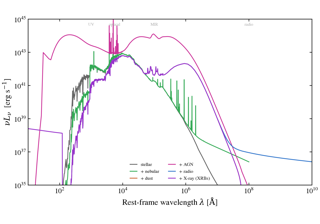
Model-summary walkthrough, SED dust anatomy, nebular-backend swap, and components-isolated anatomy tour. Fitting and inference examples live in the tutorial notebooks.
Understanding model structure through parameter provenance tags

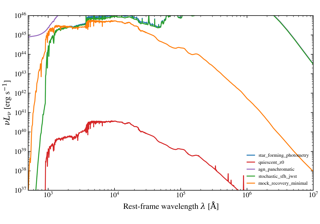
Dust attenuation across the SED: intrinsic, attenuated, and absorbed
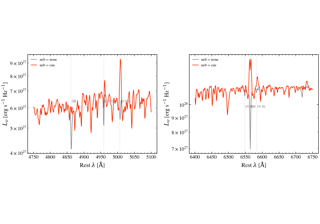
Swapping the nebular backend on, then off, on a young starburst
Recipes
Recipe comparison, introspection tour, and custom filter design.
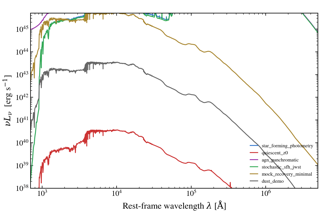
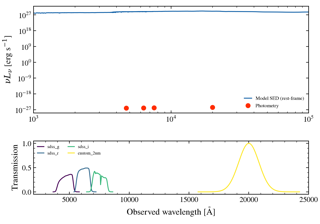
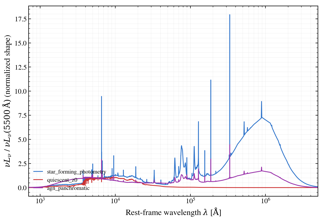
Recipe introspection and SED morphology comparison
Stellar Population Synthesis
SSP grid and age/metallicity sweeps, IMF choice, mass-to-light band comparison, and library shootout.
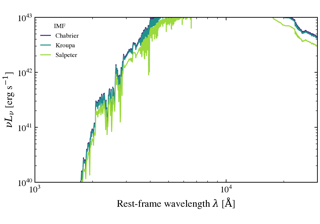
Initial Mass Function choice and stellar mass-to-light ratio
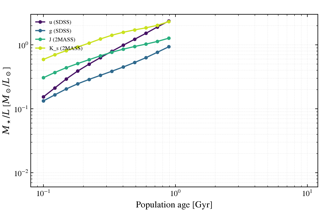
Stellar mass-to-light ratios across bands: age sensitivity

Stellar Population Aging: SSP at Solar Metallicity

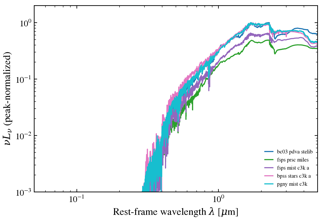
SSP Library Shootout: Comparing Spectral Predictions at 5 Gyr, Z=0

Star Formation Histories
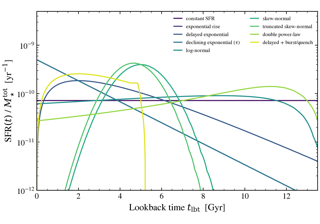
Parametric forms (DPL, delayed-exponential, lognormal) and non-parametric (PSD-governed stochastic). Quenching pathways, burst observability, and SFH form comparison.
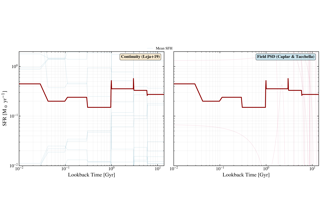
Continuity Prior vs PSD-Governed Prior: Stochastic Structure at Fixed Mean

Double power-law SFH parameter space: early growth α vs late quenching β

PSD parameter space: amplitude σ and timescale τ control burstiness
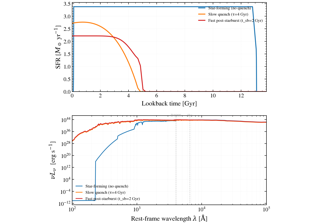
Quenching pathways: fast vs slow termination of star formation
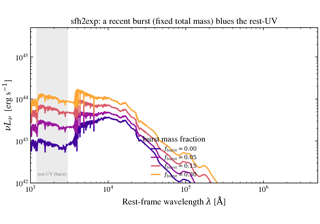
sfh2exp: double declining exponential (old population + recent burst)
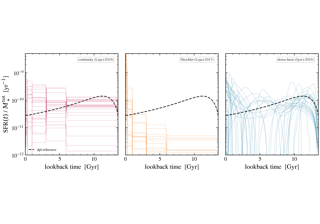

Stochastic SFH samples from GP-correlated fields with different burstiness
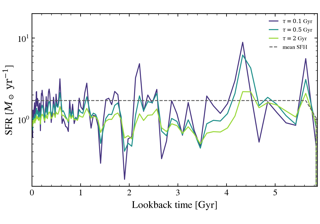
Correlation timescale τ sets how bursty a stochastic SFH looks at fixed σ
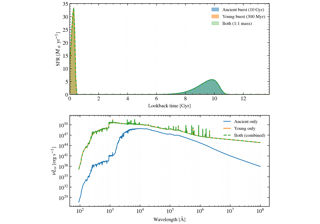
The outshining problem: young bursts eclipse ancient populations
Metallicity
Per-SSP-library Z☉ differs: MIST 0.0142, BC03/Padova 0.0190, PARSEC 0.0152, BASTI 0.0200. Cross-code comparisons must reason in absolute log(Z). Stellar and gas-phase Z are separate knobs. Age–metallicity degeneracy in broadband data. α-element enhancement.

Alpha-element enhancement suppresses iron absorption features

Metallicity shapes panchromatic SED with dust emission

Age-metallicity degeneracy in the stellar continuum

Chemical evolution: closed-box vs leaky-box enrichment histories
Nebular Emission
Emission lines are vacuum throughout: Hα is 6564.61 Å, not the 6562.8 Å air value. Mixing the two shifts every line centroid.
neb={'type': ...} takes ssp, cue, cb19, cloudy or none.
The default, ssp, uses the emission already baked into a with-nebular (wNE)
SSP grid. The live backends instead compute it, and expect a bare stellar grid.
Feed a bare grid to the baked-in path and both continuum and line fluxes come
out low, with no error raised.
Gas-phase metallicity is its own knob and does not follow the stellar one. Shock emission examples include line-ratio diagnostics and a composable shock-group sweep across shock parameters.
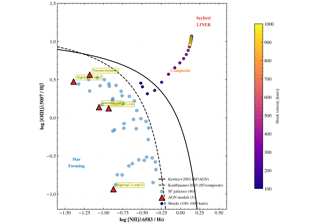
BPT diagram: star-forming galaxies, AGN, and shocks
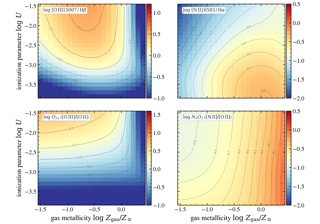
Comprehensive 2D sweep of ionization parameter and metallicity (Cue)

Escape fraction reshapes the SED from the Lyman continuum to optical lines
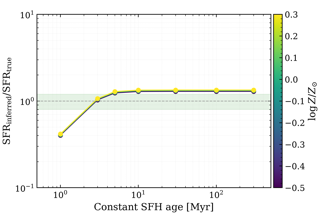
Hα SFR calibration breaks at young ages, weakly dependent on metallicity
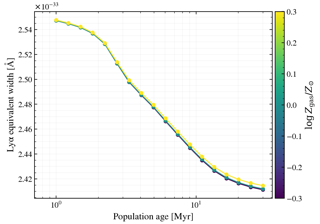
Lyman-alpha equivalent width peaks at young ages, varies with gas metallicity

Nebular backends: Cue, CloudyGrid, SSP-embedded, and BakedIn
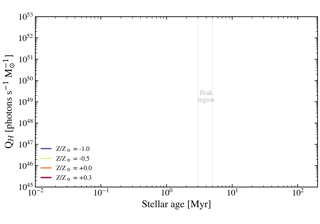
Ionizing photon production rate Q_H peaks sharply with stellar age

MAPPINGS V shocks: velocity, density, and magnetic field effects
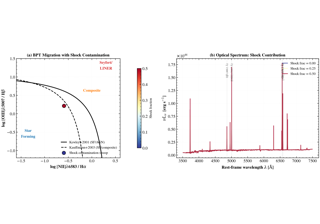
Shock-group sweep: composable shock contamination on the BPT diagram
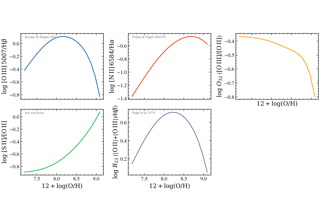
Dust Attenuation
Two-component Charlot & Fall geometry: dust_tau_bc on the birth clouds,
dust_tau_diff on the diffuse ISM. dust_slope defaults to -0.7, the
diffuse-ISM value; -1.3 is the birth-cloud one. The 2175 Å bump is a separate
always-on modifier, dust_bump_strength, defaulting to 0.0 — Calzetti
carries no bump unless you ask for one.
Dust emission templates load from data/. There is no analytic fallback: a
missing template raises FileNotFoundError rather than quietly substituting
a worse model.
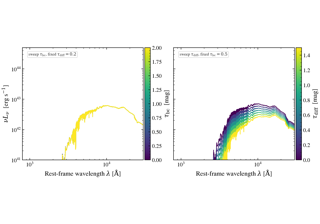
Birth-cloud vs diffuse-ISM dust: age dependence and parameter degeneracies
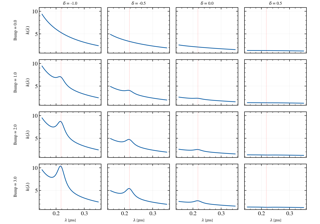
2175 Å bump × UV slope interaction in Kriek & Conroy attenuation
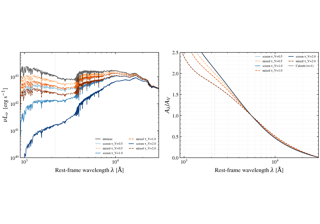
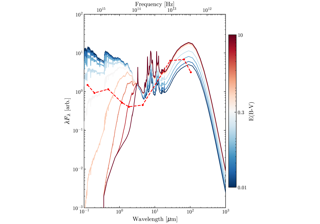
GRAHSP Fig. 7 reproduction: attenuation of the galaxy model
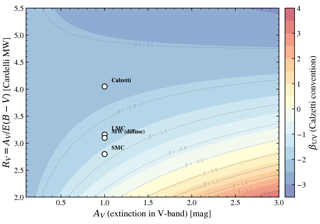
Rv and Av degeneracy in UV slope: the Calzetti trap
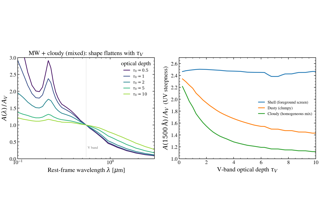
Witt & Gordon 2000: the attenuation shape greys with optical depth
Dust Emission
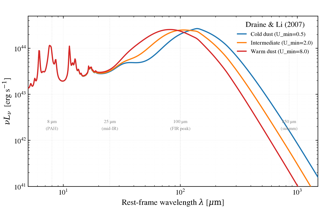
Dust emission templates auto-load from data/; analytic fallbacks are not suitable for science. PAH features in Draine & Li templates (q_PAH and U_min sweeps). Mid-IR PAH diagnostics distinguish star-forming, AGN, and composite systems. Temperature sweeps. Template libraries: BOSA, THEMIS, PAHspec, Astrodust (HD23).
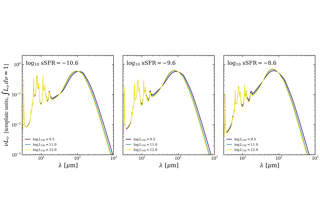
BOSA library: PAH features and FIR peak depend on both sSFR and L_TIR
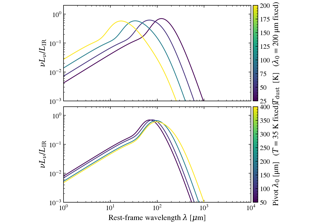
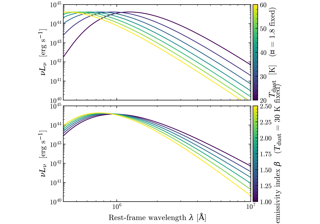
Casey 2012 dust model: temperature and pivot wavelength effects
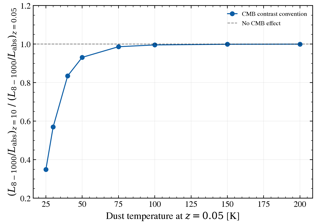
CMB heating: dust temperature and infrared luminosity ratio across redshift

The q_PAH and U_min knobs move PAH amplitude and FIR peak independently
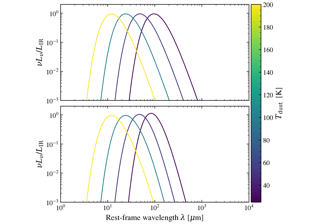
Graybody dust opacity: optically thin vs. general form across temperature
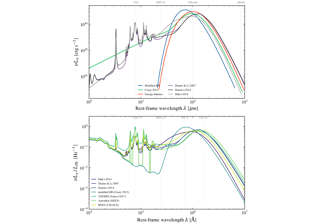
Dust IR-emission library comparison: models and templates
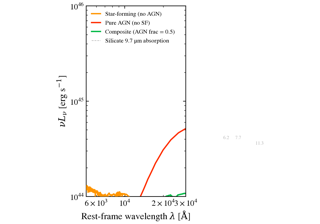
Mid-IR PAH features in star-forming, AGN, and composite galaxies

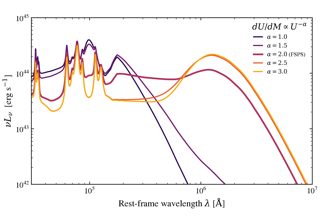
Draine+2021 PAHspec: starlight-spectrum sweep at fixed log U
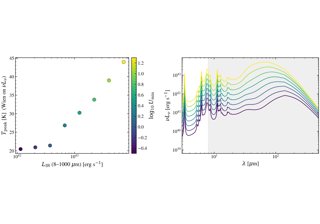
Radiation field strength sets both dust peak temperature and L_IR
AGN Models
Torus models in components/agn/torus.py are toy models; SKIRTOR is the one for science. Disc continua (multicolor, KD18, relagn, qsogen), narrow-/broad-line and FeII emission, polar-dust and Type 1/2 attenuation. Cross-validated against CIGALE and AGNfitter.
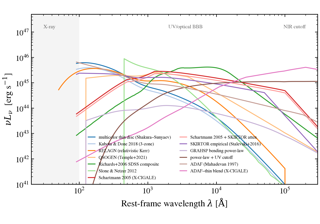
AGN disc continuum: every registered model at fixed L_bol
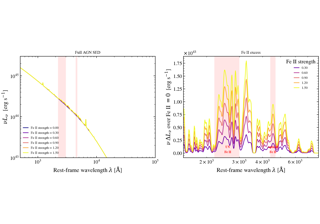
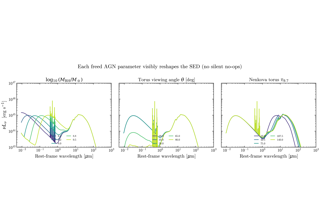
AGN parameters are free-able now — and every one moves the SED

Building up an AGN SED: disc, then torus, then lines
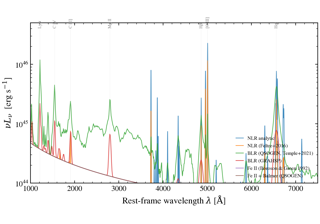

QSOgen emission lines: Baldwin effect across AGN luminosity
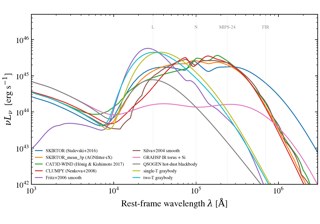
AGN dusty torus: library comparison at fixed L_bol
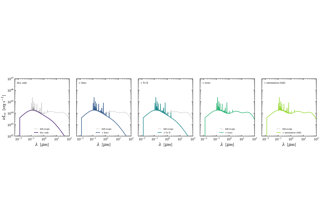
Cumulative buildup of the GRAHSP AGN recipe, one sub-block at a time
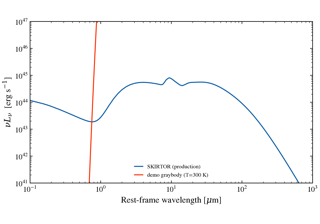
Custom AGN torus model via SEDModelComponent and direct integration
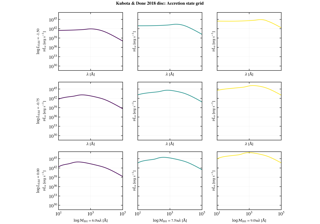
Kubota & Done 2018 disc: Accretion state effects on continuum
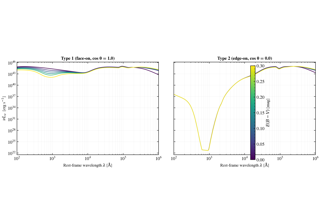
Polar dust E(B-V) reddens Type 1 & 2 AGN differently

Black-hole spin hardens the UV slope through ISCO migration
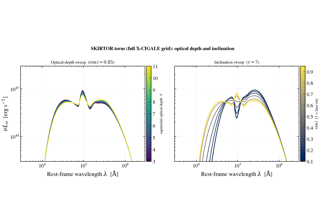
SKIRTOR torus (full X-CIGALE grid): optical depth and inclination
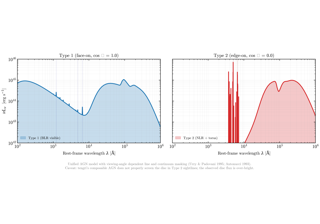
Type 1 vs Type 2 AGN: Unified viewing-angle classification
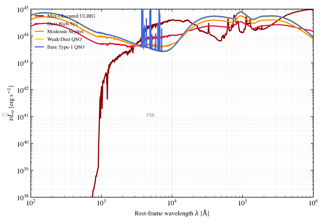
ULIRG→QSO evolutionary sequence: dust-obscured starburst to bare quasar
Radio
Star formation (free-free and synchrotron) and AGN (radio-loud) components. Far-infrared–radio correlation and non-thermal spectral slopes. Model-family comparison included.

Synchrotron spectral index: steeper α_sf dims the high-frequency tail

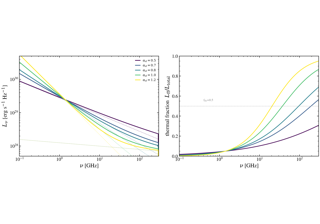
Synchrotron / free-free balance vs synchrotron slope α_sf

FIR-radio correlation: L_IR × q_IR sets radio loudness scale

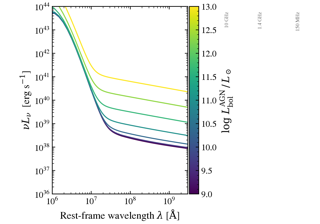
AGN radio loudness R: orders of magnitude in jet power
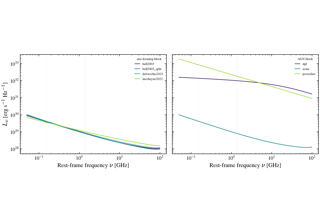
Radio blocks: which q_IR calibration, and which AGN synchrotron shape
X-ray Emission
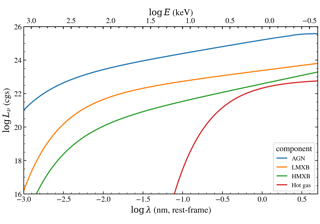
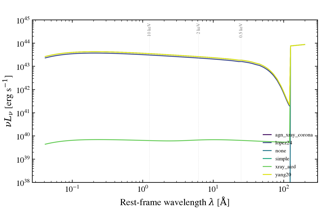
X-ray binaries (HMXB, LMXB) scaled with SFR and stellar mass. AGN coronae: luminosity, photon index γ, exponential cutoff E_cut, UV-to-X-ray slope α_ox. Model-family comparison included.
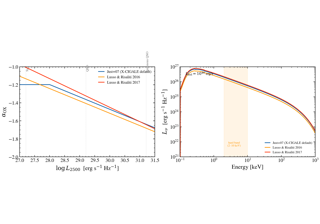
Three empirical alpha_OX-L_2500 prescriptions diverge at the quasar peak

AGN UV-to-X-ray power-law slope alpha_OX controls X-ray normalization
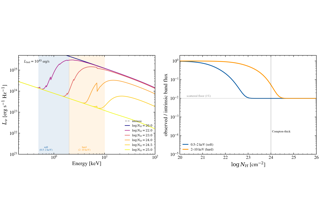
N_H column density sweep: from unobscured to Compton-thick
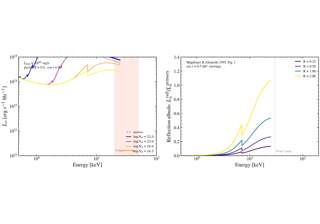
Compton hump in obscured AGN: pexrav reflection across log N_H

X-ray binary luminosity scales with SFR (HMXB) and stellar mass (LMXB)
IGM
Intergalactic-medium absorption: Madau vs Inoue prescriptions, Lyα forest, damped Lyα systems. Lyman-break/dropout signature in high-z photometric selection. IGM igm_transmission(wave_obs, z) takes observed-frame wavelengths (not rest-frame).

DLA column density sculpts the Lyman alpha forest at z=3
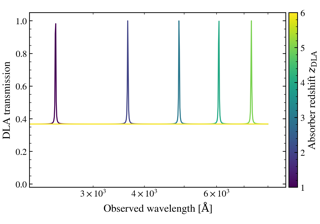
DLA damping wing evolves with absorber redshift at fixed column density
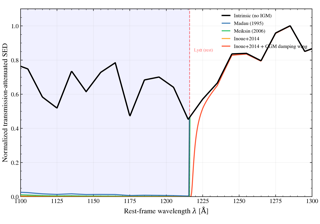
Comparison of IGM absorption models at high redshift

IGM transmission curves evolve sharply with redshift as Lyman forest deepens
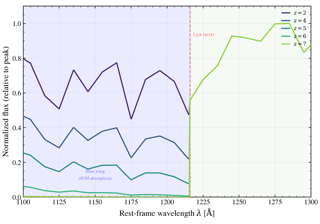
Lyman-alpha profile and IGM blue-wing absorption across redshift
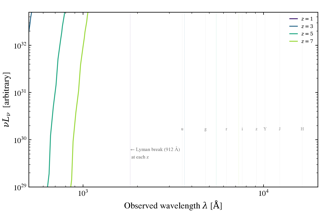
Full galaxy SED with IGM absorption applied at multiple redshifts
Photometry
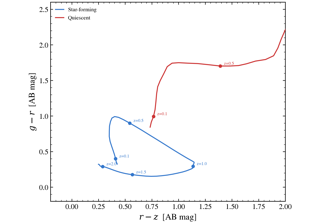
Broadband filter selection, cosmological dimming, color tracks and redshift evolution. Diagnostic planes: WISE/IRAC AGN wedges, red sequence/blue cloud. Photometric-redshift color degeneracies.
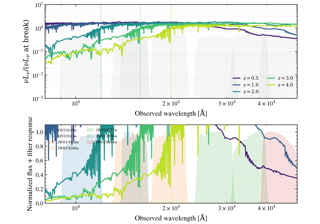
Balmer break (4000 Å) position in observed-frame filters vs redshift
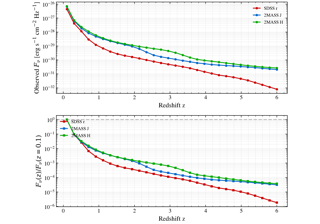
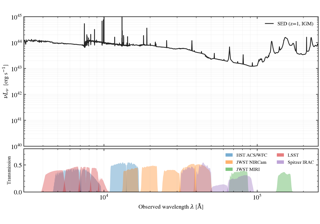
HST+JWST+LSST+Spitzer Filter Overlay on Star-Forming SED at z=1
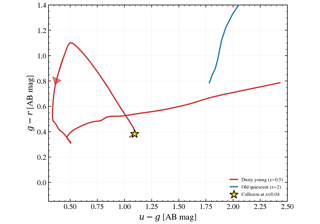
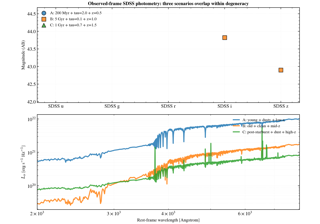
Photo-z degeneracy in color–color space: low-z dusty vs high-z quiescent
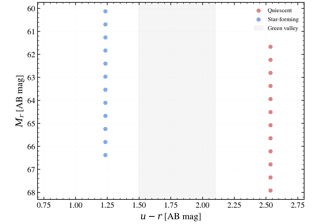
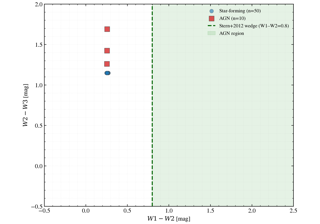
WISE W1–W2 vs W2–W3 Color-Color Diagram with Stern+2012 AGN Wedge
Spectroscopy
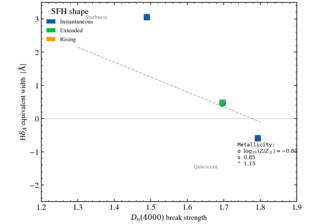
Absorption-line indices (D4000, Hδ) from stellar age and metallicity. Spectral indices vs age. Velocity dispersion, line broadening, and velocity offset. Instrumental resolution effects. High-redshift example: z ≈ 6 Lyα emitter.
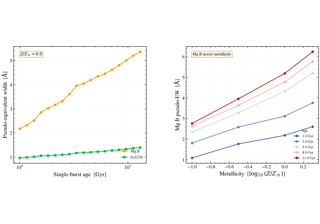
Stellar absorption bandheads: age and metallicity anti-correlation
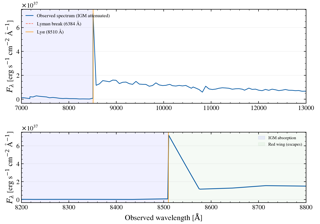
Lyman-alpha emitter spectrum at z=6: IGM absorption and Lyα escape

Instrumental resolution controls Hα + [N II] line blending
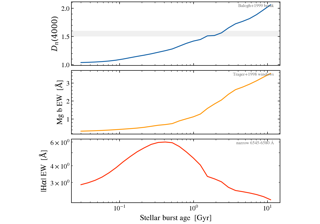

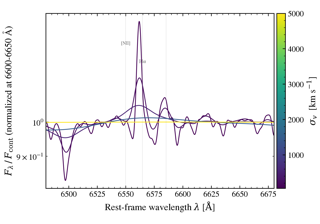
Emission-line velocity dispersion: narrow [NII] to broad Hα
Use Cases
Paper-style diagnostics: UVJ, JWST color-color, SFR indicators, age–dust degeneracy, main sequence evolution, dropout selection, spectral indices. Simulated-population Catalog examples.
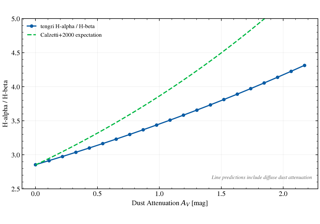
Balmer Decrement Tests Dust Attenuation on Emission Lines
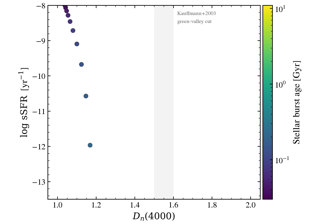
D_n(4000) – specific SFR: the Kauffmann+2003 sequence
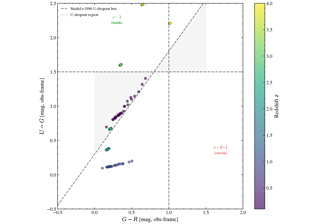
z~3 Lyman-break galaxy U-dropout selection: color-color diagnosis
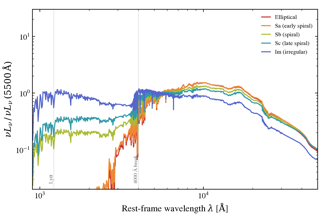
A morphological atlas: E, Sa, Sb, Sc, Im galaxy SEDs
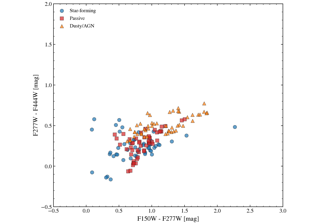
JWST NIRCam color-color diagnostics for high-z galaxy classification
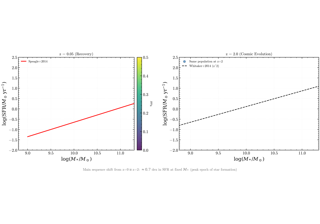
Star-forming main sequence: z = 0 → 2 cosmic evolution + recovery
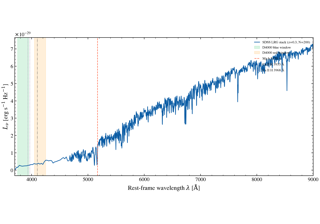
SDSS Luminous Red Galaxy Stacked Template Spectrum
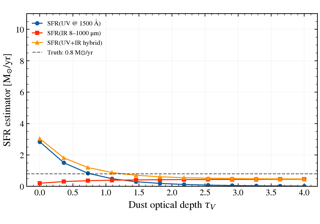
SFR calibrations: UV only vs UV+IR hybrid estimators vs dust optical depth
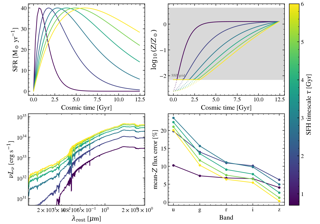
Predicting SEDs for a simulated population: what collapsing Z(t) costs
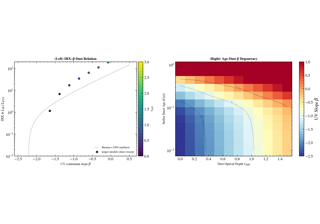
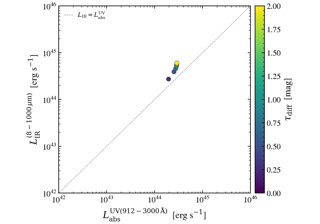
UV slope β degeneracy: dust optical depth and stellar age
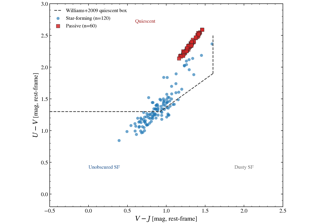
UVJ diagram: rest-frame colors separate star-forming from quiescent
Advanced Topics
Extension-point demonstration (SEDModelComponent), Fisher degeneracy, and validation techniques: gradient vs finite-difference, mass conservation, redshift-frame invariance, WavePrecomp accuracy.
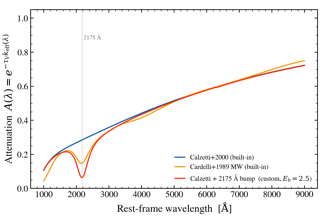
Authoring a new physics block with SEDModelComponent
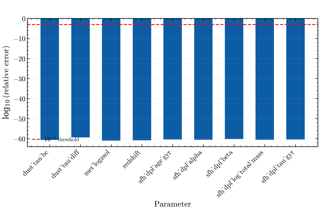
Autodiff gradients vs. finite-difference derivatives: diagnostic verification
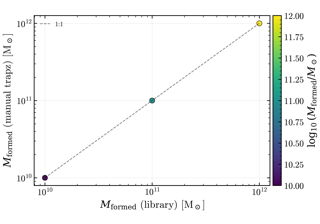
Mass conservation in SFH: manual integration vs predict_properties
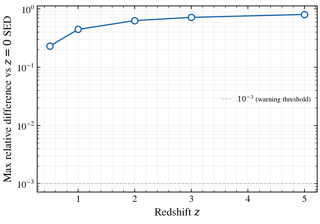
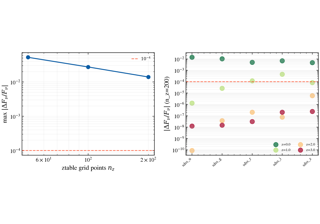
WavePrecomp photometric accuracy across redshift grids

Showcase
Full-stack demonstrations: population forward modeling, gradient diagnostics, end-to-end workflows.
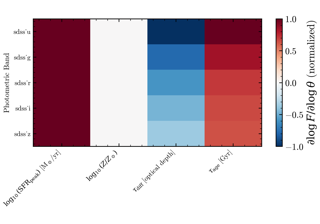
Automatic differentiation: parameter sensitivities via jax.grad