Note
Go to the end to download the full example code.
X-ray model family: five names, two prescriptions
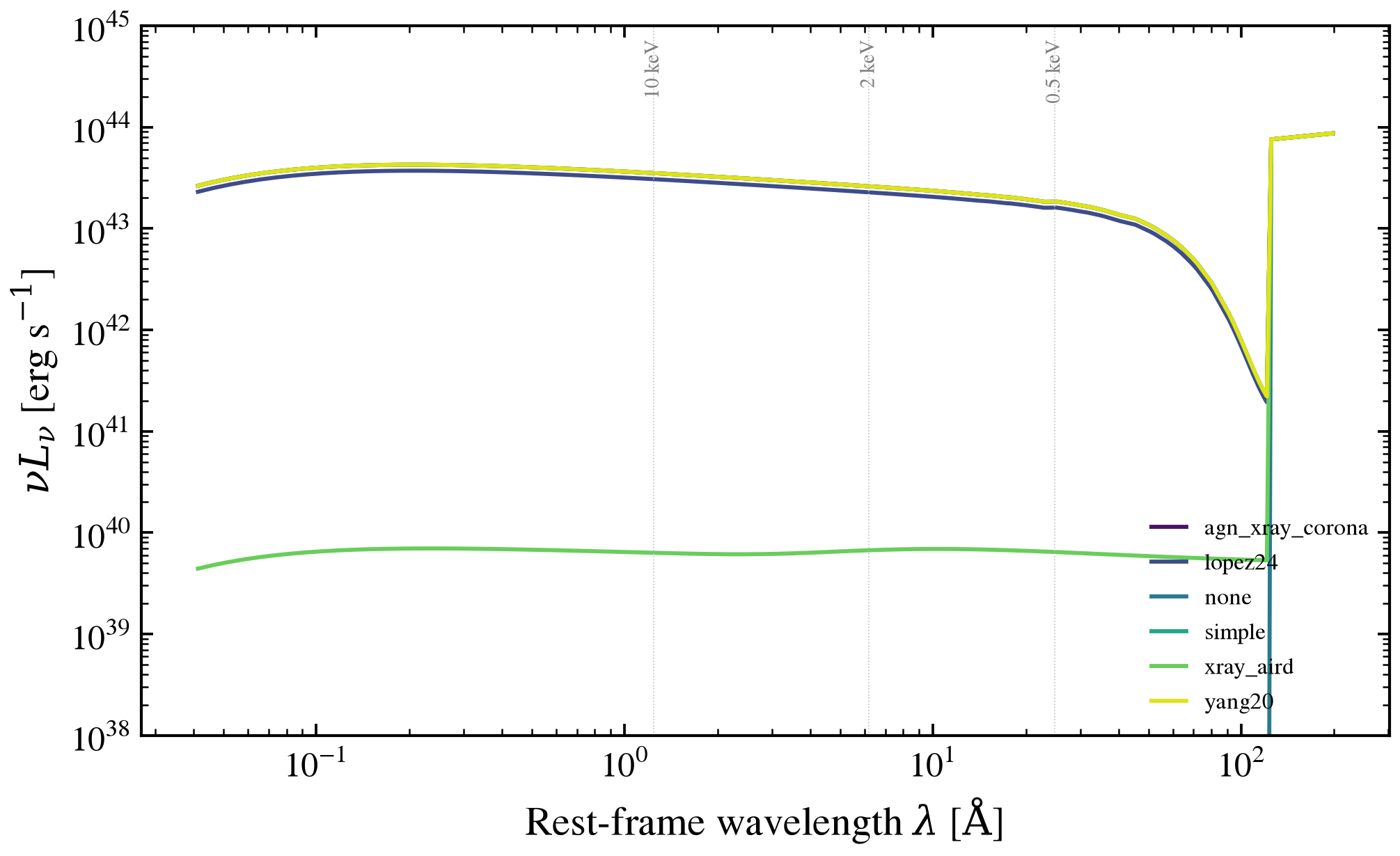
Every X-ray model tengri registers, on one host galaxy, with only the xray
block changing. At default parameters they collapse onto two curves, and that
is the point of the figure rather than a defect in it:
simple,yang20,xray_airdandagn_xray_coronaall normalize the corona through alpha_ox(L_2500) and land on top of each other to the last digit.yang20is documented as a CIGALE-parity alias ofsimple.lopez24ties the corona to the nuclear 12 μm luminosity via alpha_IRX instead, which is the appropriate normalization for obscured or IR-selected AGN, and sits ~13% lower here.noneis the control: the same galaxy with X-rays off.
So the name to choose is a choice of normalization, not of five different
SEDs — and picking among the four aliases changes nothing until you change
their parameters. Measured at 2 keV: 2.61e43 erg/s for all four, 2.27e43 for
lopez24.
Read the wavelength axis backwards from the usual: 124 A is 0.1 keV and 1.24 A is 10 keV, so harder X-rays are to the left.
The list comes from the registry, so a newly registered model joins this figure rather than quietly missing it.
Reference: Yang+2020 (alpha_ox corona); Lopez+2024, Asmus+2015 (alpha_IRX).
import os

os.environ["TF_CPP_MIN_LOG_LEVEL"] = "2"  # suppress XLA/PjRt C++ INFO+WARNING logs

import warnings

import jax
import matplotlib.pyplot as plt
import numpy as np

import tengri
from tengri.plot import setup_style
from tengri.units import C_AA

setup_style()
warnings.filterwarnings("ignore", message=".*BakedInBackend.*")
warnings.filterwarnings("ignore", message=".*experimental.*")

# One host galaxy for every model: only the xray block below changes.
SFH = {"type": "const", "all_params": tengri.Fixed(tengri.DEFAULT), "log_total_mass": 10.5}
DUST = {
    "law": "power_law",
    "type": "two_component",
    "all_params": tengri.Fixed(tengri.DEFAULT),
    "tau_diff": 0.4,
    "tau_bc": 0.5,
}
AGN = {
    "type": "composable",
    "all_params": tengri.Fixed(tengri.DEFAULT),
    "disc": {"type": "qsogen", "all_params": tengri.Fixed(tengri.DEFAULT)},
    "torus": {"type": "skirtor", "all_params": tengri.Fixed(tengri.DEFAULT)},
    "log_lbol": 11.5,  # log10(L_bol / L_sun) at API level, never erg/s
}
KEV_TO_AA = C_AA * 4.135667696e-18  # h [keV s] * c [A/s] -> A at 1 keV

ssp = tengri.load_ssp("fsps_prsc_miles_chabrier", download=True)
models = [row["name"] for row in tengri.list_xray_models()]

fig, ax = plt.subplots(figsize=(7.0, 4.4))
colors = plt.get_cmap("viridis")(np.linspace(0.05, 0.95, len(models)))

for name, color in zip(models, colors):
    model = tengri.SEDModel.build(
        ssp_data=ssp,
        sfh=SFH,
        dust_attenuation=DUST,
        agn=AGN,
        xray={"type": name, "all_params": tengri.Fixed(tengri.DEFAULT)},
        redshift=tengri.Fixed(0.05),
    )
    # Nothing is free, so the draw is the declared values and the host is
    # identical for every model. Asserted rather than assumed: a model that
    # later declares a free parameter would silently turn this into a
    # comparison of different galaxies.
    assert not model.spec.free_params, f"{name} left {model.spec.free_params} free"
    pred = model.predict(model.spec.sample(jax.random.PRNGKey(0)))
    wave = np.asarray(pred.wave_rest)
    nu_l_nu = (C_AA / wave) * np.asarray(pred.rest_sed())

    band = wave < 200.0
    ax.loglog(wave[band], nu_l_nu[band], color=color, lw=1.4, label=name)

for kev in (0.5, 2.0, 10.0):
    lam = KEV_TO_AA / kev
    ax.axvline(lam, color="0.75", lw=0.4, ls=":")
    ax.text(
        lam,
        0.98,
        f"{kev:g} keV",
        transform=ax.get_xaxis_transform(),
        fontsize=7,
        color="0.5",
        ha="center",
        va="top",
        rotation=90,
    )

ax.set(
    ylim=(1e38, 1e45),
    xlabel=r"Rest-frame wavelength $\lambda$ [$\mathrm{\AA}$]",
    ylabel=r"$\nu L_\nu$ [erg s$^{-1}$]",
)
ax.legend(frameon=False, fontsize=8, loc="lower right")

fig.tight_layout()
fig.savefig("plot_xray_model_family_compare.png", dpi=150, bbox_inches="tight")
Total running time of the script: (0 minutes 7.958 seconds)