Reproducing CIGALE’s physics with tengri¶
CIGALE (Boquien et al. 2019, A&A 622, A103) is the workhorse for panchromatic SED fitting. This study configures tengri’s public API to approximate CIGALE’s model choices; tengri’s implementation is its own, not derived from CIGALE’s code, and residual differences are documented below. This notebook places its physics modules next to their tengri equivalents at the same parameters, as shown in the module map below. Same parameters in, same SED out: any disagreement is physics, not data or fitting.
Both codes consume the same BC03 templates: CIGALE’s bundled Chabrier-IMF grid (Bruzual & Charlot 2003), repackaged into the DSPS HDF5 layout by _drivers/cigale_ssp_to_dsps.py.
The fiducial galaxy throughout: τ-delayed SFH with τ = 1 Gyr, age = 5 Gyr; Z = Z☉; modified-starburst dust with E(B−V)_lines = 0.3; Dale et al. (2014) IR re-emission with α = 2. Each section sweeps one physics block around this fiducial.
What to expect. The shared SSP grid, the parametric SFHs and the attenuation laws agree to floating point or a fraction of a percent; the dust IR, the SKIRTOR AGN components, the X-ray corona and the radio synchrotron agree to about 1 %. Three things differ, and each is stated where it is measured: the age convention of the SFH ⊗ SSP convolution (§3), exact in tengri and a discrete 1 Myr sum, equivalent to aging every star by 0.5 Myr, in CIGALE, which sets a ~1 % floor under the dust IR and the radio; the nebular emitter (Cue trained on Cloudy 22.00, Li et al. 2025, ApJ 986, 9, arXiv:2405.04598) compared with CIGALE’s bundled Cloudy grids (§8, §11b); and the Fritz (2006) torus library (§9e). Two further differences sit on CIGALE’s side: its X-ray templates are normalized on a truncated wavelength grid (§10), and its polar-dust reference is integrated on a coarser axis than tengri’s (§9d). The Meiksin IGM agrees where one Lyman line is active and differs blueward of Lyβ (§12). Every section prints the number it claims.
Setup¶
[1]:
import os

os.environ.setdefault("TENGRI_NO_BACKGROUND_COMPILE", "1")

import warnings

# Register CIGALE's own Dale et al. 2014 grid for this reproduction notebook.
# tengri ships two Dale grids. ``dale2014`` (``data/dale2014_templates.h5``) is
# the unmodified Wyoming-source release, which embeds a star-forming radio
# synchrotron continuum rising to 2.2459e9 Å; ``dale2014_cigale``
# (``data/dale2014_templates_cigale.h5``) is CIGALE's own ``dale2014`` template,
# whose red end falls away because CIGALE adds radio in a separate module.
# Use ``dale2014_cigale`` whenever the model also carries a ``radio={...}`` block
# (the radio block supplies the synchrotron once), and to compare with pcigale.
# Both files come from ``scripts/regenerate_dale2014_from_{cigale,official}.py``.
from pathlib import (
    Path,
    Path as _Path,
)

import jax
import jax.numpy as jnp
import matplotlib.pyplot as plt
import numpy as np

from reproduction import _validation as V
from reproduction.cigale._drivers import cigale_driver as C, units as U

import tengri
from tengri import DEFAULT, Fixed, SEDModel, Uniform, load_ssp_data
from tengri.components.radio.radio import radio_freefree
from tengri.dust import register_dale2014_tabulated
from tengri.utils.physics_constants import C_AA, L_SUN, LOG10_ZSUN

# Force the inline backend so figures embed on (re-)render regardless of the
# ambient MPLBACKEND. A non-inline backend (e.g. Agg) drops the save_fig()
# auto-display and produces a figure-less notebook. No-op when run as a script.
try:  # noqa: SIM105
    get_ipython().run_line_magic("matplotlib", "inline")
except NameError:
    pass

# nbclient kernels don't bind ``__file__``; fall back to cwd to work around
# environment differences between kernel and file-system contexts.
_CIGALE_DALE_PARENT = (
    _Path(__file__).parent.parent.parent
    if "__file__" in dir()
    else _Path.cwd().resolve().parent.parent
)
_CIGALE_DALE_PATH = _CIGALE_DALE_PARENT / "data" / "dale2014_templates_cigale.h5"
if _CIGALE_DALE_PATH.is_file():
    register_dale2014_tabulated(str(_CIGALE_DALE_PATH), name="dale2014_cigale")

warnings.filterwarnings("ignore")
warnings.filterwarnings("default", module=r"tengri(\.|$)")
tengri.plot.setup_style()
plt.rcParams["figure.dpi"] = 120  # 22 inline figures, 4 MiB cap; ×1.44 scaling

# Unit-sanity guard: every panel below claims percent-level agreement,
# which rests on the CIGALE-W/nm → tengri-erg/s/Hz converter in
# ``_drivers/units.py``. A factor-of-10 or 1e7 bug there would silently
# misshape every comparison. Assert the bolometric round-trip here so the
# entire notebook trips at Setup if the converter ever drifts.
_unit_check = U.verify_unit_conversion(rtol=1e-3)
print(
    f"unit-conversion bolometric round-trip: "
    f"rel_err = {_unit_check['rel_err']:.2e}  (target < 1e-3)"
)

# CIGALE's `sfhdelayed(..., normalise=True)` integrates the τ-delayed
# shape to 1 M☉ formed. tengri's parametric SFHs adopt the Bagpipes /
# Prospector convention: every shape is rescaled so that
# `trapezoid(SFR, t_lookback) = 10**log_total_mass` exactly. Setting
# `log_total_mass = 0.0` is the bit-for-bit equivalent.
#
# Dust mapping: CIGALE's `dustatt_modified_starburst(E_BV_lines)` applies a
# **single** Calzetti screen to the stellar continuum. tengri's `two_component`
# (Charlot & Fall) has a birth-cloud term; to match CIGALE, set
# `tau_bc = 0`, `tau_diff = R_V * 0.44 * E_BV / 1.086`.
_E_BV_LINES = 0.3
_R_V_CALZETTI = 4.05
_F_CONT_OVER_LINES = 0.44
TAU_DIFF_FIDUCIAL = _R_V_CALZETTI * _F_CONT_OVER_LINES * _E_BV_LINES / 1.086
TAU_BC_FIDUCIAL = 0.0  # CIGALE modified_starburst = single continuum screen

# Metallicity pin — CIGALE bc03(metallicity=0.02) is Z_abs = 0.02 (≈ Z_⊙).
# tengri's met_logzsol = log10(Z/Z_⊙) with Z_⊙ = 10**LOG10_ZSUN ≈ 0.0142
# (Asplund+2009). Pin explicitly so the comparison is bit-aligned regardless
# of registry-default convention.
MET_LOGZSOL = float(np.log10(0.02) - LOG10_ZSUN)  # ≈ +0.149
MET_FIDUCIAL = {"logzsol": Fixed(MET_LOGZSOL), "all_params": Fixed(DEFAULT)}

# One fiducial nebular configuration, reused in every build below (§1 excepted):
# Cue at logU = -2, Z_gas matched to the stellar metallicity, f_esc = 0 — the
# same values §8 uses. Only §8b varies logU, Z_gas or f_esc. Every
# tengri/CIGALE residual from here on therefore also carries the Cue-vs-CLOUDY
# nebular-model difference §8 quantifies, on top of whatever else the section
# is measuring.
NEB_FIDUCIAL_TENGRI = {
    "type": "cue",
    "neb_logU": Fixed(-2.0),
    "neb_logZ_gas": Fixed(MET_LOGZSOL),
    "neb_fesc": Fixed(0.0),
    # neb_fdust_frac = f_dust / (1 - f_esc): CIGALE's f_esc = 0, f_dust = 0
    # below maps to 0.0. Stated explicitly, like neb_fesc above, so the
    # pairing is visible in the configuration.
    "neb_fdust_frac": Fixed(0.0),
    "all_params": Fixed(DEFAULT),
}
NEB_FIDUCIAL_CIGALE = (
    "nebular",
    dict(
        logU=-2.0,
        zgas=0.02,
        ne=100,
        f_esc=0.0,
        f_dust=0.0,
        lines_width=300.0,
        emission=True,
        line_list="",
    ),
)

# Notebook-vs-script compatible: ``__file__`` is undefined when this
# is run via nbclient (the kernel's resources path is set to the
# reproduction/cigale/ directory instead), so fall back to the CWD.
_HERE = Path(__file__).resolve().parent if "__file__" in dir() else Path.cwd().resolve()
figs_dir = _HERE / "_figs"
figs_dir.mkdir(exist_ok=True)


_FIG_DPI = 120


def save_fig(filename: str) -> None:
    """Save figure to ``_figs/`` and leave it open so inline embeds work."""
    plt.savefig(str(figs_dir / filename), dpi=_FIG_DPI, bbox_inches="tight")


def _lbol_nu(wave_aa, l_nu):
    """∫L_ν dν [erg/s] from L_ν [erg/s/Hz] on a wavelength grid [Å]."""
    w = np.asarray(wave_aa)
    order = np.argsort(w)[::-1]  # → increasing frequency
    return float(np.trapezoid(np.asarray(l_nu)[order], C_AA / w[order]))


def _assert_comparable(arr_ref, arr_t, *, name: str) -> None:
    """Guard against shipping a blank or wildly mis-scaled panel."""
    a_ref = np.asarray(arr_ref)
    a_t = np.asarray(arr_t)
    assert np.isfinite(a_ref).any() and np.isfinite(a_t).any(), f"{name}: NaN-only"
    assert (a_ref > 0).any() and (a_t > 0).any(), f"{name}: zero/negative-only"
    ratio = a_ref.max() / a_t.max()
    assert 1e-3 < ratio < 1e3, f"{name}: y-scale ratio {ratio:.2e} out of range"


def _band_energy_ratio(w_ref, l_ref, w_t, l_t, lo_aa: float, hi_aa: float) -> float:
    """Energy-weighted tengri / reference ratio, ∫L_ν dν over [lo_aa, hi_aa] [Å].

    tengri is regridded onto the reference grid and both are integrated over
    the same points, so the ratio is the ratio of band luminosities. A median
    over grid points would instead weight a band by how many points each code
    places in it, and CIGALE's nebular line grid puts far more points in the
    ultraviolet than in the optical.
    """
    w = np.asarray(w_ref)
    sel = (w >= lo_aa) & (w <= hi_aa)
    if int(sel.sum()) < 2:
        return float("nan")
    l_t_on_ref = U.regrid(np.asarray(w_t), np.asarray(l_t), w)
    num = _lbol_nu(w[sel], l_t_on_ref[sel])
    den = _lbol_nu(w[sel], np.asarray(l_ref)[sel])
    return num / den if den > 0 else float("nan")
unit-conversion bolometric round-trip: rel_err = 3.11e-06 (target < 1e-3)
Common SSP grid¶
CIGALE’s BC03 Chabrier templates re-shaped into the DSPS HDF5 layout that tengri reads, with the same numerical SSPs on both sides.
[2]:
ssp_file = _HERE / "_drivers" / "data" / "bc03_from_cigale.h5"
if not ssp_file.is_file():
    raise SystemExit(
        f"SSP grid {ssp_file} is missing. Generate it once with:\n"
        f"    python -m reproduction.cigale._drivers.cigale_ssp_to_dsps"
    )
ssp = load_ssp_data(str(ssp_file.resolve()))
print(
    f"BC03 Chabrier SSP: {ssp.ssp_wave.shape[0]} wavelengths, "
    f"{ssp.ssp_lgmet.shape[0]} metallicities, "
    f"{ssp.ssp_lg_age_gyr.shape[0]} age bins.\n"
    f"repackaged from pcigale {C.cigale_version()}"
)
BC03 Chabrier SSP: 1262 wavelengths, 6 metallicities, 13700 age bins.
repackaged from pcigale 2025.1
Module map¶
The CIGALE module on the left, the tengri registry on the right. The tengri side is enumerated live via tengri.list_*() so the table reflects what the installed version actually exposes.
[3]:
def _names(rows):
    return [r["name"] for r in rows]


registries = {
    "SFH": (
        "sfhdelayed · sfh2exp · sfhdelayedbq · sfhperiodic · sfhfromfile · "
        "sfh_buat08 · sfhstochastic_carvajal2025",
        _names(tengri.list_sfh_models()),
    ),
    "Nebular": (
        "nebular (static CLOUDY grids)",
        _names(tengri.list_nebular_backends()),
    ),
    "Dust attenuation": (
        "calzleit · modified_CF00 · modified_starburst · powerlaw · 2powerlaws",
        _names(tengri.list_dust_laws()),
    ),
    "Dust IR emission": (
        "dl2007 · dl2014 · dale2014 · casey2012 · schreiber2016 · mbb",
        _names(tengri.list_dust_emission_models()),
    ),
    "AGN": (
        "fritz2006 · skirtor2016 · dale2014 (fracAGN)",
        _names(tengri.list_agn_models()),
    ),
    "X-ray": (
        "xray (Yang+2020 corona + XRB + photoelectric N_H) · "
        "lopez24 (Lopez+2024 corona from L_12um)",
        _names(tengri.list_xray_models()),
    ),
    "Radio": (
        "radio (q_IR + radio-loud AGN power-law)",
        _names(tengri.list_radio_models()),
    ),
    "IGM": (
        "redshifting (Meiksin 2006)",
        _names(tengri.list_igm_models()),
    ),
}

for block, (cig, tng) in registries.items():
    print(f"\n{block}")
    print(f"  CIGALE  {cig}")
    print(f"  tengri  {', '.join(tng)}")
SFH
  CIGALE  sfhdelayed · sfh2exp · sfhdelayedbq · sfhperiodic · sfhfromfile · sfh_buat08 · sfhstochastic_carvajal2025
  tengri  buat08, burst, bursty_continuity, const, const_exp, constant_then_exponential, continuity, continuity_flex, continuity_young_fraction, db, dbp, declining_exp, delayed, delayed_bq, dense_basis, dense_basis_pure, dexp, dirichlet, dpl, dpl_lookback, exp, field, gaussian_burst, lnorm, norm, periodic, prospector_beta, psb, psb_flex, psb_suess2022, psb_wild2020, recent, recent_ssfr, sfh2exp, snorm, snorm_burst, table, top_hat, trunc_exp, tsnorm, tsnorm_burst

Nebular
  CIGALE  nebular (static CLOUDY grids)
  tengri  cb19, cloudy, cue, gutkin16, mappings, mappings_agn, none, ssp

Dust attenuation
  CIGALE  calzleit · modified_CF00 · modified_starburst · powerlaw · 2powerlaws
  tengri  calzetti, cardelli, chevallard13, conroy2010, d03_mwrv31, fitzpatrick99, gordon03_smcbar, hd23_mwrv31, kriek_conroy, leitherer02, li08, lmc, narayanan_z, noll09, power_law, prevot_smc, reddy15, salim, salim_sbl18, smc, tea, vw07_bc, vw07_diff, wd01_mwrv31, wd01_smcbar

Dust IR emission
  CIGALE  dl2007 · dl2014 · dale2014 · casey2012 · schreiber2016 · mbb
  tengri  astrodust, bosa, casey2012, dale2014, dale2014_cigale, dh02_ce01, dl07, dl07_tabulated, dl14, draine2021_pah, draine_li2007, draine_li2014, energy_balance_split, graybody, mbb, modified_blackbody, pah_drude, schreiber2016, schreiber2018, themis

AGN
  CIGALE  fritz2006 · skirtor2016 · dale2014 (fracAGN)
  tengri  adaf, cat3d_wind, composable, grahsp, kubota_done, kubota_done_full, multicolor_agn, qsogen, relagn, richards2006, silva04, skirtor, skirtor_stalevski, unified_nlr_blr

X-ray
  CIGALE  xray (Yang+2020 corona + XRB + photoelectric N_H) · lopez24 (Lopez+2024 corona from L_12um)
  tengri  agn_xray_corona, lopez24, none, simple, xray_aird, yang20

Radio
  CIGALE  radio (q_IR + radio-loud AGN power-law)
  tengri  condon92, none, radio_dpl, radio_powerlaw

IGM
  CIGALE  redshifting (Meiksin 2006)
  tengri  asada25, inoue, inoue14, madau, meiksin06, none
What this notebook does not compare¶
The sections below pair every module of the table above that has a counterpart at matched parameters. Five pieces of CIGALE are outside the comparison, and each reason matters when choosing a configuration.
``m2005``, ``bpassv2`` and ``cb19`` stellar populations. The common SSP grid is CIGALE’s BC03 Chabrier release only, so the stellar library is shared and is not under test. A model on another library has no matched grid here; run it through its own SSP file.
``skirtor2016`` with ``disk_type=2``. The ADAF disc is not compared. The matched discs are
disk_type=0(§9b) anddisk_type=1(§9); tengri’sdisc.adaf_lopez2024is available for use but has no pcigale reference in this notebook.``restframe_parameters``. It derives indices, colours and band luminosities from a finished SED and adds no physical component, so there is nothing to reproduce. Measure those quantities on the tengri SED directly.
``fritz2006`` away from δ = 0. pcigale’s δ tilts the disc’s optical slope (default −0.36). The Fritz runs of §9e and §9f set δ = 0, the Schartmann disc of the SKIRTOR runs, so that only the torus differs between the codes; a CIGALE-matched Fritz model uses δ = 0.
``sfhstochastic_carvajal2025``. A single realization has no counterpart, because both codes draw their own random field. The two are compared statistically (variance and autocorrelation over many draws) in
validate_carvajal2025_stochastic.py, next to this notebook.
§1 Stellar populations¶
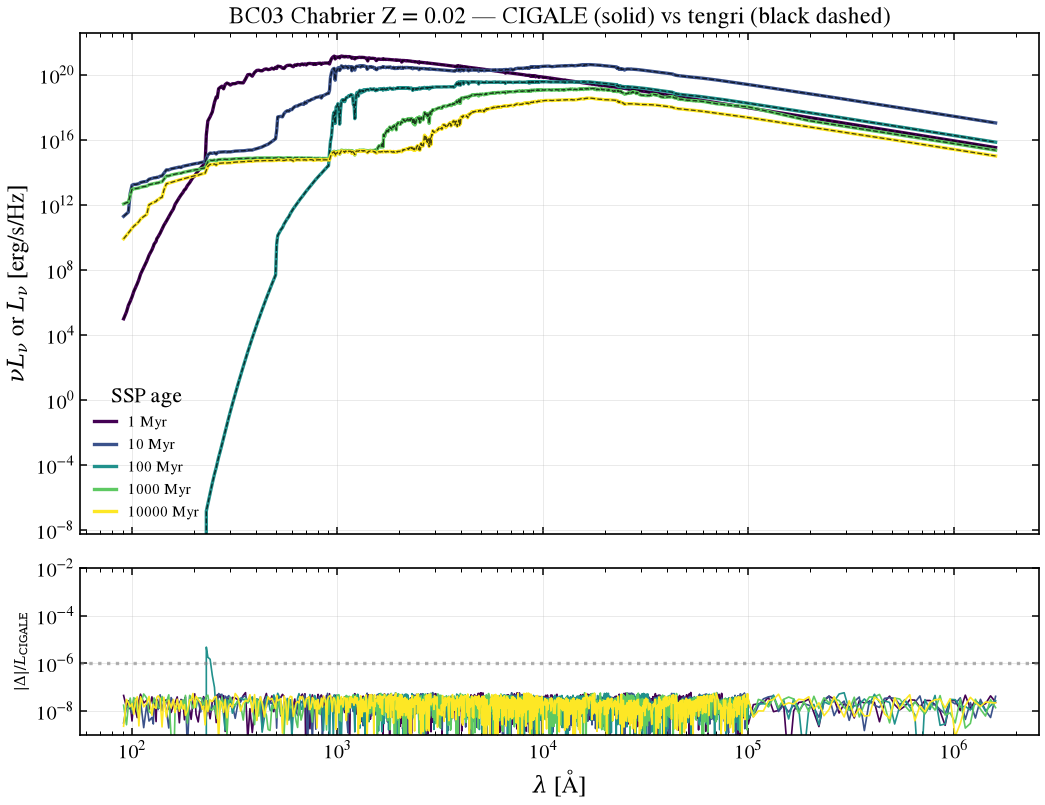
BC03 Chabrier (Bruzual & Charlot 2003) at Z = 0.02 from 1 Myr to 10 Gyr: CIGALE’s bc03/Z=0.02_imf=chab.pickle read directly against the same templates in tengri’s HDF5. The relative residual |tengri − CIGALE| / CIGALE is the float32 round-trip of the repackaged grid and nothing else: median 2e-8 at every age, and max 6e-8 at four of the five. Only the 100 Myr SSP has points above 1e-7, which are four of its 1218 non-zero points, all in the extreme UV below 240 Å where the SSP is 15 decades
below its peak and the relative measure is reading the last float32 digit of a number near zero (the 230 Å point, \(L_\nu = 1.5\times10^{-7}\) of the peak, is the 5e-6 spike on the residual panel).
Both sides divide by the same speed of light: tengri’s C_AA, which _drivers/cigale_ssp_to_dsps.py also uses to write the grid and _drivers/units.py to convert CIGALE’s W/nm. A rounded c on either side puts a floor of \(|\Delta c|/c\) under this residual at every wavelength and every age, 2.5e-5 for the usual 2.998e18, which is three decades above the float32 floor this panel is measuring.
[4]:
import pickle as _pickle
from pathlib import Path as _P

ages_yr = [1e6, 1e7, 1e8, 1e9, 1e10]

# CIGALE side: raw BC03 Chabrier Z=0.02 pickle, converted W/nm/Msun →
# Lsun/Hz/Msun (the exact conversion used by _drivers/cigale_ssp_to_dsps.py).
import sys as _sys

_pkl_path = next(
    (
        _p / "pcigale" / "data" / "bc03" / "Z=0.02_imf=chab.pickle"
        for _p in map(_P, _sys.path)
        if (_p / "pcigale" / "data" / "bc03" / "Z=0.02_imf=chab.pickle").exists()
    ),
    _P(_sys.prefix)
    / "lib"
    / "python3.12"
    / "site-packages"
    / "pcigale"
    / "data"
    / "bc03"
    / "Z=0.02_imf=chab.pickle",
)
with open(_pkl_path, "rb") as _f:
    _raw = _pickle.load(_f)
_wl_aa = np.asarray(_raw.wl) * 10.0  # nm → Å
cigale_ssp = []
for age_yr in ages_yr:
    ia = int(np.argmin(np.abs(np.asarray(_raw.t) - age_yr / 1e6)))  # raw.t in Myr
    lnu = np.asarray(_raw.spec[:, ia]) * 1e6 * _wl_aa**2 / C_AA / L_SUN  # Lsun/Hz/Msun
    cigale_ssp.append((_wl_aa, lnu * L_SUN))  # → erg/s/Hz/Msun for plotting

i_zsun = int(np.argmin(np.abs(ssp.ssp_lgmet - np.log10(0.02))))
tengri_ssp = []
for age_yr in ages_yr:
    i_age = int(np.argmin(np.abs(ssp.ssp_lg_age_gyr - np.log10(age_yr / 1e9))))
    # ssp_flux axes: (n_met, n_age, n_wave) — metallicity first, then age.
    tengri_ssp.append((ssp.ssp_wave, ssp.ssp_flux[i_zsun, i_age, :] * L_SUN))

# Overlay both codes on one SED axis + a residual panel underneath.
fig, (ax, ax_r) = plt.subplots(
    2, 1, figsize=(9, 7), sharex=True, gridspec_kw={"height_ratios": [3, 1]}
)
colors = plt.cm.viridis(np.linspace(0, 1, len(ages_yr)))
print("§1 SSP residual |tengri − CIGALE| / CIGALE (float32 eps = 1.19e-7):")
for color, age_yr, (w_c, L_c), (w_t, L_t) in zip(colors, ages_yr, cigale_ssp, tengri_ssp):
    label = f"{age_yr / 1e6:g} Myr"
    ax.plot(w_c, L_c, color=color, linewidth=2.0, label=label)
    ax.plot(w_t, L_t, color="k", linewidth=0.8, linestyle="--", alpha=0.7)
    # Residual on the CIGALE wavelength grid (tengri regridded onto it).
    L_t_on_c = U.regrid(w_t, L_t, w_c)
    resid = np.abs(L_t_on_c - L_c) / np.maximum(np.abs(L_c), 1e-30)
    resid[~np.isfinite(resid)] = 0.0
    _pos = L_c > 0
    print(
        f"    {age_yr / 1e6:>6g} Myr: median {np.median(resid[_pos]):.2e}, "
        f"max {resid[_pos].max():.2e}, "
        f"{int((resid[_pos] > 1e-7).sum())}/{int(_pos.sum())} points above 1e-7"
    )
    ax_r.plot(w_c, resid, color=color, linewidth=1.0)
ax.set_xscale("log")
ax.set_yscale("log")
ax.set_ylabel(r"$\nu L_\nu$ or $L_\nu$ [erg/s/Hz]")
ax.set_title("BC03 Chabrier Z = 0.02 — CIGALE (solid) vs tengri (black dashed)")
ax.legend(fontsize=9, title="SSP age")
ax.grid(True, alpha=0.3)
ax_r.set_xscale("log")
ax_r.set_yscale("log")
ax_r.set_xlabel(r"$\lambda$ [Å]")
ax_r.set_ylabel(r"$|\Delta| / L_{\rm CIGALE}$", fontsize=9)
ax_r.set_ylim(1e-9, 1e-2)
ax_r.axhline(1e-6, color="gray", linestyle=":", alpha=0.6)
ax_r.grid(True, alpha=0.3)
fig.tight_layout()
save_fig("cigale_01_ssp_bc03.png")
§1 SSP residual |tengri − CIGALE| / CIGALE (float32 eps = 1.19e-7):
         1 Myr: median 2.13e-08, max 5.91e-08, 0/1262 points above 1e-7
        10 Myr: median 2.00e-08, max 5.83e-08, 0/1262 points above 1e-7
       100 Myr: median 2.24e-08, max 4.72e-06, 4/1218 points above 1e-7
      1000 Myr: median 1.98e-08, max 5.77e-08, 0/1262 points above 1e-7
     10000 Myr: median 2.10e-08, max 5.63e-08, 0/1262 points above 1e-7
§2 Star formation histories¶
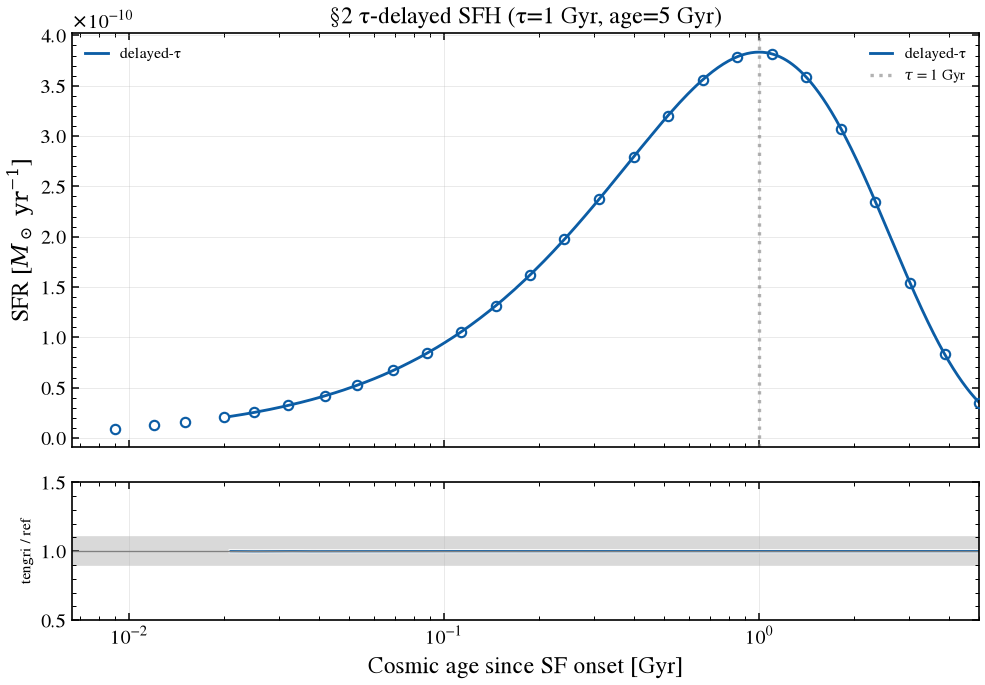
CIGALE module sfhdelayed ↔ tengri sfh={'type': 'delayed'}: the same τ-delayed shape, SFR(t) ∝ t · exp(−t/τ), peaking at t = τ. Both integrate to 1 M☉ formed by age (CIGALE via normalise=True, tengri via log_total_mass = 0.0). The figure overlays the two SFR(t) curves; tengri’s is state.derived["sfr_history"] on a 256-point log-spaced lookback grid.
Each subsection prints the SFR(t) shape agreement and the mass integral. The two codes sample the same analytic shape on different grids, so CIGALE is interpolated onto tengri’s points and the median and worst-point ratios are reported. The plotted maximum of the delayed curve falls at the log node nearest t = τ, which is where the grid is and not a different peak.
Verification Status: PARTIAL (11/33): Parametric SFH family physics
τ-delayed¶
[5]:
t_c, sfr_c = C.sfh_curve(
    "sfhdelayed",
    tau_main=1000,
    age_main=5000,
    tau_burst=50,
    age_burst=20,
    f_burst=0.0,
    sfr_A=1.0,
    normalise=True,
)

# tengri's actual pipeline SFR history (not the analytic formula): build
# a minimal SEDModel with the delayed SFH and read sfr_history off the
# resulting state. The pipeline samples on the spec's log-spaced
# lookback grid (n_grid=256 by default) — visibly smooth across the
# rise-and-decay. That grid is what every fit downstream sees, so
# plotting it honestly is the test: if the area under this curve doesn't
# integrate to 1 M☉ formed (= log_total_mass = 0.0), tengri's SFH
# normalization is broken regardless of how clean the analytic shape
# looks.
tau_gyr, age_gyr = 1.0, 5.0
_m_sfh = SEDModel.build(
    ssp_data=ssp,
    met=MET_FIDUCIAL,
    sfh={
        "type": "delayed",
        "tau_gyr": Fixed(tau_gyr),
        "age_gyr": Fixed(age_gyr),
        "log_total_mass": Fixed(0.0),
        "all_params": Fixed(DEFAULT),
    },
    dust_attenuation={
        "law": "power_law",
        "type": "two_component",
        "tau_bc": Fixed(0.0),
        "tau_diff": Fixed(0.0),
        "all_params": Fixed(DEFAULT),
    },
    neb=NEB_FIDUCIAL_TENGRI,
    redshift=Fixed(0.0),
    # dense lookback grid: the table compares the SFH form, not the
    # 256-point diagnostic grid
    n_grid=4096,
)
_state_sfh = _m_sfh.predict_state({})
_lbt_yr = np.asarray(_state_sfh.derived["sfh_grid_lbt_yr"])
_sfr_history = np.asarray(_state_sfh.derived["sfr_history"])
# Convert lookback time → cosmic age since SF onset (consistent with the
# CIGALE x-axis above): t_cosmic = age_gyr - lbt
t_t = (age_gyr - _lbt_yr / 1e9) * 1e9  # yr
sfr_t = _sfr_history
# The SFH grid spans the full cosmic lookback; keep the epoch after formation.
_keep_t = t_t >= 0
t_t_valid = t_t[_keep_t]
sfr_t_valid = sfr_t[_keep_t]
assert t_t_valid.min() >= 0, f"negative cosmic age: min={t_t_valid.min()}"
# Verify normalization: trapezoid of SFR over cosmic-age axis should be
# 10**log_total_mass = 1.0 M☉ within numerical accuracy of the n_grid pipeline.
# tengri's pipeline carries sfh_grid in decreasing lookback time, so
# integrate against the increasing-time order.
_idx = np.argsort(t_t_valid)
_mass_formed = float(np.trapezoid(sfr_t_valid[_idx], t_t_valid[_idx]))
print(f"tengri ∫SFR dt = {_mass_formed:.4f} M☉  (log_total_mass=0 → 1.0000)")


def _sfr_shape_report(label, t_c_yr, sfr_c_arr, t_t_yr, sfr_t_arr, age_gyr):
    """Print the SFR(t) shape agreement on tengri's own grid.

    The two codes sample the same shape on different grids — CIGALE on a
    uniform 1-Myr axis, tengri on a 256-point log-spaced lookback axis — so
    the comparison is CIGALE interpolated onto tengri's points, over the
    interior of the history (the first 2 % and last 1 % of the age are
    dropped: both ends are grid edges, not physics).
    """
    _c_on_t = np.interp(
        t_t_yr, np.asarray(t_c_yr), np.asarray(sfr_c_arr), left=np.nan, right=np.nan
    )
    _ok = (
        np.isfinite(_c_on_t)
        & (_c_on_t > 0)
        & (t_t_yr > 0.02 * age_gyr * 1e9)
        & (t_t_yr < 0.99 * age_gyr * 1e9)
    )
    _rr = np.asarray(sfr_t_arr)[_ok] / _c_on_t[_ok]
    _k = int(np.argmax(np.abs(_rr - 1.0)))
    print(
        f"{label} SFR(t) shape, tengri / CIGALE on tengri's grid: "
        f"median {float(np.median(_rr)):.5f}×, max {float(_rr.max()):.4f}× at "
        f"t = {t_t_yr[_ok][_k] / 1e9:.3f} Gyr, "
        f"{int((np.abs(_rr - 1.0) > 0.01).sum())}/{int(_ok.sum())} points more than 1 % off"
    )


_sfr_shape_report("§2 delayed", t_c, sfr_c, t_t_valid, sfr_t_valid, age_gyr)

# Both arms on their common interval.
_t_min_broad = max(t_c.min() / 1e9, t_t_valid.min() / 1e9)
_t_max_broad = min(t_c.max() / 1e9, t_t_valid.max() / 1e9)
_keep_c_1 = (t_c / 1e9 >= _t_min_broad) & (t_c / 1e9 <= _t_max_broad)
_keep_t_1 = (t_t_valid / 1e9 >= _t_min_broad) & (t_t_valid / 1e9 <= _t_max_broad)

_t_c_temp = (t_c / 1e9)[_keep_c_1]
_t_t_temp = (t_t_valid / 1e9)[_keep_t_1]
_t_min_aligned = max(_t_c_temp.min(), _t_t_temp.min())
_keep_final_c = _t_c_temp >= _t_min_aligned
_keep_final_t = _t_t_temp >= _t_min_aligned
_t_c_overlap = t_c[_keep_c_1][_keep_final_c]
_sfr_c_overlap = sfr_c[_keep_c_1][_keep_final_c]
_t_t_valid_overlap = t_t_valid[_keep_t_1][_keep_final_t]
_sfr_t_valid_overlap = sfr_t_valid[_keep_t_1][_keep_final_t]

print(
    f"  common interval: t_c [{_t_c_overlap.min() / 1e9:.4f}, {_t_c_overlap.max() / 1e9:.4f}] Gyr, "
    f"t_t range [{_t_t_valid_overlap.min() / 1e9:.4f}, {_t_t_valid_overlap.max() / 1e9:.4f}] Gyr"
)

fig, (ax, ax_r), ratio = V.sweep_fig(
    [
        (
            "delayed-τ",
            _t_c_overlap / 1e9,
            _sfr_c_overlap,
            _t_t_valid_overlap / 1e9,
            _sfr_t_valid_overlap,
        )
    ],
    ref_label="pcigale",
    title="§2 τ-delayed SFH (τ=1 Gyr, age=5 Gyr)",
    xlabel="Cosmic age since SF onset [Gyr]",
    ylabel=r"SFR [$M_\odot\ \mathrm{yr}^{-1}$]",
    xlim=(0, 5),
    logy=False,
)
ax.axvline(1.0, color="gray", linestyle=":", alpha=0.6, label=r"$\tau$ = 1 Gyr")
ax.legend(fontsize=9)
fig.tight_layout()
save_fig("cigale_02_sfh_tau.png")
src/tengri/forward/sed_model.py:13601: SFHBeyondOldestTemplateWarning: The SSP grid's oldest template is 13.700 Gyr but the universe is 13.787 Gyr old at redshift 0. Stars formed in that gap are older than every template, so both age kernels assign them to the oldest one: the formed mass is conserved, and those stars carry the colors of a 13.700 Gyr population. Use a grid whose oldest template reaches 13.787 Gyr (e.g. MIST) to remove the approximation.
  return cls(
tengri ∫SFR dt = 0.9999 M☉  (log_total_mass=0 → 1.0000)
§2 delayed SFR(t) shape, tengri / CIGALE on tengri's grid: median 1.00002×, max 1.0000× at t = 0.112 Gyr, 0/1970 points more than 1 % off
  common interval: t_c [0.0090, 4.9990] Gyr, t_t range [0.0205, 4.9990] Gyr
Note on the FSPS / BAGPIPES declining-exponential¶
CIGALE’s sfh2exp(f_burst=0) and FSPS’s sfh=1 both produce a declining exponential peaking at galaxy formation, a different shape from CIGALE’s sfhdelayed plotted above. tengri intentionally does not register this shape as sfh.tau, to avoid confusion with the τ-delayed model, which has opposite physics; delayed (= CIGALE sfhdelayed) is the only τ-style SFH in the registry. The declining_exponential function remains importable from the sfh builder grammar for
expert use cases.
Double-exponential with a burst (sfh2exp)¶
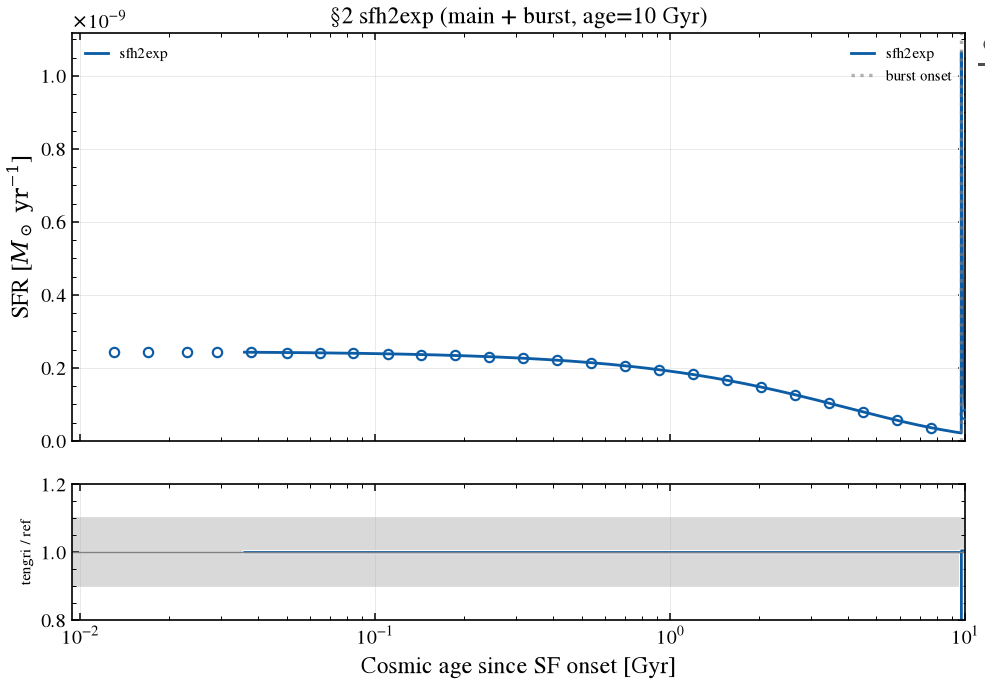
CIGALE’s sfh2exp superposes an old declining-exponential population and a recent exponential burst that carries a fixed fraction f_burst of the total stellar mass. tengri registers the same form (sfh.sfh2exp). At matched parameters (τ_main = 4 Gyr, τ_burst = 0.1 Gyr, f_burst = 0.1, burst 0.3 Gyr ago, age 10 Gyr) the two histories agree everywhere except at the burst onset.
The burst onset is a step, and the two codes resolve it differently. f_burst turns the burst on discontinuously at burst_age. CIGALE evaluates its SFH on a uniform 1-Myr grid, so it puts a grid point on each side of the step; tengri’s 256-point log-spaced lookback grid places a point on the step itself. The printed comparison gives the median ratio and the number of points more than 1 % from CIGALE; the points that differ sit at the discontinuity, so this is a sampling difference and
not a difference in the SFH. The printed ∫SFR dt is the trapezoid sum over tengri’s sampled history, to be read against the 1 M☉ the shape is normalized to.
[6]:
t_c2, sfr_c2 = C.sfh_curve(
    "sfh2exp",
    tau_main=4000,
    tau_burst=100,
    f_burst=0.1,
    age=10000,
    burst_age=300,
    sfr_0=1.0,
    normalise=True,
)

_age_gyr_2exp = 10.0
_m_2exp = SEDModel.build(
    ssp_data=ssp,
    met=MET_FIDUCIAL,
    sfh={
        "type": "sfh2exp",
        "tau_main_gyr": Fixed(4.0),
        "tau_burst_gyr": Fixed(0.1),
        "f_burst": Fixed(0.1),
        "age_gyr": Fixed(_age_gyr_2exp),
        "burst_age_gyr": Fixed(0.3),
        "log_total_mass": Fixed(0.0),
        "all_params": Fixed(DEFAULT),
    },
    dust_attenuation={
        "law": "power_law",
        "type": "two_component",
        "tau_bc": Fixed(0.0),
        "tau_diff": Fixed(0.0),
        "all_params": Fixed(DEFAULT),
    },
    neb=NEB_FIDUCIAL_TENGRI,
    redshift=Fixed(0.0),
    n_grid=4096,
)
_st_2exp = _m_2exp.predict_state({})
_lbt_2exp = np.asarray(_st_2exp.derived["sfh_grid_lbt_yr"])
_sfr_2exp = np.asarray(_st_2exp.derived["sfr_history"])
_t_2exp = (_age_gyr_2exp - _lbt_2exp / 1e9) * 1e9  # cosmic age since SF onset [yr]
# Restrict to the epoch the galaxy exists: keep only samples with _t_2exp >= 0
_keep_2exp = _t_2exp >= 0
_t_2exp_valid = _t_2exp[_keep_2exp]
_sfr_2exp_valid = _sfr_2exp[_keep_2exp]
assert _t_2exp_valid.min() >= 0, f"negative cosmic age: min={_t_2exp_valid.min()}"
_idx2 = np.argsort(_t_2exp_valid)
_mass_2exp = float(np.trapezoid(_sfr_2exp_valid[_idx2], _t_2exp_valid[_idx2]))
print(f"tengri ∫SFR dt = {_mass_2exp:.4f} M☉  (log_total_mass=0 → 1.0000)")
_sfr_shape_report("§2 sfh2exp", t_c2, sfr_c2, _t_2exp_valid, _sfr_2exp_valid, _age_gyr_2exp)

# Both arms on their common interval.
_t2_min_broad = max(t_c2.min() / 1e9, _t_2exp_valid.min() / 1e9)
_t2_max_broad = min(t_c2.max() / 1e9, _t_2exp_valid.max() / 1e9)
_keep2_c_1 = (t_c2 / 1e9 >= _t2_min_broad) & (t_c2 / 1e9 <= _t2_max_broad)
_keep2_t_1 = (_t_2exp_valid / 1e9 >= _t2_min_broad) & (_t_2exp_valid / 1e9 <= _t2_max_broad)

_t2_c_temp = (t_c2 / 1e9)[_keep2_c_1]
_t2_t_temp = (_t_2exp_valid / 1e9)[_keep2_t_1]
_t2_min_aligned = max(_t2_c_temp.min(), _t2_t_temp.min())
_keep2_final_c = _t2_c_temp >= _t2_min_aligned
_keep2_final_t = _t2_t_temp >= _t2_min_aligned
_t_c2_overlap = t_c2[_keep2_c_1][_keep2_final_c]
_sfr_c2_overlap = sfr_c2[_keep2_c_1][_keep2_final_c]
_t_2exp_valid_overlap = _t_2exp_valid[_keep2_t_1][_keep2_final_t]
_sfr_2exp_valid_overlap = _sfr_2exp_valid[_keep2_t_1][_keep2_final_t]

print(
    f"  common interval: t_c2 [{_t_c2_overlap.min() / 1e9:.4f}, {_t_c2_overlap.max() / 1e9:.4f}] Gyr, "
    f"_t_2exp range [{_t_2exp_valid_overlap.min() / 1e9:.4f}, {_t_2exp_valid_overlap.max() / 1e9:.4f}] Gyr"
)

fig, (ax, ax_r), ratio = V.sweep_fig(
    [
        (
            "sfh2exp",
            _t_c2_overlap / 1e9,
            _sfr_c2_overlap,
            _t_2exp_valid_overlap / 1e9,
            _sfr_2exp_valid_overlap,
        )
    ],
    ref_label="pcigale",
    title="§2 sfh2exp (main + burst, age=10 Gyr)",
    xlabel="Cosmic age since SF onset [Gyr]",
    ylabel=r"SFR [$M_\odot\ \mathrm{yr}^{-1}$]",
    xlim=(0, 10),
    logy=False,
    ratio_ylim=(0.8, 1.2),
)
ax.axvline(_age_gyr_2exp - 0.3, color="gray", linestyle=":", alpha=0.6, label="burst onset")
ax.legend(fontsize=9)
ax.set_ylim(bottom=0.0)
fig.tight_layout()
save_fig("cigale_02_sfh2exp.png")
src/tengri/forward/sed_model.py:13601: SFHBeyondOldestTemplateWarning: The SSP grid's oldest template is 13.700 Gyr but the universe is 13.787 Gyr old at redshift 0. Stars formed in that gap are older than every template, so both age kernels assign them to the oldest one: the formed mass is conserved, and those stars carry the colors of a 13.700 Gyr population. Use a grid whose oldest template reaches 13.787 Gyr (e.g. MIST) to remove the approximation.
  return cls(
tengri ∫SFR dt = 0.9970 M☉  (log_total_mass=0 → 1.0000)
§2 sfh2exp SFR(t) shape, tengri / CIGALE on tengri's grid: median 1.00015×, max 1.0054× at t = 9.699 Gyr, 2/1969 points more than 1 % off
  common interval: t_c2 [0.0130, 9.9990] Gyr, _t_2exp range [0.0354, 9.9990] Gyr
§2c Beyond delayed: delayed_bq, periodic, buat08¶
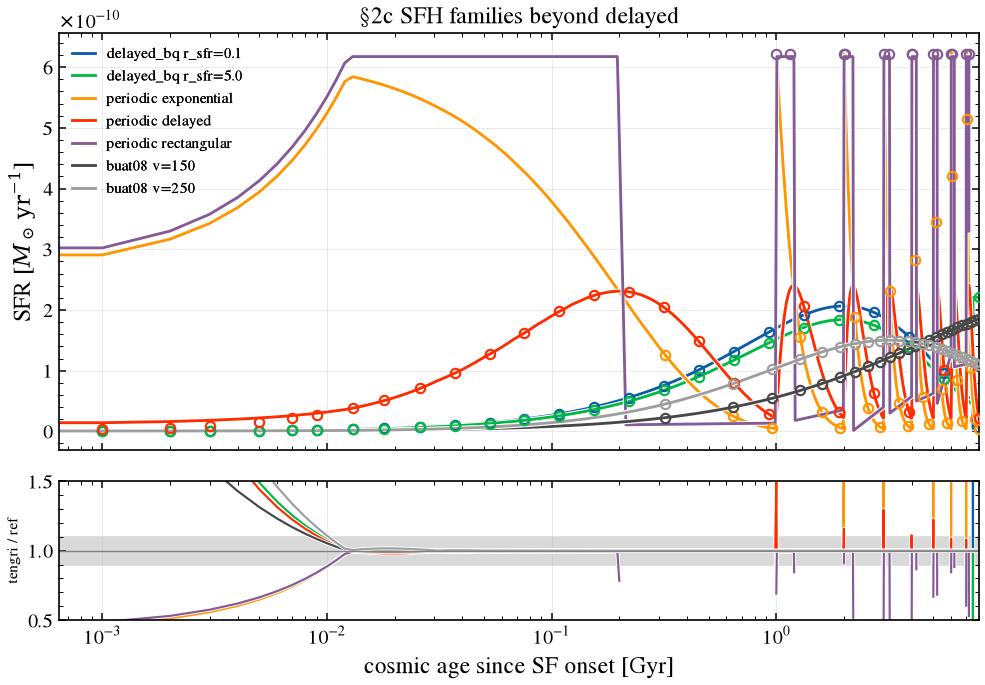
Three more parametric SFHs. delayed_bq (Ciesla+2017) adds a burst/quench step of ratio r_sfr at lookback age_bq; periodic repeats one burst shape (burst_type 0/1/2 = exponential/delayed/ rectangular) every delta_bursts; buat08 sets the shape from a rotational velocity, with the same parameters in Gyr as sfh.delayed_bq, sfh.periodic, sfh.buat08. Seven cases: τ_main=2, age_main=8, age_bq=0.5 Gyr, r_sfr ∈ {0.1, 5}; burst_type ∈ {0, 1, 2} at δ=1, τ=0.2, age=8
Gyr; velocity ∈ {150, 250} km/s at age=8 Gyr. The shapes agree (median ratio 1.000 in every case except periodic exponential, 0.999, and periodic rectangular, 0.993). The large maximum deviations sit on discontinuities, the delayed_bq burst/quench step at T = age_main − age_bq and the periodic burst onsets at T = kΔ, where each code’s time grid samples the edge differently. Tabulated histories enter tengri via Catalog.from_histories, so sfhfromfile is not compared.
[7]:
_AGE_2C_GYR = 8.0
_DUST_OFF_2C = {
    "law": "power_law",
    "type": "two_component",
    "tau_bc": Fixed(0.0),
    "tau_diff": Fixed(0.0),
    "all_params": Fixed(DEFAULT),
}
_cases_2c = []

for _r in (0.1, 5.0):
    _t_c, _sfr_c = C.sfh_curve(
        "sfhdelayedbq",
        tau_main=2000,
        age_main=8000,
        age_bq=500,
        r_sfr=_r,
        sfr_A=1.0,
        normalise=True,
    )
    _m = SEDModel.build(
        ssp_data=ssp,
        met=MET_FIDUCIAL,
        sfh={
            "type": "delayed_bq",
            "tau_main_gyr": Fixed(2.0),
            "age_main_gyr": Fixed(_AGE_2C_GYR),
            "age_bq_gyr": Fixed(0.5),
            "r_sfr": Fixed(_r),
            "log_total_mass": Fixed(0.0),
            "all_params": Fixed(DEFAULT),
        },
        dust_attenuation=_DUST_OFF_2C,
        neb=NEB_FIDUCIAL_TENGRI,
        redshift=Fixed(0.0),
        n_grid=4096,
    )
    _st = _m.predict_state({})
    _lbt = np.asarray(_st.derived["sfh_grid_lbt_yr"])
    _sfr_t = np.asarray(_st.derived["sfr_history"])
    _t_t = (_AGE_2C_GYR - _lbt / 1e9) * 1e9
    _idx = np.argsort(_t_t)
    _cases_2c.append(
        (f"delayed_bq r_sfr={_r}", np.asarray(_t_c), np.asarray(_sfr_c), _t_t[_idx], _sfr_t[_idx])
    )

for _bt in (0, 1, 2):
    _t_c, _sfr_c = C.sfh_curve(
        "sfhperiodic",
        type_bursts=_bt,
        delta_bursts=1000,
        tau_bursts=200,
        age=8000,
        sfr_A=1.0,
        normalise=True,
    )
    _m = SEDModel.build(
        ssp_data=ssp,
        met=MET_FIDUCIAL,
        sfh={
            "type": "periodic",
            "delta_bursts_gyr": Fixed(1.0),
            "tau_bursts_gyr": Fixed(0.2),
            "burst_type": Fixed(_bt),
            "age_gyr": Fixed(_AGE_2C_GYR),
            "log_total_mass": Fixed(0.0),
            "all_params": Fixed(DEFAULT),
        },
        dust_attenuation=_DUST_OFF_2C,
        neb=NEB_FIDUCIAL_TENGRI,
        redshift=Fixed(0.0),
        n_grid=4096,
    )
    _st = _m.predict_state({})
    _lbt = np.asarray(_st.derived["sfh_grid_lbt_yr"])
    _sfr_t = np.asarray(_st.derived["sfr_history"])
    _t_t = (_AGE_2C_GYR - _lbt / 1e9) * 1e9
    _idx = np.argsort(_t_t)
    _label = {0: "exponential", 1: "delayed", 2: "rectangular"}[_bt]
    _cases_2c.append(
        (f"periodic {_label}", np.asarray(_t_c), np.asarray(_sfr_c), _t_t[_idx], _sfr_t[_idx])
    )

for _v in (150, 250):
    _t_c, _sfr_c = C.sfh_curve("sfh_buat08", velocity=_v, age=8000, normalise=True)
    _m = SEDModel.build(
        ssp_data=ssp,
        met=MET_FIDUCIAL,
        sfh={
            "type": "buat08",
            "velocity_km_s": Fixed(float(_v)),
            "age_gyr": Fixed(_AGE_2C_GYR),
            "log_total_mass": Fixed(0.0),
            "all_params": Fixed(DEFAULT),
        },
        dust_attenuation=_DUST_OFF_2C,
        neb=NEB_FIDUCIAL_TENGRI,
        redshift=Fixed(0.0),
        n_grid=4096,
    )
    _st = _m.predict_state({})
    _lbt = np.asarray(_st.derived["sfh_grid_lbt_yr"])
    _sfr_t = np.asarray(_st.derived["sfr_history"])
    _t_t = (_AGE_2C_GYR - _lbt / 1e9) * 1e9
    _idx = np.argsort(_t_t)
    _cases_2c.append(
        (f"buat08 v={_v}", np.asarray(_t_c), np.asarray(_sfr_c), _t_t[_idx], _sfr_t[_idx])
    )

for _label, _wr, _lr, _wt, _lt in _cases_2c:
    _assert_comparable(_lr, _lt, name=f"§2c {_label}")

fig, (ax, ax_r), _ratios_2c = V.sweep_fig(
    _cases_2c,
    ref_label="CIGALE",
    title="§2c SFH families beyond delayed",
    xlim=(0, _AGE_2C_GYR),
    x_of_wave=lambda t: t / 1e9,
    xlabel="cosmic age since SF onset [Gyr]",
    ylabel=r"SFR [$M_\odot\,\mathrm{yr}^{-1}$]",
    logy=False,
)
fig.tight_layout()
save_fig("cigale_02c_sfh_families.png")

_rows_2c = V.window_rows(
    _cases_2c, lo=0.02 * _AGE_2C_GYR * 1e9, hi=0.95 * _AGE_2C_GYR * 1e9, rel_to="peak"
)
V.print_window_table(
    _rows_2c,
    ref_name="CIGALE",
    title="§2c SFH families beyond delayed (SFR(t), 2-95% of age; deviation as % of peak SFR)",
    x_unit="Gyr",
    x_scale=1e-9,
)
src/tengri/forward/sed_model.py:13601: SFHBeyondOldestTemplateWarning: The SSP grid's oldest template is 13.700 Gyr but the universe is 13.787 Gyr old at redshift 0. Stars formed in that gap are older than every template, so both age kernels assign them to the oldest one: the formed mass is conserved, and those stars carry the colors of a 13.700 Gyr population. Use a grid whose oldest template reaches 13.787 Gyr (e.g. MIST) to remove the approximation.
  return cls(
  §2c SFH families beyond delayed (SFR(t), 2-95% of age; deviation as % of peak SFR)
  case                           median × max |Δ| [% peak]  x at max [Gyr]
  --------------------------------------------------------------------------
  delayed_bq r_sfr=0.1              1.000x           13.7%            7.50  <-- check
  delayed_bq r_sfr=5.0              1.000x           50.7%            7.50  <-- check
  periodic exponential              0.999x           90.5%            4.00  <-- check
  periodic delayed                  1.000x            4.4%            1.00
  periodic rectangular              0.993x           90.8%            4.00  <-- check
  buat08 v=150                      1.000x            0.0%            7.60
  buat08 v=250                      1.000x            0.0%            3.25
§3 Integrated stellar SED¶
CIGALE sfhdelayed + bc03 + nebular against tengri delayed SFH on the shared SSP with the Setup nebular fiducial; no dust. The figure overlays the two intrinsic SEDs. CIGALE is normalized to 1 M☉ formed by construction; tengri’s stellar mass formed is reported in the annotation.
The one convention difference on this SSP, and where it goes. The two codes convolve the same star formation with the same SSP grid in different ways, and the rest of the notebook inherits the result, so it is stated once here.
tengri computes the exact SFH ⊗ SSP convolution: each parcel of star formation is placed at its own age, and a cloud-in-cell kernel splits it between the two SSP nodes that bracket that age. CIGALE samples the SFR at integer Myr (pcigale/sed_modules/sfhdelayed.py) and pairs each 1 Myr bin with the SSP at the bin’s older edge (pcigale/sed_modules/bc03.py). That ages every star by about 0.5 Myr and gives no weight to stars younger than 1 Myr. Q_H and the far-UV fall steeply over the first
~10 Myr, so 0.5 Myr is a large fraction of the young population’s output and a negligible one of the old population’s: the difference is strongly wavelength-dependent.
The cell after the table tests this on Q_H. Convolving the SFH continuously with the BC03 n_ly(t) of §1 reproduces tengri’s Q_H, and aging every star by 0.5 Myr before the same convolution reproduces CIGALE’s. Measured on this pair as energy-weighted ratios (the ratio of the luminosity each code puts in the band; a median over grid points would weight a band by how many points CIGALE’s nebular line grid places in it), printed below:
quantity |
tengri / CIGALE |
|---|---|
912–1200 Å |
1.063× |
1200–3000 Å |
1.030× |
0.3–1 μm |
1.007× |
stellar L_bol |
1.017× |
Q_H (λ < 911.76 Å) |
1.150× |
The 200–912 Å band is not quoted: with the nebular emitter on, both codes absorb nearly every Lyman-continuum photon, so there is nothing to take a ratio of. Neither convention is a defect: tengri’s is the continuous convolution, CIGALE’s a 1 Myr discrete sum with the bin’s older-edge age.
Three later sections are this table and nothing else. §6’s dust IR is normalized to L_absorbed, which inherits the L_bol offset weighted toward the UV, and lands at 1.011× CIGALE’s dust.luminosity. §11’s synchrotron is anchored on the same luminosity, so that factor appears there as a flat offset. §8’s line luminosities scale with Q_H. None of those is a separate discrepancy.
[8]:
sed_c = C.run_chain(
    [
        (
            "sfhdelayed",
            dict(
                tau_main=1000,
                age_main=5000,
                tau_burst=50,
                age_burst=20,
                f_burst=0.0,
                sfr_A=1.0,
                normalise=True,
            ),
        ),
        ("bc03", dict(imf=1, metallicity=0.02, separation_age=10)),
        NEB_FIDUCIAL_CIGALE,
    ]
)
w_c, L_c = C.to_lnu(sed_c)

m_stellar = SEDModel.build(
    ssp_data=ssp,
    met=MET_FIDUCIAL,
    sfh={
        "type": "delayed",
        "tau_gyr": Fixed(1.0),
        "age_gyr": Fixed(5.0),
        "log_total_mass": Fixed(0.0),
        "all_params": Fixed(DEFAULT),
    },
    dust_attenuation={
        "law": "power_law",
        "type": "two_component",
        "tau_bc": Fixed(0.0),
        "tau_diff": Fixed(0.0),
        "all_params": Fixed(DEFAULT),
    },
    neb=NEB_FIDUCIAL_TENGRI,
    redshift=Fixed(0.0),
)
s_stellar = m_stellar.predict_state({})
_assert_comparable(L_c, s_stellar.sed_intrinsic, name="§3 stellar")

# Shared-axis overlay + tengri/CIGALE ratio panel: a single scale makes any
# normalization offset visible at a glance. Both codes form 1 M_sun; the
# tengri box reports its *surviving* stellar mass, so the ratio panel shows
# whether the M_star = 1.0 vs 0.558 label difference is a real SED offset (it is
# not — formed-vs-surviving-mass convention) or a genuine ~1.8x mismatch.
m_star = 10.0 ** float(s_stellar.derived["log_mstar"])
fig, ax, ax_r, ratio = U.overlay_ratio_fig(
    w_c,
    L_c,
    np.asarray(s_stellar.wave),
    np.asarray(s_stellar.sed_intrinsic),
    title="§3 stellar SED — CIGALE sfhdelayed+bc03 vs tengri (both 1 M$_\\odot$ formed)",
    label_c="CIGALE  sfhdelayed + bc03",
    label_t="tengri  sfh.delayed + bc03",
    xlim=(1e2, 1e6),
)
ax.text(
    0.05,
    0.95,
    rf"formed $M_\star = 1\,M_\odot$ both; tengri surviving $M_\star = {m_star:.3f}\,M_\odot$",
    transform=ax.transAxes,
    fontsize=9,
    va="top",
    bbox=dict(boxstyle="round", facecolor="wheat", alpha=0.5),
)
# The age-binning convention, band by band, as energy-weighted ratios: the
# ratio of the luminosity each code puts in the band. This is the table the §3
# prose quotes, and the term every later section inherits. A median over grid
# points is not used: CIGALE's nebular line grid carries many more points in the
# ultraviolet than in the optical, so a point-count median weights the bands by
# grid density.
_L_t_on_c3 = U.regrid(np.asarray(s_stellar.wave), np.asarray(s_stellar.sed_intrinsic), w_c)
print("§3 intrinsic stellar SED, energy-weighted ratio by band (∫L_ν dν, tengri / CIGALE):")
for _lo, _hi, _wname in (
    (912.0, 1200.0, "912–1200 Å "),
    (1200.0, 3000.0, "1200–3000 Å"),
    (3000.0, 10000.0, "0.3–1 µm   "),
    (1000.0, 10000.0, "0.1–1 µm   "),
):
    print(
        f"    {_wname}: "
        f"{_band_energy_ratio(w_c, L_c, np.asarray(s_stellar.wave), np.asarray(s_stellar.sed_intrinsic), _lo, _hi):.3f}×"
    )
_pos3 = L_c > 0
_lbol_c3 = _lbol_nu(w_c[_pos3], np.asarray(L_c)[_pos3])
_lbol_t3 = _lbol_nu(w_c[_pos3], _L_t_on_c3[_pos3])
_n_ly_c3 = float(sed_c.info["stellar.n_ly"])
_q_h_t3 = float(np.asarray(s_stellar.derived["nion"]))
print(
    f"    stellar L_bol: CIGALE {_lbol_c3:.4e}, tengri {_lbol_t3:.4e} erg/s "
    f"→ {_lbol_t3 / _lbol_c3:.3f}×"
)
print(
    f"    Q_H          : CIGALE {_n_ly_c3:.4e}, tengri {_q_h_t3:.4e} ph/s "
    f"→ {_q_h_t3 / _n_ly_c3:.3f}×"
)
fig.tight_layout()
plt.close(fig)  # superseded by §3b's tau x age grid, which replaces this panel
src/tengri/forward/sed_model.py:13601: SFHBeyondOldestTemplateWarning: The SSP grid's oldest template is 13.700 Gyr but the universe is 13.787 Gyr old at redshift 0. Stars formed in that gap are older than every template, so both age kernels assign them to the oldest one: the formed mass is conserved, and those stars carry the colors of a 13.700 Gyr population. Use a grid whose oldest template reaches 13.787 Gyr (e.g. MIST) to remove the approximation.
  return cls(
§3 intrinsic stellar SED, energy-weighted ratio by band (∫L_ν dν, tengri / CIGALE):
    912–1200 Å : 1.063×
    1200–3000 Å: 1.030×
    0.3–1 µm   : 1.007×
    0.1–1 µm   : 1.017×
    stellar L_bol: CIGALE 4.7400e+33, tengri 4.8188e+33 erg/s → 1.017×
    Q_H          : CIGALE 5.2700e+42, tengri 6.0583e+42 ph/s → 1.150×
[9]:
# The age convention, tested on the ionizing photon rate. The BC03 pickle read in
# §1 carries n_ly(t) on a 1 Myr age axis. Convolving the τ-delayed SFH with it
# continuously (every parcel at its own age, the SSP linear in age between nodes
# and held at its 1 Myr value below) is the exact SFH ⊗ SSP convolution tengri
# computes. Aging every star by 0.5 Myr first is the convention CIGALE's discrete
# 1 Myr sum implies: each 1 Myr bin is paired with the SSP at its older edge.
_t_ssp_myr = np.asarray(_raw.t, dtype=float)  # SSP ages [Myr], 1 Myr spacing
_q_ssp = np.asarray(_raw.info)[2]  # n_ly per M☉ formed [ph/s]


def _q_h_continuous(shift_myr: float, tau_myr=1000.0, age_myr=5000.0, d_age=0.01) -> float:
    """Q_H [ph/s per M☉ formed] of the τ-delayed SFH, every star aged by ``shift_myr``."""
    a = np.arange(0.5 * d_age, age_myr, d_age)  # lookback age of each parcel [Myr]
    sfr = (age_myr - a) * np.exp(-(age_myr - a) / tau_myr)
    sfr = sfr / (sfr.sum() * d_age)  # normalized to 1 M☉ formed
    return float(np.sum(sfr * np.interp(a + shift_myr, _t_ssp_myr, _q_ssp)) * d_age)


_q_exact_3 = _q_h_continuous(0.0)
_q_shift_3 = _q_h_continuous(0.5)
print(
    f"§3 Q_H, continuous SFH ⊗ SSP convolution: {_q_exact_3:.4e} ph/s "
    f"→ {_q_exact_3 / _q_h_t3:.3f}× tengri's {_q_h_t3:.4e}"
)
print(
    f"§3 Q_H, the same convolution with every star aged by 0.5 Myr: {_q_shift_3:.4e} ph/s "
    f"→ {_q_shift_3 / _n_ly_c3:.3f}× CIGALE's {_n_ly_c3:.4e}"
)
assert abs(_q_exact_3 / _q_h_t3 - 1.0) < 0.02, "continuous convolution should match tengri's Q_H"
assert abs(_q_shift_3 / _n_ly_c3 - 1.0) < 0.01, "a 0.5 Myr aging should reproduce CIGALE's Q_H"
§3 Q_H, continuous SFH ⊗ SSP convolution: 6.1145e+42 ph/s → 1.009× tengri's 6.0583e+42
§3 Q_H, the same convolution with every star aged by 0.5 Myr: 5.2679e+42 ph/s → 1.000× CIGALE's 5.2700e+42
§3b τ × age grid¶
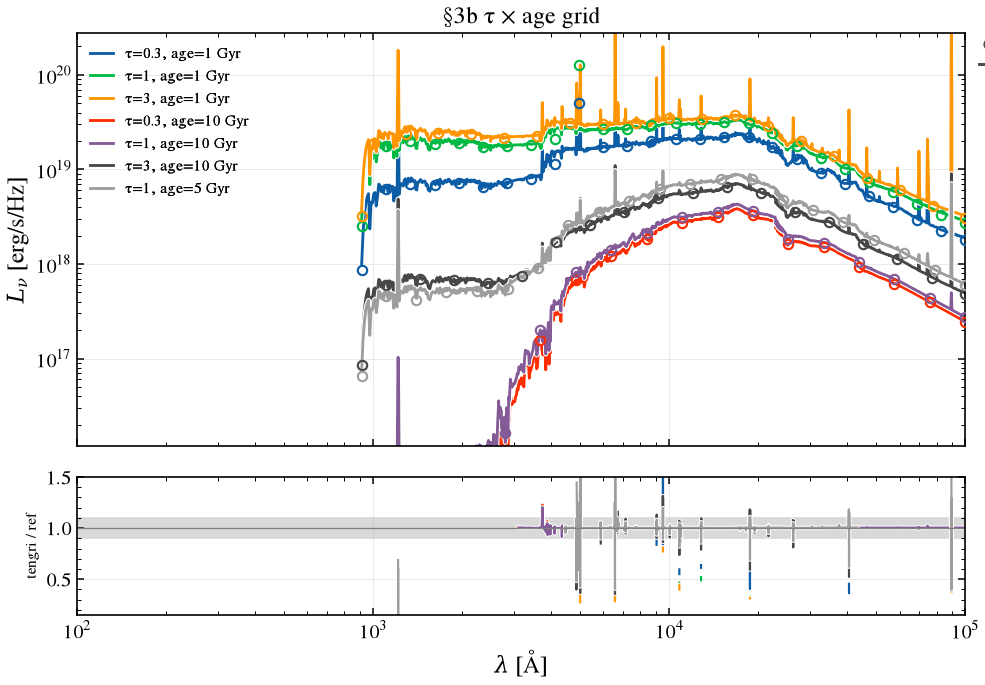
Stellar SED dependence on the delayed SFH’s shape parameters: τ ∈ {0.3, 1, 3} Gyr at age = 1 and 10 Gyr, plus the τ = 1 Gyr, age = 5 Gyr fiducial (7 cases). One tengri build per case with sfh_delayed_tau_gyr and sfh_delayed_age_gyr fixed (a free age is expressed as a fraction of the age of the universe, so absolute ages are fixed per build), evaluated via predict_rest_sed; one CIGALE sfhdelayed + bc03 chain per case. Table over the GALEX-through-2MASS bands (UV_TO_NIR),
since this comparison carries no dust IR. The worst band ratio in the printed table is τ = 3 Gyr, age = 1 Gyr (1.066×, SDSS u). The τ = 1 and 3 Gyr cases at age 1 Gyr have one band each outside 5 % (worst 1.062× and 1.066×, both SDSS u), where the youngest stars carry the §3 convention; the remaining five cases have none. Of those five, the three 10 Gyr cases tie at 1.044× (GALEX NUV, GALEX FUV and SDSS u for τ = 0.3, 1 and 3 Gyr), and the worst band of each case is printed. The quiescent cases
sit near unity because Cue counts ionizing photons from every stellar age, so the old population supplies the nebular far-UV that CIGALE also includes.
[10]:
_tau_age_cases_grid = [
    (0.3, 1.0),
    (1.0, 1.0),
    (3.0, 1.0),
    (0.3, 10.0),
    (1.0, 10.0),
    (3.0, 10.0),
    (1.0, 5.0),
]

def _build_3b(tau_gyr, age_gyr):
    """One fixed-timing tengri build per (tau, age) case."""
    return SEDModel.build(
        ssp_data=ssp,
        met=MET_FIDUCIAL,
        sfh={
            "type": "delayed",
            "tau_gyr": Fixed(tau_gyr),
            "age_gyr": Fixed(age_gyr),
            "log_total_mass": Fixed(0.0),
            "all_params": Fixed(DEFAULT),
        },
        dust_attenuation={
            "law": "power_law",
            "type": "two_component",
            "tau_bc": Fixed(0.0),
            "tau_diff": Fixed(0.0),
            "all_params": Fixed(DEFAULT),
        },
        neb=NEB_FIDUCIAL_TENGRI,
        redshift=Fixed(0.0),
    )


_cases_3b = []
for _tau, _age in _tau_age_cases_grid:
    _t_main, _a_main = int(round(_tau * 1000)), int(round(_age * 1000))
    _sed_c3b = C.run_chain(
        [
            (
                "sfhdelayed",
                dict(
                    tau_main=_t_main,
                    age_main=_a_main,
                    tau_burst=50,
                    age_burst=20,
                    f_burst=0.0,
                    sfr_A=1.0,
                    normalise=True,
                ),
            ),
            ("bc03", dict(imf=1, metallicity=0.02, separation_age=10)),
            NEB_FIDUCIAL_CIGALE,
        ]
    )
    _w_c3b, _L_c3b = C.to_lnu(_sed_c3b)
    _m_3b = _build_3b(_tau, _age)
    _o_3b = _m_3b.predict_rest_sed(dict(_m_3b.spec.sample(jax.random.PRNGKey(0))))
    _cases_3b.append(
        (
            f"τ={_tau:g}, age={_age:g} Gyr",
            _w_c3b,
            _L_c3b,
            np.asarray(_o_3b.wavelength),
            np.asarray(_o_3b.sed),
        )
    )
    _assert_comparable(_L_c3b, np.asarray(_o_3b.sed), name=f"§3b tau={_tau} age={_age}")

fig, (ax, ax_r), _ratios_3b = V.sweep_fig(
    _cases_3b, ref_label="CIGALE", title="§3b τ × age grid", xlim=(1e2, 1e5)
)
fig.tight_layout()
save_fig("cigale_03b_tau_age_grid.png")

print("§3b τ × age grid (UV_TO_NIR band ratio per case):")
for _label, _w_ref, _L_ref, _w_t, _L_t in _cases_3b:
    _rows = V.filter_rows_native(
        np.asarray(_w_t), np.asarray(_L_t), _w_ref, _L_ref, filters=V.UV_TO_NIR
    )
    V.print_filter_table(
        _rows, ref_name="CIGALE", title=f"§3b {_label}", compact=True, show_worst_band=True
    )
src/tengri/forward/sed_model.py:13601: SFHBeyondOldestTemplateWarning: The SSP grid's oldest template is 13.700 Gyr but the universe is 13.787 Gyr old at redshift 0. Stars formed in that gap are older than every template, so both age kernels assign them to the oldest one: the formed mass is conserved, and those stars carry the colors of a 13.700 Gyr population. Use a grid whose oldest template reaches 13.787 Gyr (e.g. MIST) to remove the approximation.
  return cls(
§3b τ × age grid (UV_TO_NIR band ratio per case):
  §3b τ=0.3, age=1 Gyr                                 median 1.009x  worst 1.046x (SDSS u)  0/10 outside 5%
  §3b τ=1, age=1 Gyr                                   median 1.016x  worst 1.062x (SDSS u)  1/10 outside 5%
  §3b τ=3, age=1 Gyr                                   median 1.018x  worst 1.066x (SDSS u)  1/10 outside 5%
  §3b τ=0.3, age=10 Gyr                                median 1.001x  worst 1.044x (GALEX NUV)  0/10 outside 5%
  §3b τ=1, age=10 Gyr                                  median 1.002x  worst 1.044x (GALEX FUV)  0/10 outside 5%
  §3b τ=3, age=10 Gyr                                  median 1.006x  worst 1.044x (SDSS u)  0/10 outside 5%
  §3b τ=1, age=5 Gyr                                   median 1.005x  worst 1.041x (GALEX FUV)  0/10 outside 5%
§4 Dust attenuation curves¶
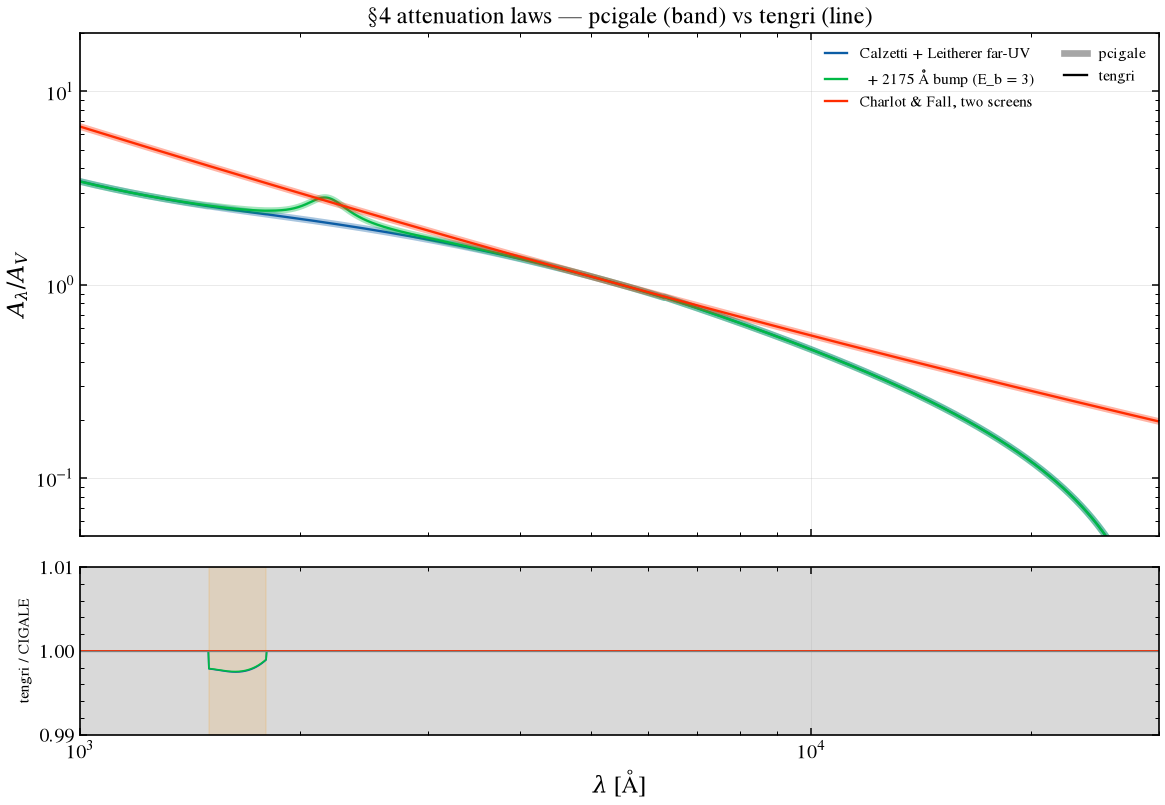
CIGALE’s three dustatt_* families against tengri’s, each side evaluating its own analytic curve on one grid and normalized to A(λ)/A_V at 5500 Å. The pairings are by curve, not by module name:
CIGALE |
tengri |
shared continuum |
|---|---|---|
|
|
Calzetti+2000 with the L02 far-UV extension |
|
|
the same, plus the 2175 Å Drude bump |
|
|
(λ/5500 Å)^δ, two screens |
calzleit is paired with leitherer02, not with tengri’s calzetti: CIGALE’s curve carries the Leitherer far-UV extension and tengri’s bare calzetti does not, which is an 8.4 % gap below 1500 Å between two laws that are not the same law. modified_CF00 needs two curves on each side: CIGALE attenuates young stars through the birth cloud and the ISM (Av_BC = Av_ISM(1−μ)/μ = 1.53 at the defaults), so a single (λ/5500 Å)^−0.7 is the wrong object to compare it against.
The one real convention difference is the Leitherer↔Calzetti crossover. CIGALE hands over at 1500 Å (a_vs_ebv), tengri at 1800 Å, which is the upper end of the 912–1800 Å range Leitherer et al. (2002) state for their fit. That is the whole of the printed max |Δ| below; away from 1500–1800 Å the pairs agree to 0.000 %. tengri is the reference here: pcigale’s own k_leitherer2002 docstring gives the range as 91.2–180 nm while a_vs_ebv truncates it at 150 nm.
Below the Lyman limit the two diverge by construction: CIGALE’s curves are zero there, tengri’s polynomial continues unless dust_attenuation={'lyman_cutoff': True} clips it. Every applied-dust section below sets that flag; see §5.
Verification Status: CROSSVAL: Attenuation law library
[11]:
from tengri.dust import list_laws

_tengri_laws = list_laws(headline=False).to_dict("fn")  # {name: fn(wave_aa) -> k at tau_V=1}
wave_law = np.logspace(np.log10(1000.0), np.log10(30000.0), 2000)


def _norm_AV(wave, A):
    """A(λ) normalized to A_V at 5500 Å."""
    return A / A[np.argmin(np.abs(wave - 5500.0))]


# CIGALE's bump/slope arguments are the module defaults except where a pair
# exercises one of them: bump_wave and bump_width in nm, bump_ampl the
# Milky-Way 3.0 for the second pair, power_slope 0.
_BUMP_KW = dict(bump_wave=217.5, bump_width=35.0, bump_ampl=0.0, power_slope=0.0)

_A_ISM, _MU = 1.2, 0.44
_AV_BC = _A_ISM * (1.0 - _MU) / _MU  # CIGALE ModCF00Att._init_code

# Charlot & Fall: the curve a young star sees is both screens in series.
# CIGALE returns A(λ)/A_V per screen, so compose in magnitudes before
# normalizing; tengri's law functions return k(λ) with k(5500 Å) = 1, so the
# same composition is A_V-weighted there.
_cf00_c = _A_ISM * C.attenuation_curve(
    "dustatt_modified_CF00", wave_law, delta=-0.7
) + _AV_BC * C.attenuation_curve("dustatt_modified_CF00", wave_law, delta=-1.3)
_cf00_t = _A_ISM * np.asarray(
    _tengri_laws["power_law"](wave_law, dust_slope=-0.7)
) + _AV_BC * np.asarray(_tengri_laws["power_law"](wave_law, dust_slope=-1.3))

_law_pairs = [
    (
        "Calzetti + Leitherer far-UV",
        C.attenuation_curve("dustatt_calzleit", wave_law, **_BUMP_KW),
        np.asarray(_tengri_laws["leitherer02"](wave_law)),
        "calzleit ↔ leitherer02",
    ),
    (
        "  + 2175 Å bump (E_b = 3)",
        C.attenuation_curve(
            "dustatt_modified_starburst", wave_law, **{**_BUMP_KW, "bump_ampl": 3.0}
        ),
        np.asarray(_tengri_laws["noll09"](wave_law, dust_bump_strength=3.0)),
        "modified_starburst ↔ noll09",
    ),
    (
        "Charlot & Fall, two screens",
        _cf00_c,
        _cf00_t,
        "modified_CF00 ↔ power_law × 2",
    ),
]

# pcigale thick and translucent, tengri thin on top (the §6-knobs
# convention): agreement reads as a line down the middle of its own halo.
fig, (ax, ax_r) = plt.subplots(
    2, 1, figsize=(10, 7), sharex=True, gridspec_kw={"height_ratios": [3, 1]}
)
print("§4 attenuation law parity (tengri / CIGALE, A_λ/A_V):")
for (label, A_c, A_t, pair), color in zip(_law_pairs, ("C0", "C1", "C3")):
    a_c, a_t = _norm_AV(wave_law, A_c), _norm_AV(wave_law, A_t)
    ax.plot(wave_law, a_c, color=color, lw=4.0, alpha=0.35, solid_capstyle="round")
    ax.plot(wave_law, a_t, color=color, lw=1.4, label=label)
    _r = a_t / np.where(a_c > 0, a_c, np.nan)
    ax_r.plot(wave_law, _r, color=color, lw=1.0)
    _cross = (wave_law >= 1500.0) & (wave_law <= 1800.0)
    print(
        f"  {pair:34s} max|Δ| {float(np.nanmax(np.abs(_r - 1.0))) * 100:6.3f}%  "
        f"median ratio {float(np.nanmedian(_r)):.5f}  "
        f"(outside 1500–1800 Å: max|Δ| "
        f"{float(np.nanmax(np.abs(_r[~_cross] - 1.0))) * 100:6.3f}%)"
    )

# The mispairing this section avoids, measured rather than asserted: tengri's
# bare ``calzetti`` against the same CIGALE calzleit curve, below 1500 Å.
_a_c_cz = _norm_AV(wave_law, C.attenuation_curve("dustatt_calzleit", wave_law, **_BUMP_KW))
_a_t_cz = _norm_AV(wave_law, np.asarray(_tengri_laws["calzetti"](wave_law)))
_m_fuv = wave_law < 1500.0
print(
    f"  for contrast, calzleit ↔ calzetti (no L02 extension) below 1500 Å: "
    f"max|Δ| {float(np.abs(_a_t_cz[_m_fuv] / _a_c_cz[_m_fuv] - 1.0).max()) * 100:.1f}%"
)

ax.plot([], [], "k-", lw=4.0, alpha=0.35, label="pcigale")
ax.plot([], [], "k-", lw=1.4, label="tengri")
ax.set(xscale="log", yscale="log", xlim=(1e3, 3e4), ylim=(0.05, 20))
ax.set_ylabel(r"$A_\lambda / A_V$")
ax.set_title("§4 attenuation laws — pcigale (band) vs tengri (line)")
ax.legend(fontsize=9, ncol=2)
ax.grid(True, alpha=0.3)
ax_r.axhspan(0.99, 1.01, color="0.85", zorder=0)
ax_r.axhline(1.0, color="0.5", lw=0.8)
ax_r.axvspan(1500.0, 1800.0, color="C2", alpha=0.12, zorder=0)
ax_r.set(xscale="log", ylim=(0.99, 1.01))
ax_r.set_xlabel(r"$\lambda$ [Å]")
ax_r.set_ylabel("tengri / CIGALE", fontsize=9)
ax_r.grid(True, alpha=0.3)
fig.tight_layout()
save_fig("cigale_04_dust_attenuation.png")
plt.show()
§4 attenuation law parity (tengri / CIGALE, A_λ/A_V):
  calzleit ↔ leitherer02             max|Δ|  0.252%  median ratio 1.00000  (outside 1500–1800 Å: max|Δ|  0.000%)
  modified_starburst ↔ noll09        max|Δ|  0.247%  median ratio 1.00000  (outside 1500–1800 Å: max|Δ|  0.000%)
  modified_CF00 ↔ power_law × 2      max|Δ|  0.000%  median ratio 1.00000  (outside 1500–1800 Å: max|Δ|  0.000%)
  for contrast, calzleit ↔ calzetti (no L02 extension) below 1500 Å: max|Δ| 8.4%
§5 Dust attenuation applied¶
Fiducial galaxy with and without attenuation. CIGALE uses modified_starburst at E(B−V)_lines = 0.3; tengri uses the two-component Calzetti law at τ_BC and τ_diff derived from the same E(B−V)_lines via cigale_ebv_lines_to_tau.
The printed energy-weighted ratios are the comparison. The printed maximum |Δ| over 0.1–1 μm is a single point in an emission-line wing and not a continuum difference. The point nearest the vacuum Lyα line (1215.67 Å) sits in a wing that the two codes draw differently: tengri renders Cue’s Lyα as a flux-conserving triweight of σ = 100 km/s on the SSP wavelength grid and interpolates it onto CIGALE’s grid, while CIGALE uses a Gaussian of FWHM 300 km/s on its own line-augmented grid. The cell therefore also prints the maximum outside ±10 Å of Lyα; the largest remaining points are on other emission-line wings, for example the Hα line wing (6563–6573 Å), and are set by the same difference in profile and sampling.
Verification Status: PARTIAL (2/88): Two-component attenuation (birth cloud and diffuse)
[12]:
sed_c_nodust = C.run_chain(
    [
        (
            "sfhdelayed",
            dict(
                tau_main=1000,
                age_main=5000,
                tau_burst=50,
                age_burst=20,
                f_burst=0.0,
                sfr_A=1.0,
                normalise=True,
            ),
        ),
        ("bc03", dict(imf=1, metallicity=0.02, separation_age=10)),
        NEB_FIDUCIAL_CIGALE,
    ]
)
w_c_nd, L_c_nd = C.to_lnu(sed_c_nodust)

sed_c_dust = C.run_chain(
    [
        (
            "sfhdelayed",
            dict(
                tau_main=1000,
                age_main=5000,
                tau_burst=50,
                age_burst=20,
                f_burst=0.0,
                sfr_A=1.0,
                normalise=True,
            ),
        ),
        ("bc03", dict(imf=1, metallicity=0.02, separation_age=10)),
        NEB_FIDUCIAL_CIGALE,
        ("dustatt_modified_starburst", dict(E_BV_lines=0.3)),
    ]
)
w_c_d, L_c_d = C.to_lnu(sed_c_dust)

m_nd = SEDModel.build(
    ssp_data=ssp,
    met=MET_FIDUCIAL,
    sfh={
        "type": "delayed",
        "tau_gyr": Fixed(1.0),
        "age_gyr": Fixed(5.0),
        "log_total_mass": Fixed(0.0),
        "all_params": Fixed(DEFAULT),
    },
    dust_attenuation={
        "law": "power_law",
        "type": "two_component",
        "tau_bc": Fixed(0.0),
        "tau_diff": Fixed(0.0),
        "all_params": Fixed(DEFAULT),
    },
    neb=NEB_FIDUCIAL_TENGRI,
    redshift=Fixed(0.0),
)
s_nd = m_nd.predict_state({})

m_d = SEDModel.build(
    ssp_data=ssp,
    met=MET_FIDUCIAL,
    sfh={
        "type": "delayed",
        "tau_gyr": Fixed(1.0),
        "age_gyr": Fixed(5.0),
        "log_total_mass": Fixed(0.0),
        "all_params": Fixed(DEFAULT),
    },
    dust_attenuation={
        "type": "two_component",
        "law_bc": "leitherer02",
        "law_diff": "leitherer02",
        "tau_bc": Fixed(TAU_BC_FIDUCIAL),
        "tau_diff": Fixed(TAU_DIFF_FIDUCIAL),
        # Match CIGALE's ``dustatt_modified_starburst``, which zeros its curve
        # below the Lyman limit (LyC photons ionize H rather than heat dust).
        # Without this tengri's leitherer02 polynomial extrapolates through the
        # FUV and over-attenuates λ < 912 Å relative to CIGALE.
        "lyman_cutoff": True,
        "all_params": Fixed(DEFAULT),
    },
    neb=NEB_FIDUCIAL_TENGRI,
    redshift=Fixed(0.0),
)
s_d = m_d.predict_state({})
_assert_comparable(L_c_d, s_d.derived["sed_dust_attenuated"], name="§5 dust applied")

# The four panels are two comparisons — intrinsic and attenuated — and a
# side-by-side layout with independent y-axes cannot show a normalization
# offset in either. One number each.
_LYA_VAC_AA, _LYA_WINDOW_AA = 1215.67, 10.0  # vacuum Lyα [Å], half-width of the excluded window
print("§5 attenuation applied (tengri / CIGALE, on CIGALE's grid):")
for _name, _wc, _Lc, _wt, _Lt in (
    ("intrinsic ", w_c_nd, L_c_nd, np.asarray(s_nd.wave), np.asarray(s_nd.sed_intrinsic)),
    (
        "attenuated",
        w_c_d,
        L_c_d,
        np.asarray(s_d.wave),
        np.asarray(s_d.derived["sed_dust_attenuated"]),
    ),
):
    _Lt_on_c = U.regrid(_wt, _Lt, _wc)
    _r5 = _Lt_on_c / np.where(_Lc > 0, _Lc, np.nan)
    for _lo, _hi, _wname in ((912.0, 1200.0, "912–1200 Å"), (1000.0, 10000.0, "0.1–1 µm  ")):
        _m5 = (_wc >= _lo) & (_wc <= _hi) & np.isfinite(_r5)
        _d5 = np.abs(_r5[_m5] - 1.0)
        # The band luminosity ratio, and where the worst point is: the extremum
        # is a single point in an emission-line wing, where the two codes draw the
        # line with different profiles (a 100 km/s triweight on the SSP grid in
        # tengri, a 300 km/s FWHM Gaussian on CIGALE's line grid) and different
        # sampling. The maximum is therefore printed twice, over the whole band
        # and outside a ±10 Å window around the vacuum Lyα line.
        _m5_out = _m5 & (np.abs(_wc - _LYA_VAC_AA) > _LYA_WINDOW_AA)
        _d5_out = np.abs(_r5[_m5_out] - 1.0)
        print(
            f"    {_name} {_wname}: energy-weighted "
            f"{_band_energy_ratio(_wc, _Lc, _wt, _Lt, _lo, _hi):.4f}×, "
            f"max |Δ| {float(_d5.max()) * 100:.2f}% at "
            f"{float(_wc[_m5][int(np.argmax(_d5))]):.0f} Å; "
            f"outside Lyα ±{_LYA_WINDOW_AA:g} Å: {float(_d5_out.max()) * 100:.2f}% at "
            f"{float(_wc[_m5_out][int(np.argmax(_d5_out))]):.0f} Å"
        )

fig, ((ax_l1, ax_r1), (ax_l2, ax_r2)) = plt.subplots(2, 2, sharey=True, figsize=(12, 8))
U.panel(ax_l1, ax_r1, label_l="pcigale  intrinsic", label_r="tengri  intrinsic")
U.panel(
    ax_l2,
    ax_r2,
    label_l="pcigale  modified_starburst  (E(B−V)_lines = 0.3)",
    label_r=rf"tengri  two-component Calzetti  ($\tau_{{BC}}$={TAU_BC_FIDUCIAL:.2f}, "
    rf"$\tau_{{diff}}$={TAU_DIFF_FIDUCIAL:.2f})",
)
ax_l1.plot(w_c_nd, L_c_nd, "C0-", linewidth=1.5)
ax_r1.plot(s_nd.wave, s_nd.sed_intrinsic, "C1-", linewidth=1.5)
ax_l2.plot(w_c_d, L_c_d, "C0-", linewidth=1.5)
ax_r2.plot(s_d.wave, s_d.derived["sed_dust_attenuated"], "C1-", linewidth=1.5)
_ymax = float(np.asarray(s_nd.sed_intrinsic).max())
for ax in (ax_l1, ax_r1, ax_l2, ax_r2):
    ax.set_ylim(_ymax * 1e-6, _ymax * 2)
    ax.grid(True, alpha=0.3)
fig.tight_layout()
plt.close(fig)  # superseded by §5b's attenuation-knob grids, which replace this panel
src/tengri/forward/sed_model.py:13601: SFHBeyondOldestTemplateWarning: The SSP grid's oldest template is 13.700 Gyr but the universe is 13.787 Gyr old at redshift 0. Stars formed in that gap are older than every template, so both age kernels assign them to the oldest one: the formed mass is conserved, and those stars carry the colors of a 13.700 Gyr population. Use a grid whose oldest template reaches 13.787 Gyr (e.g. MIST) to remove the approximation.
  return cls(
§5 attenuation applied (tengri / CIGALE, on CIGALE's grid):
    intrinsic  912–1200 Å: energy-weighted 1.0631×, max |Δ| 14.54% at 915 Å; outside Lyα ±10 Å: 14.54% at 915 Å
    intrinsic  0.1–1 µm  : energy-weighted 1.0168×, max |Δ| 942.48% at 1214 Å; outside Lyα ±10 Å: 149.69% at 6573 Å
    attenuated 912–1200 Å: energy-weighted 1.0571×, max |Δ| 12.01% at 915 Å; outside Lyα ±10 Å: 12.01% at 915 Å
    attenuated 0.1–1 µm  : energy-weighted 0.9923×, max |Δ| 94.48% at 1216 Å; outside Lyα ±10 Å: 75.41% at 6563 Å
§5b Attenuation knobs¶
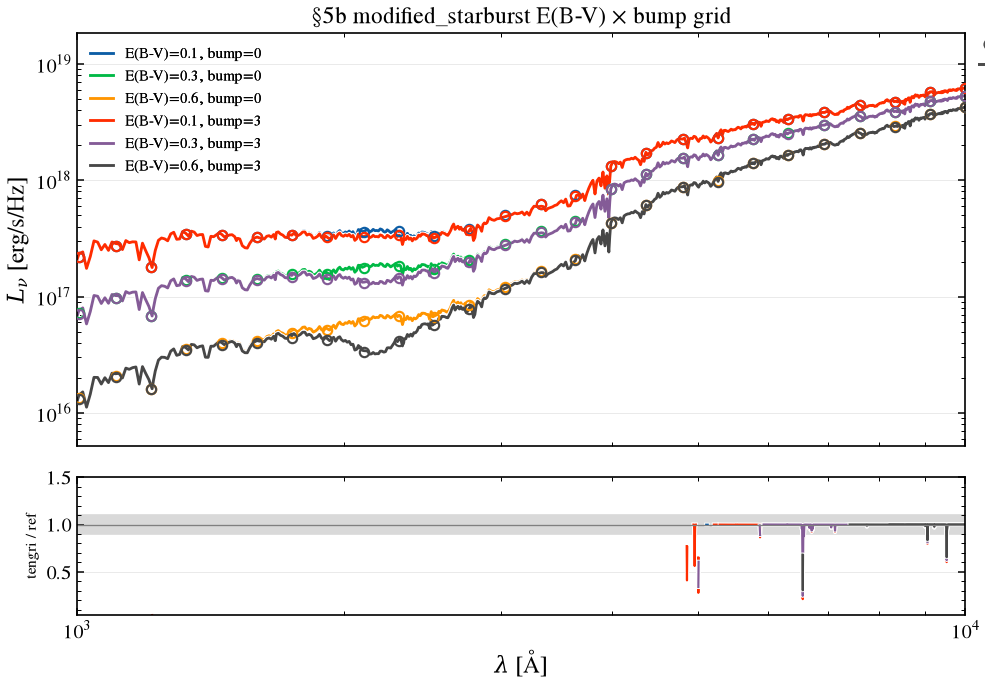
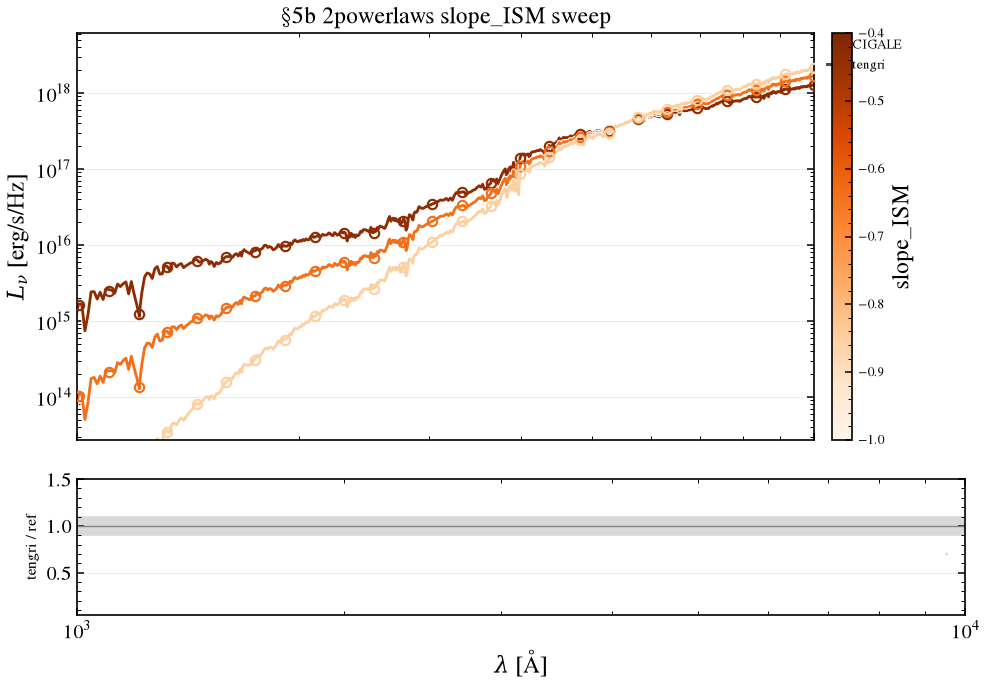
Two more attenuation modules. dustatt_modified_starburst at E(B−V)_lines ∈ {0.1, 0.3, 0.6} × uv_bump_amplitude ∈ {0, 3} (6 cases) → tengri two_component, law noll09 on both screens, tau_diff from the Setup E→τ conversion, tau_bc = 0, bump_strength_diff matching the bump. dustatt_2powerlaws (Av_BC=1.0, slope_BC=−1.3, BC_to_ISM_factor=0.44) at slope_ISM ∈ {−0.4, −0.7, −1.0} (3 cases) → tengri power_law on both screens, tau_bc = 1.0/1.086,
tau_diff = (1.0/0.44)/1.086 (CIGALE sets Av_ISM = Av_BC / BC_to_ISM_factor, not the product). Both attenuated SEDs against the UV_TO_NIR bands; both stand-alone A(λ)/A_V curves against C.attenuation_curve over 1216–3000 Å. This fiducial galaxy is old-star dominated, so the ISM screen carries almost all the attenuation and the 2powerlaws ratio does not move with slope_ISM.
[13]:
_cases_5b_noll = []
for _ebv, _bump in [(0.1, 0.0), (0.3, 0.0), (0.6, 0.0), (0.1, 3.0), (0.3, 3.0), (0.6, 3.0)]:
    _tau_d = _R_V_CALZETTI * _F_CONT_OVER_LINES * _ebv / 1.086
    _sed_cn = C.run_chain(
        [
            (
                "sfhdelayed",
                dict(
                    tau_main=1000,
                    age_main=5000,
                    tau_burst=50,
                    age_burst=20,
                    f_burst=0.0,
                    sfr_A=1.0,
                    normalise=True,
                ),
            ),
            ("bc03", dict(imf=1, metallicity=0.02, separation_age=10)),
            NEB_FIDUCIAL_CIGALE,
            ("dustatt_modified_starburst", dict(E_BV_lines=_ebv, uv_bump_amplitude=_bump)),
        ]
    )
    _w_cn, _L_cn = C.to_lnu(_sed_cn)
    _m_n = SEDModel.build(
        ssp_data=ssp,
        met=MET_FIDUCIAL,
        sfh={
            "type": "delayed",
            "tau_gyr": Fixed(1.0),
            "age_gyr": Fixed(5.0),
            "log_total_mass": Fixed(0.0),
            "all_params": Fixed(DEFAULT),
        },
        dust_attenuation={
            "type": "two_component",
            "law_bc": "noll09",
            "law_diff": "noll09",
            "tau_bc": Fixed(0.0),
            "tau_diff": Fixed(_tau_d),
            "bump_strength_diff": _bump,
            "lyman_cutoff": True,
            "all_params": Fixed(DEFAULT),
        },
        neb=NEB_FIDUCIAL_TENGRI,
        redshift=Fixed(0.0),
    )
    _s_n = _m_n.predict_state({})
    _cases_5b_noll.append(
        (
            f"E(B-V)={_ebv}, bump={_bump:g}",
            _w_cn,
            _L_cn,
            np.asarray(_s_n.wave),
            np.asarray(_s_n.derived["sed_dust_attenuated"]),
        )
    )
    _assert_comparable(
        _L_cn, np.asarray(_s_n.derived["sed_dust_attenuated"]), name=f"§5b noll09 {_ebv},{_bump}"
    )

fig, (ax, ax_r), _ratios_5bn = V.sweep_fig(
    _cases_5b_noll,
    ref_label="CIGALE",
    title="§5b modified_starburst E(B-V) × bump grid",
    xlim=(1e3, 1e4),
)
fig.tight_layout()
save_fig("cigale_05b_noll09_grid.png")
print("§5b modified_starburst E(B-V) × bump grid (UV_TO_NIR):")
for _label, _w_ref, _L_ref, _w_t, _L_t in _cases_5b_noll:
    _rows = V.filter_rows_native(
        np.asarray(_w_t), np.asarray(_L_t), _w_ref, _L_ref, filters=V.UV_TO_NIR
    )
    V.print_filter_table(_rows, ref_name="CIGALE", title=f"§5b {_label}", compact=True)

_cases_5b_2pl = []
for _slope_ism in (-0.4, -0.7, -1.0):
    _sed_c2p = C.run_chain(
        [
            (
                "sfhdelayed",
                dict(
                    tau_main=1000,
                    age_main=5000,
                    tau_burst=50,
                    age_burst=20,
                    f_burst=0.0,
                    sfr_A=1.0,
                    normalise=True,
                ),
            ),
            ("bc03", dict(imf=1, metallicity=0.02, separation_age=10)),
            NEB_FIDUCIAL_CIGALE,
            (
                "dustatt_2powerlaws",
                dict(Av_BC=1.0, slope_BC=-1.3, BC_to_ISM_factor=0.44, slope_ISM=_slope_ism),
            ),
        ]
    )
    _w_c2p, _L_c2p = C.to_lnu(_sed_c2p)
    _m_2p = SEDModel.build(
        ssp_data=ssp,
        met=MET_FIDUCIAL,
        sfh={
            "type": "delayed",
            "tau_gyr": Fixed(1.0),
            "age_gyr": Fixed(5.0),
            "log_total_mass": Fixed(0.0),
            "all_params": Fixed(DEFAULT),
        },
        dust_attenuation={
            "type": "two_component",
            "law_bc": "power_law",
            "law_diff": "power_law",
            "slope_bc": -1.3,
            "slope_diff": _slope_ism,
            # CIGALE's dustatt_2powerlaws sets Av_ISM = Av_BC / BC_to_ISM_factor
            # (dustatt_2powerlaws.py _init_code), not Av_BC * factor despite the
            # parameter's "Av ISM / Av BC (<1)" docstring -- verified against the
            # installed module directly.
            "tau_bc": Fixed(1.0 / 1.086),
            "tau_diff": Fixed((1.0 / 0.44) / 1.086),
            "lyman_cutoff": True,
            "all_params": Fixed(DEFAULT),
        },
        neb=NEB_FIDUCIAL_TENGRI,
        redshift=Fixed(0.0),
    )
    _s_2p = _m_2p.predict_state({})
    _cases_5b_2pl.append(
        (
            f"slope_ISM={_slope_ism}",
            _w_c2p,
            _L_c2p,
            np.asarray(_s_2p.wave),
            np.asarray(_s_2p.derived["sed_dust_attenuated"]),
        )
    )
    _assert_comparable(
        _L_c2p,
        np.asarray(_s_2p.derived["sed_dust_attenuated"]),
        name=f"§5b 2powerlaws {_slope_ism}",
    )

fig, (ax, ax_r), _ratios_5b2 = V.sweep_fig(
    _cases_5b_2pl,
    ref_label="CIGALE",
    title="§5b 2powerlaws slope_ISM sweep",
    xlim=(1e3, 1e4),
    cmap="Oranges",
    values=[-0.4, -0.7, -1.0],
    param_label="slope_ISM",
)
fig.tight_layout()
save_fig("cigale_05c_2powerlaws_slope.png")
print("§5b 2powerlaws slope_ISM sweep (UV_TO_NIR):")
for _label, _w_ref, _L_ref, _w_t, _L_t in _cases_5b_2pl:
    _rows = V.filter_rows_native(
        np.asarray(_w_t), np.asarray(_L_t), _w_ref, _L_ref, filters=V.UV_TO_NIR
    )
    V.print_filter_table(_rows, ref_name="CIGALE", title=f"§5b {_label}", compact=True)

# Stand-alone A(λ)/A_V curves (no SFH/SSP, no E(B-V) scale — the ratio is
# shape-only), the same way §4 reads each law's own analytic function.
_wave_5b = np.logspace(np.log10(1000.0), np.log10(30000.0), 2000)
_cases_5b_curve = []
for _bump in (0.0, 3.0):
    _A_c = _norm_AV(
        _wave_5b,
        C.attenuation_curve(
            "dustatt_modified_starburst",
            _wave_5b,
            bump_wave=217.5,
            bump_width=35.0,
            bump_ampl=_bump,
            power_slope=0.0,
        ),
    )
    _A_t = _norm_AV(
        _wave_5b, np.asarray(_tengri_laws["noll09"](_wave_5b, dust_bump_strength=_bump))
    )
    _cases_5b_curve.append((f"bump={_bump:g}", _wave_5b, _A_c, _wave_5b, _A_t))
_rows_5b_curve = V.window_rows(_cases_5b_curve, lo=1216.0, hi=3000.0)
V.print_window_table(
    _rows_5b_curve, ref_name="CIGALE", title="§5b A(λ)/A_V, modified_starburst screen, 1216-3000 Å"
)
src/tengri/forward/sed_model.py:13601: SFHBeyondOldestTemplateWarning: The SSP grid's oldest template is 13.700 Gyr but the universe is 13.787 Gyr old at redshift 0. Stars formed in that gap are older than every template, so both age kernels assign them to the oldest one: the formed mass is conserved, and those stars carry the colors of a 13.700 Gyr population. Use a grid whose oldest template reaches 13.787 Gyr (e.g. MIST) to remove the approximation.
  return cls(
§5b modified_starburst E(B-V) × bump grid (UV_TO_NIR):
  §5b E(B-V)=0.1, bump=0                               median 0.997x  worst 0.958x  0/10 outside 5%
  §5b E(B-V)=0.3, bump=0                               median 0.997x  worst 0.974x  0/10 outside 5%
  §5b E(B-V)=0.6, bump=0                               median 0.998x  worst 1.033x  0/10 outside 5%
  §5b E(B-V)=0.1, bump=3                               median 0.997x  worst 0.959x  0/10 outside 5%
  §5b E(B-V)=0.3, bump=3                               median 0.998x  worst 1.028x  0/10 outside 5%
  §5b E(B-V)=0.6, bump=3                               median 1.000x  worst 1.044x  0/10 outside 5%
src/tengri/forward/sed_model.py:13601: SFHBeyondOldestTemplateWarning: The SSP grid's oldest template is 13.700 Gyr but the universe is 13.787 Gyr old at redshift 0. Stars formed in that gap are older than every template, so both age kernels assign them to the oldest one: the formed mass is conserved, and those stars carry the colors of a 13.700 Gyr population. Use a grid whose oldest template reaches 13.787 Gyr (e.g. MIST) to remove the approximation.
  return cls(
§5b 2powerlaws slope_ISM sweep (UV_TO_NIR):
  §5b slope_ISM=-0.4                                   median 0.999x  worst 1.022x  0/10 outside 5%
  §5b slope_ISM=-0.7                                   median 0.999x  worst 1.022x  0/10 outside 5%
  §5b slope_ISM=-1.0                                   median 0.999x  worst 1.022x  0/10 outside 5%

  §5b A(λ)/A_V, modified_starburst screen, 1216-3000 Å
  case                           median ×     max |Δ| [%]    x at max [Å]
  --------------------------------------------------------------------------
  bump=0                            1.000x            0.3%         1632.34
  bump=3                            1.000x            0.2%         1629.57
§6 Dust IR re-emission and energy balance¶
CIGALE re-emits absorbed stellar UV/optical through the Dale et al. (2014) template family (α = 2); tengri evaluates the same templates and enforces energy balance, \(L_{\rm IR,\,emitted} \equiv L_{\rm absorbed}\), to floating point: the residual is annotated on the right panel and printed below, and it is exactly zero.
The energy anchor. tengri’s L_absorbed sits 1.1 % above CIGALE’s dust.luminosity (printed below). That is §3’s age convention arriving here: the absorbed luminosity is an integral over the attenuated far-UV and optical, weighted toward the wavelengths where CIGALE’s 0.5 Myr older stars emit less than tengri’s. The two codes’ attenuation curves are not the cause: §4 measures them agreeing to 0.000 % away from the 1500–1800 Å crossover, and the absorbed fractions they produce are
printed below (0.359 for CIGALE, 0.358 for tengri). Since the IR is normalized to that anchor, it appears in the printed 10–100 μm median as a floor under whatever the templates themselves do.
Lyman continuum. tengri’s attenuation curves polynomial-extend through the FUV; CIGALE zeros attenuation below 912 Å, and the models here set dust_attenuation={'lyman_cutoff': True} to match. This changes the emergent far-UV continuum, which is what §7’s panel shows, and not the IR budget: L_absorbed masks λ < 912 Å unconditionally, on the reasoning that Lyman-continuum photons ionize hydrogen rather than heat dust. The IR here is bit-identical with and without the flag.
Verification Status: CROSSVAL: Dust IR emission versus BAGPIPES
[14]:
sed_c_ir = C.run_chain(
    [
        (
            "sfhdelayed",
            dict(
                tau_main=1000,
                age_main=5000,
                tau_burst=50,
                age_burst=20,
                f_burst=0.0,
                sfr_A=1.0,
                normalise=True,
            ),
        ),
        ("bc03", dict(imf=1, metallicity=0.02, separation_age=10)),
        NEB_FIDUCIAL_CIGALE,
        ("dustatt_modified_starburst", dict(E_BV_lines=0.3)),
        ("dale2014", dict(alpha=2.0)),
    ]
)
w_c_ir, L_c_ir = C.to_lnu(sed_c_ir)

m_ir = SEDModel.build(
    ssp_data=ssp,
    met=MET_FIDUCIAL,
    sfh={
        "type": "delayed",
        "tau_gyr": Fixed(1.0),
        "age_gyr": Fixed(5.0),
        "log_total_mass": Fixed(0.0),
        "all_params": Fixed(DEFAULT),
    },
    dust_attenuation={
        "type": "two_component",
        "law_bc": "leitherer02",
        "law_diff": "leitherer02",
        "tau_bc": Fixed(TAU_BC_FIDUCIAL),
        "tau_diff": Fixed(TAU_DIFF_FIDUCIAL),
        # Lyman-limit clip (CIGALE parity) — see §5. The dust IR is energy-balance
        # normalized to L_absorbed, whose integral already excludes λ < 912 Å, so
        # this only changes the emergent FUV continuum, not the IR budget.
        "lyman_cutoff": True,
        "all_params": Fixed(DEFAULT),
    },
    dust_emission={
        "type": "dale2014_cigale",
        "alpha_dale": Fixed(2.0),
        "all_params": Fixed(DEFAULT),
    },
    neb=NEB_FIDUCIAL_TENGRI,
    redshift=Fixed(0.0),
)
s_ir = m_ir.predict_state({})
L_abs = float(s_ir.derived.get("L_absorbed", 0.0))
L_emit = float(s_ir.derived.get("L_ir", 0.0))
residual = abs(L_abs - L_emit) / max(L_abs, 1e-30)
_assert_comparable(L_c_ir, s_ir.sed_intrinsic, name="§6 IR")

# Shared-axis overlay + ratio panel: the FIR-peak partition difference is
# only readable on one scale.
fig, ax, ax_r, ratio = U.overlay_ratio_fig(
    w_c_ir,
    L_c_ir,
    np.asarray(s_ir.wave),
    np.asarray(s_ir.sed_intrinsic),
    title="§6 stellar + Dale+2014 dust IR — CIGALE vs tengri",
    label_c="CIGALE  + Dale+2014 (α = 2)",
    label_t="tengri  + dust.emission.dale2014 (α = 2)",
    xlim=(1e3, 5e6),
    dyn_range=1e-4,
)
ax.text(
    0.98,
    0.05,
    rf"tengri $|L_{{\rm IR}} - L_{{\rm abs}}|/L_{{\rm abs}} = {residual:.1e}$",
    transform=ax.transAxes,
    fontsize=9,
    ha="right",
    va="bottom",
    bbox=dict(boxstyle="round", facecolor="wheat", alpha=0.7),
)
print(
    "§6 dust IR tengri/CIGALE energy-weighted (10–100 µm): "
    f"{_band_energy_ratio(w_c_ir, L_c_ir, np.asarray(s_ir.wave), np.asarray(s_ir.sed_intrinsic), 1e5, 1e6):.3f}×"
)

# The energy anchor the IR is normalized to, and the absorbed fraction that
# sets it. Printed because §6's IR ratio, §11's synchrotron amplitude and the
# capstone's FIR all rest on this one number, and it is not the attenuation
# curve (§4) — it is the §3 age-binning convention reaching the integral.
_L_DUST_C = float(sed_c_ir.info["dust.luminosity"]) * 1e7
_L_STAR_C = float(sed_c_ir.info["stellar.lum"]) * 1e7
# §3's dust-free twin is this galaxy's intrinsic stellar SED — same SFH, same
# SSP, same 1 M☉ — so its bolometric integral is the denominator CIGALE's
# ``stellar.lum`` is.
_L_star_t = _lbol_nu(np.asarray(s_stellar.wave), np.asarray(s_stellar.sed_intrinsic))
print(
    f"§6 energy anchor: CIGALE dust.luminosity {_L_DUST_C:.4e}, "
    f"tengri L_absorbed {L_abs:.4e} erg/s → {L_abs / _L_DUST_C:.4f}×"
)
print(f"§6 absorbed fraction: CIGALE {_L_DUST_C / _L_STAR_C:.6f}, tengri {L_abs / _L_star_t:.6f}")
print(f"§6 energy balance |L_IR − L_abs| / L_abs = {residual:.3e}")
fig.tight_layout()
plt.close(fig)  # superseded by §6c's IR-library grids, which replace this panel
src/tengri/forward/sed_model.py:13601: SFHBeyondOldestTemplateWarning: The SSP grid's oldest template is 13.700 Gyr but the universe is 13.787 Gyr old at redshift 0. Stars formed in that gap are older than every template, so both age kernels assign them to the oldest one: the formed mass is conserved, and those stars carry the colors of a 13.700 Gyr population. Use a grid whose oldest template reaches 13.787 Gyr (e.g. MIST) to remove the approximation.
  return cls(
§6 dust IR tengri/CIGALE energy-weighted (10–100 µm): 1.013×
§6 energy anchor: CIGALE dust.luminosity 1.6367e+33, tengri L_absorbed 1.6555e+33 erg/s → 1.0114×
§6 absorbed fraction: CIGALE 0.359135, tengri 0.357854
§6 energy balance |L_IR − L_abs| / L_abs = 0.000e+00
Dust-IR model knobs: AGN heating and the radiation-field slope¶
Two further CIGALE dust-IR parameters. Both panels sit on the same energy anchor as §6: _knob_model uses the notebook’s fiducial attenuation block, a single screen (tau_bc = 0, matching dustatt_modified_starburst, which has no Charlot & Fall birth cloud; A_V = R_V × E(B−V)_cont = 4.05 × 0.132 = 0.535 mag) carrying the Leitherer-extended Calzetti curve with the 912 Å clip. So the 1.1 % anchor offset of §3/§6 enters every ratio printed here, and what the panels add is whatever the
templates do on top of it.
Left: Dale 2014 AGN fraction (``dale2014.fracAGN``). fracAGN adds an AGN-heated source as a separate power budget (\(L_{\rm AGN}=L_{\rm
dust}\,f/(1-f)\)) using CIGALE’s own model_quasar template (\(SED = L\,T_{\rm SF}(\alpha) + L_{\rm AGN}\,T_{\rm QSO}\), dale2014.py). The subtlety that makes the mixing work: CIGALE normalizes model_quasar to unit luminosity over its full native grid (~60 nm onward), where ~46 % of the quasar energy is the UV/optical accretion-disc continuum below the dust grid’s blue edge. Only its ~0.42 IR share enters the dust mixing, and tengri carries that same partition. The cell prints the
3–8 μm and 8–1000 μm median ratio at each \(f_{\rm AGN}\), so the question of whether the mid-IR lift drifts with \(f_{\rm AGN}\) is answered by three numbers rather than by eye.
Right: THEMIS slope :math:`alpha` (``themis.alpha``, :math:`dU/dM propto
U^{-alpha}`, matched ``qhac=0.17, umin=1.0, gamma=0.1``). tengri’s THEMIS templates are built from the published DustEM grids (Jones+2017) and conserve the absorbed energy. The a-C(:H) aromatic fraction qhac is pinned to CIGALE’s 0.17 on both sides. CIGALE quotes it as a fraction while the DustEM grid tabulates it in FSPS scaling (qhac × 100/2.2), so the two must be reconciled before interpolation or the wrong grain model is selected. One input is not matched and cannot be: CIGALE’s
own DustEM run used umax = 1e7, a slightly hotter PDR. The cell prints both an 8–30 μm and an 8–1000 μm ratio at each α, so a redistribution of the IR within the band can be told apart from a change in its total.
[15]:
import jax
import jax.numpy as jnp

_c_aa_dust = C_AA

# Matched fiducial chain (mirrors the §6 dale2014 cell): same SFH + BC03 +
# Calzetti attenuation on both sides, so the absorbed luminosity that feeds
# the IR re-emission template is identical. pcigale's normalise=True forms
# 1 M_sun; tengri's log_total_mass=11 forms 1e11 M_sun, so scale the pcigale
# curve by 1e11 to overlay the two at the same stellar mass.
_KNOB_MASS = 1e11
_SFH_CHAIN = (
    "sfhdelayed",
    dict(
        tau_main=1000,
        age_main=5000,
        tau_burst=50,
        age_burst=20,
        f_burst=0.0,
        sfr_A=1.0,
        normalise=True,
    ),
)
_BC03_CHAIN = ("bc03", dict(imf=1, metallicity=0.02, separation_age=10))
_DUSTATT_CHAIN = ("dustatt_modified_starburst", dict(E_BV_lines=0.3))


def _knob_model(emission_type, **emkw):
    """tengri fiducial twin of the matched pcigale chain (1e11 M_sun).

    The attenuation is the notebook's fiducial: a **single** screen
    (``tau_bc = 0``, matching CIGALE's ``dustatt_modified_starburst``, which
    has no Charlot & Fall birth cloud) carrying the Leitherer-extended
    Calzetti curve with the 912 Å clip, i.e. exactly the block §5–§11 use.
    That matters here rather than being housekeeping: the Dale and THEMIS
    templates are normalized to the *absorbed* starlight, so the IR can only
    match to the extent the attenuation does, and a different curve or a
    missing clip would show up as an IR offset with no dust-side cause.
    """
    return SEDModel.build(
        ssp_data=ssp,
        met=MET_FIDUCIAL,
        sfh={
            "type": "delayed",
            "tau_gyr": Fixed(1.0),
            "age_gyr": Fixed(5.0),
            "log_total_mass": Fixed(11.0),
            "all_params": Fixed(DEFAULT),
        },
        dust_attenuation={
            "type": "two_component",
            "law_bc": "leitherer02",
            "law_diff": "leitherer02",
            "tau_bc": Fixed(TAU_BC_FIDUCIAL),
            "tau_diff": Fixed(TAU_DIFF_FIDUCIAL),
            "lyman_cutoff": True,
            "all_params": Fixed(DEFAULT),
        },
        dust_emission=(
            {"type": "none"}
            if emission_type == "none"
            else {"type": emission_type, "all_params": Fixed(DEFAULT), **emkw}
        ),
        neb=NEB_FIDUCIAL_TENGRI,
        redshift=Fixed(0.0),
    )


def _nu_lnu(wave_aa, l_nu):
    w = np.asarray(wave_aa)
    return w, _c_aa_dust / w * np.asarray(l_nu)


def _band_median(ratio, wave_aa, lo_um, hi_um):
    """Median of ``ratio`` over ``[lo_um, hi_um]`` on the Å grid ``wave_aa``."""
    m = (wave_aa >= lo_um * 1e4) & (wave_aa <= hi_um * 1e4) & np.isfinite(ratio)
    return float(np.median(ratio[m])) if m.any() else float("nan")


fig = plt.figure(figsize=(11, 6.5))
gs = fig.add_gridspec(2, 2, height_ratios=[3, 1], hspace=0.3)
ax_l, ax_r = fig.add_subplot(gs[0, 0]), fig.add_subplot(gs[0, 1])
ax_lr, ax_rr = fig.add_subplot(gs[1, 0]), fig.add_subplot(gs[1, 1])
ax_lr.sharex(ax_l)
ax_rr.sharex(ax_r)

# Where the two codes agree, a thin pcigale line simply disappears under
# tengri's — the panel then reads as though only one code were plotted, which
# is the opposite of the point. Draw pcigale as a thick translucent band and
# tengri as a thin line on top (the convention the AGNFITTER-RX notebook uses):
# agreement shows as a crisp line running down the middle of its own halo, and
# any divergence separates the two immediately.
_REF_KW = dict(lw=4.0, alpha=0.35, solid_capstyle="round")
_TNG_LW = 1.4
_peaks = []
_ratios_l, _ratios_r = [], []

# LEFT — Dale 2014 AGN fraction: pcigale dale2014.fracAGN (band) vs tengri (line).
m_frac = _knob_model(
    "dale2014_cigale", alpha_dale=Fixed(2.0), frac_agn=Uniform(0.0, 0.99, default=0.3)
)
p_frac = dict(m_frac.spec.sample(jax.random.PRNGKey(0)))
print("§6 knobs — Dale 2014 fracAGN sweep (tengri / CIGALE, median in band):")
for f, c in zip([0.0, 0.3, 0.6], ["C0", "C1", "C3"]):
    sed = C.run_chain(
        [
            _SFH_CHAIN,
            _BC03_CHAIN,
            NEB_FIDUCIAL_CIGALE,
            _DUSTATT_CHAIN,
            ("dale2014", dict(alpha=2.0, fracAGN=f)),
        ]
    )
    w_c, nl_c = _nu_lnu(*C.to_lnu(sed))
    ax_l.loglog(w_c, nl_c * _KNOB_MASS, color=c, **_REF_KW)
    o = m_frac.predict_rest_sed({**p_frac, "dust_frac_agn": jnp.float64(f)})
    w_t, nl_t = _nu_lnu(o.wavelength, o.sed)
    ax_l.loglog(w_t, nl_t, color=c, lw=_TNG_LW, label=rf"$f_{{\rm AGN}}={f}$")
    _peaks.append(float(np.nanmax(nl_t)))
    _rk = U.regrid(w_t, nl_t, w_c) / np.where(nl_c > 0, nl_c * _KNOB_MASS, np.nan)
    _ratios_l.append((c, w_c, _rk))
    print(
        f"    f_AGN = {f}:  3–8 µm {_band_median(_rk, w_c, 3.0, 8.0):.4f}×"
        f"   8–1000 µm {_band_median(_rk, w_c, 8.0, 1000.0):.4f}×"
    )
ax_l.plot([], [], "k-", **_REF_KW, label="pcigale")
ax_l.plot([], [], "k-", lw=_TNG_LW, label="tengri")
ax_l.set(
    xlim=(1e4, 1e7),
    ylabel=r"$\nu L_\nu$ [erg s$^{-1}$]",
    title="Dale 2014 AGN fraction",
)
ax_l.legend(fontsize=8, frameon=False, ncol=2)
ax_l.tick_params(labelbottom=False)

# RIGHT — THEMIS slope alpha, matched qhac=0.17, umin=1.0, gamma=0.1.
m_alpha = _knob_model(
    "themis", gamma_dl=Fixed(0.1), qhac=Fixed(0.17), alpha=Uniform(1.0, 3.0, default=2.0)
)
p_alpha = dict(m_alpha.spec.sample(jax.random.PRNGKey(0)))
print("§6 knobs — THEMIS α sweep (tengri / CIGALE, median in band):")
for a, c in zip([1.0, 2.0, 3.0], ["C0", "C1", "C3"]):
    sed = C.run_chain(
        [
            _SFH_CHAIN,
            _BC03_CHAIN,
            NEB_FIDUCIAL_CIGALE,
            _DUSTATT_CHAIN,
            ("themis", dict(qhac=0.17, umin=1.0, gamma=0.1, alpha=a)),
        ]
    )
    w_c, nl_c = _nu_lnu(*C.to_lnu(sed))
    ax_r.loglog(w_c, nl_c * _KNOB_MASS, color=c, **_REF_KW)
    o = m_alpha.predict_rest_sed({**p_alpha, "dust_alpha": jnp.float64(a)})
    w_t, nl_t = _nu_lnu(o.wavelength, o.sed)
    ax_r.loglog(w_t, nl_t, color=c, lw=_TNG_LW, label=rf"$\alpha={a}$")
    _peaks.append(float(np.nanmax(nl_t)))
    _rk = U.regrid(w_t, nl_t, w_c) / np.where(nl_c > 0, nl_c * _KNOB_MASS, np.nan)
    _ratios_r.append((c, w_c, _rk))
    print(
        f"    α = {a}:  8–30 µm {_band_median(_rk, w_c, 8.0, 30.0):.4f}×"
        f"   8–1000 µm {_band_median(_rk, w_c, 8.0, 1000.0):.4f}×"
    )
ax_r.plot([], [], "k-", **_REF_KW, label="pcigale")
ax_r.plot([], [], "k-", lw=_TNG_LW, label="tengri")
ax_r.set(xlim=(3e4, 1e7), title=r"THEMIS radiation-field slope $\alpha$")
ax_r.legend(fontsize=8, frameon=False, ncol=2)
ax_r.tick_params(labelbottom=False)

# Ratio panels
for c, w, ratio in _ratios_l:
    pos = w > 0
    ax_lr.plot(w[pos], ratio[pos], color=c, linewidth=1.0)
ax_lr.axhspan(0.9, 1.1, color="0.85", zorder=0)
ax_lr.axhline(1.0, color="0.5", linewidth=0.8)
ax_lr.set(
    xlim=(1e4, 1e7), ylim=(0.5, 1.5), yscale="log", xlabel=r"$\lambda$ [Å]", ylabel="tengri/CIGALE"
)
ax_lr.grid(True, alpha=0.3)

for c, w, ratio in _ratios_r:
    pos = w > 0
    ax_rr.plot(w[pos], ratio[pos], color=c, linewidth=1.0)
ax_rr.axhspan(0.9, 1.1, color="0.85", zorder=0)
ax_rr.axhline(1.0, color="0.5", linewidth=0.8)
ax_rr.set(
    xlim=(3e4, 1e7), ylim=(0.5, 1.5), yscale="log", xlabel=r"$\lambda$ [Å]", ylabel="tengri/CIGALE"
)
ax_rr.grid(True, alpha=0.3)

_ypk = max(_peaks)
for ax in (ax_l, ax_r):
    ax.set_ylim(_ypk * 1e-5, _ypk * 2.0)

fig.tight_layout()
save_fig("cigale_06_dust_ir_knobs.png")
plt.show()
src/tengri/forward/sed_model.py:13601: SFHBeyondOldestTemplateWarning: The SSP grid's oldest template is 13.700 Gyr but the universe is 13.787 Gyr old at redshift 0. Stars formed in that gap are older than every template, so both age kernels assign them to the oldest one: the formed mass is conserved, and those stars carry the colors of a 13.700 Gyr population. Use a grid whose oldest template reaches 13.787 Gyr (e.g. MIST) to remove the approximation.
  return cls(
§6 knobs — Dale 2014 fracAGN sweep (tengri / CIGALE, median in band):
    f_AGN = 0.0:  3–8 µm 1.0080×   8–1000 µm 1.0117×
    f_AGN = 0.3:  3–8 µm 1.0118×   8–1000 µm 1.0128×
    f_AGN = 0.6:  3–8 µm 1.0142×   8–1000 µm 1.0144×
src/tengri/forward/sed_model.py:13601: SFHBeyondOldestTemplateWarning: The SSP grid's oldest template is 13.700 Gyr but the universe is 13.787 Gyr old at redshift 0. Stars formed in that gap are older than every template, so both age kernels assign them to the oldest one: the formed mass is conserved, and those stars carry the colors of a 13.700 Gyr population. Use a grid whose oldest template reaches 13.787 Gyr (e.g. MIST) to remove the approximation.
  return cls(
§6 knobs — THEMIS α sweep (tengri / CIGALE, median in band):
    α = 1.0:  8–30 µm 1.0117×   8–1000 µm 1.0134×
    α = 2.0:  8–30 µm 1.0117×   8–1000 µm 1.0117×
    α = 3.0:  8–30 µm 1.0119×   8–1000 µm 1.0118×
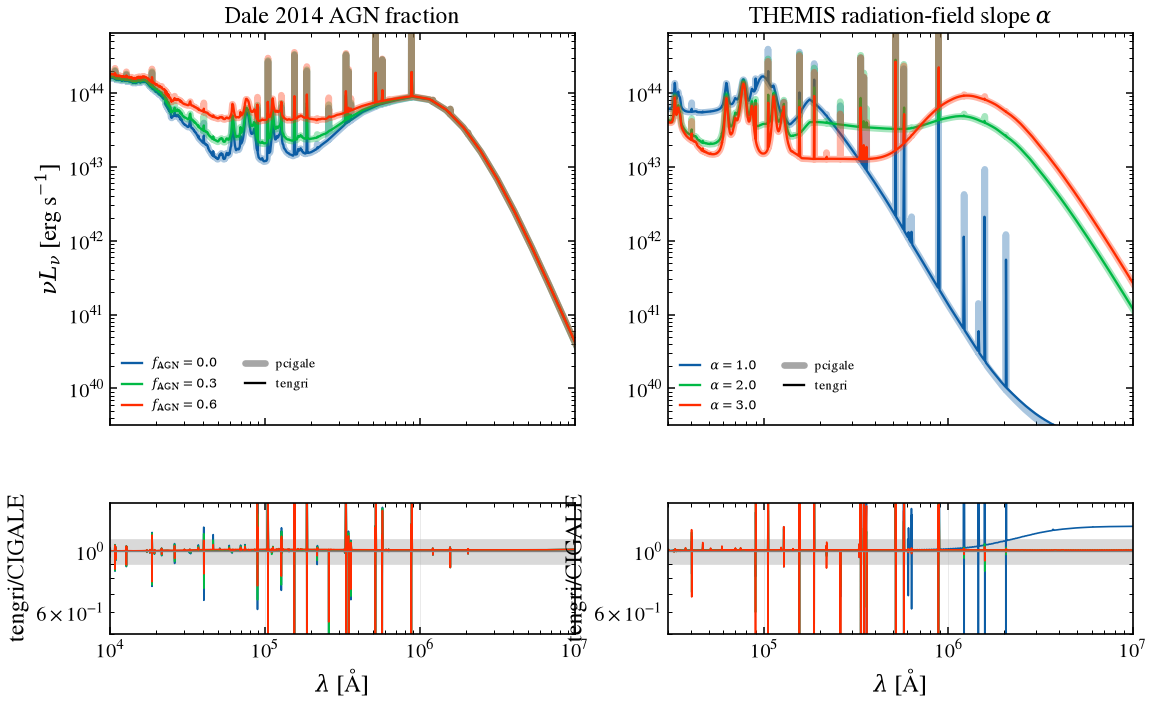
§6c IR library sweep¶
Three more dust-IR template families, on the §6-knobs fiducial (1e11 M☉, single-screen Calzetti attenuation; the §3 energy-anchor offset sits under every ratio). dl2007 (qpah, umin, γ) at three grid points, cold to warm; dl2014 at α ∈ {1, 2, 3}; casey2012 at T ∈ {25, 35, 50} K (β=1.6, α_mir=2.0); schreiber2016 at T ∈ {25, 35, 50} K; dale2014 (CIGALE’s own grid, via dale2014_cigale) at α ∈ {0.5, 2, 4}. One tengri build per family, swept knob(s) free, via
predict_rest_sed. IR_BANDS rows plus the 8–1000 μm L_ν ratio locate each family’s shape. Both implementations are normalized on the same absorbed stellar energy (L_absorbed), and the 8–1000 μm L_ν ratios printed below lie between 1.0111× and 1.0143× across the sweep. The filter-by-filter tables show where shapes differ: no row has a band outside 5 % (f_pah matches CIGALE’s 0.05 default). dl2014 is compared as dust emission alone: at α = 1 the dust is only part of the total
beyond 250 μm, and the rest is the nebular free-free continuum, so a total-SED ratio there measures the nebular continuum and not the dust. Each code’s twin without dust emission, at the same attenuation, is subtracted from its total; the dust-only 8–1000 μm medians are 1.0121×, 1.0118× and 1.0118× for α = 1, 2 and 3, with worst filter ratios 1.012×, 0.985× and 0.975×. schreiber2016 is the tabulated Schreiber et al. (2018) library as CIGALE packages it: per unit dust mass, a dust-continuum
and a PAH template at each temperature (the library tabulates 15–99 K; pcigale accepts 15–60 K), mixed by the PAH mass fraction f_pah as pcigale does and normalized to the absorbed energy. At T = 25, 35 and 50 K its 8–1000 μm ratio is 1.0117×, 1.0117× and 1.0118×, and its filter-by-filter median is 1.011×, 1.011× and 1.012×, with worst cases of 1.021×, 1.020× and 1.038×.
[16]:
_peaks_6c = []
fig = plt.figure(figsize=(11, 6.5))
gs = fig.add_gridspec(2, 2, height_ratios=[3, 1], hspace=0.3)
ax_l, ax_r = fig.add_subplot(gs[0, 0]), fig.add_subplot(gs[0, 1])
ax_lr, ax_rr = fig.add_subplot(gs[1, 0]), fig.add_subplot(gs[1, 1])
ax_lr.sharex(ax_l)
ax_rr.sharex(ax_r)
ax_rr.sharey(ax_lr)

print("§6c dl2007 grid (tengri / CIGALE, median in 8-1000 µm band):")
m_dl07 = _knob_model(
    "draine_li2007",
    qpah=Uniform(0.47, 4.58, default=2.5),
    umin=Uniform(0.1, 10.0, default=1.0),
    gamma_dl=Uniform(0.01, 0.5, default=0.1),
)
p_dl07 = dict(m_dl07.spec.sample(jax.random.PRNGKey(0)))
_dl07_cases = []
_ratios_6c_l, _ratios_6c_r = [], []
for (_qpah, _umin, _gamma), _c in zip(
    [(0.47, 0.1, 0.01), (2.5, 1.0, 0.1), (4.58, 10.0, 0.5)], ["C0", "C1", "C3"]
):
    sed = C.run_chain(
        [
            _SFH_CHAIN,
            _BC03_CHAIN,
            NEB_FIDUCIAL_CIGALE,
            _DUSTATT_CHAIN,
            ("dl2007", dict(qpah=_qpah, umin=_umin, gamma=_gamma)),
        ]
    )
    _w_c_raw, _L_c_raw = C.to_lnu(sed)
    w_c, nl_c = _nu_lnu(_w_c_raw, _L_c_raw)
    ax_l.loglog(w_c, nl_c * _KNOB_MASS, color=_c, **_REF_KW)
    o = m_dl07.predict_rest_sed(
        {
            **p_dl07,
            "dust_qpah": jnp.float64(_qpah),
            "dust_umin": jnp.float64(_umin),
            "dust_gamma_dl": jnp.float64(_gamma),
        }
    )
    w_t, nl_t = _nu_lnu(o.wavelength, o.sed)
    ax_l.loglog(w_t, nl_t, color=_c, lw=_TNG_LW, label=rf"qpah={_qpah:g}, umin={_umin:g}")
    _peaks_6c.append(float(np.nanmax(nl_t)))
    _rk = U.regrid(w_t, nl_t, w_c) / np.where(nl_c > 0, nl_c * _KNOB_MASS, np.nan)
    _ratios_6c_l.append((_c, w_c, _rk))
    print(
        f"    qpah={_qpah:g} umin={_umin:g} gamma={_gamma:g}: 8-1000 µm {_band_median(_rk, w_c, 8.0, 1000.0):.4f}×"
    )
    _dl07_cases.append(
        (
            f"dl2007 qpah={_qpah:g}",
            _w_c_raw,
            _L_c_raw * _KNOB_MASS,
            np.asarray(o.wavelength),
            np.asarray(o.sed),
        )
    )
ax_l.plot([], [], "k-", **_REF_KW, label="pcigale")
ax_l.plot([], [], "k-", lw=_TNG_LW, label="tengri")
ax_l.set(xlim=(1e4, 1e7), ylabel=r"$\nu L_\nu$ [erg s$^{-1}$]", title="Draine & Li 2007")
ax_l.legend(fontsize=8, frameon=False)
ax_l.tick_params(labelbottom=False)

print("§6c dl2014 grid (dust emission only, tengri / CIGALE, median in 8-1000 µm band):")
# Both codes add the dust emission to a stellar + nebular + attenuation baseline,
# and at α = 1 the dust is a minor part of the total beyond 250 µm, where the
# nebular free-free continuum carries the rest. The no-dust-emission twin of each
# code is built at the same attenuation and subtracted, so the ratio is the dust
# emission against the dust emission.
_sed_c_twin = C.run_chain([_SFH_CHAIN, _BC03_CHAIN, NEB_FIDUCIAL_CIGALE, _DUSTATT_CHAIN])
_w_twin_c, _L_twin_c = C.to_lnu(_sed_c_twin)
_m_twin_t = _knob_model("none")
_o_twin_t = _m_twin_t.predict_rest_sed(dict(_m_twin_t.spec.sample(jax.random.PRNGKey(0))))
_w_twin_t, _L_twin_t = np.asarray(_o_twin_t.wavelength), np.asarray(_o_twin_t.sed)
m_dl14 = _knob_model(
    "draine_li2014",
    qpah=Fixed(2.5),
    umin=Fixed(1.0),
    gamma_dl=Fixed(0.1),
    alpha_dl14=Uniform(1.0, 3.0, default=2.0),
)
p_dl14 = dict(m_dl14.spec.sample(jax.random.PRNGKey(0)))
_dl14_cases = []
_dl14_medians = []
for _alpha, _c in zip([1.0, 2.0, 3.0], ["C0", "C1", "C3"]):
    sed = C.run_chain(
        [
            _SFH_CHAIN,
            _BC03_CHAIN,
            NEB_FIDUCIAL_CIGALE,
            _DUSTATT_CHAIN,
            ("dl2014", dict(qpah=2.5, umin=1.0, alpha=_alpha, gamma=0.1)),
        ]
    )
    _w_c_raw, _L_c_raw = C.to_lnu(sed)
    w_c, nl_c = _nu_lnu(_w_c_raw, _L_c_raw)
    ax_r.loglog(w_c, nl_c * _KNOB_MASS, color=_c, **_REF_KW)
    o = m_dl14.predict_rest_sed({**p_dl14, "dust_alpha_dl14": jnp.float64(_alpha)})
    w_t, nl_t = _nu_lnu(o.wavelength, o.sed)
    ax_r.loglog(w_t, nl_t, color=_c, lw=_TNG_LW, label=rf"$\alpha$={_alpha:g}")
    _peaks_6c.append(float(np.nanmax(nl_t)))
    # Dust emission alone: total minus the same model without dust emission.
    _L_dust_c = (_L_c_raw - U.regrid(_w_twin_c, _L_twin_c, _w_c_raw)) * _KNOB_MASS
    _L_dust_t = np.asarray(o.sed) - U.regrid(_w_twin_t, _L_twin_t, np.asarray(o.wavelength))
    _, nl_dust_c = _nu_lnu(_w_c_raw, _L_dust_c)
    _, nl_dust_t = _nu_lnu(o.wavelength, _L_dust_t)
    _rk = U.regrid(w_t, nl_dust_t, w_c) / np.where(nl_dust_c > 0, nl_dust_c, np.nan)
    _ratios_6c_r.append((_c, w_c, _rk))
    _dl14_medians.append(_band_median(_rk, w_c, 8.0, 1000.0))
    _band_sel = (_w_c_raw >= 2.5e6) & (_w_c_raw <= 1e7)
    _share_c = _lbol_nu(_w_c_raw[_band_sel], _L_dust_c[_band_sel]) / _lbol_nu(
        _w_c_raw[_band_sel], (_L_c_raw * _KNOB_MASS)[_band_sel]
    )
    print(
        f"    alpha={_alpha:g}: dust-only 8-1000 µm {_dl14_medians[-1]:.4f}×; "
        f"dust is {_share_c * 100:.0f}% of CIGALE's total SED over 250-1000 µm"
    )
    _dl14_cases.append(
        (
            f"dl2014 α={_alpha:g} (dust only)",
            _w_c_raw,
            _L_dust_c,
            np.asarray(o.wavelength),
            _L_dust_t,
        )
    )
assert all(0.98 < _m < 1.04 for _m in _dl14_medians), _dl14_medians
ax_r.plot([], [], "k-", **_REF_KW, label="pcigale")
ax_r.plot([], [], "k-", lw=_TNG_LW, label="tengri")
ax_r.set(xlim=(1e4, 1e7), title="Draine & Li 2014")
ax_r.legend(fontsize=8, frameon=False)
ax_r.tick_params(labelbottom=False)

_ypk6c = max(_peaks_6c)
for ax in (ax_l, ax_r):
    ax.set_ylim(_ypk6c * 1e-5, _ypk6c * 2.0)

# Ratio panels for dl2007 (restrict to dust-dominated range above 10^5 Å to avoid nebular line spikes)
for c, w, ratio in _ratios_6c_l:
    pos = (w >= 1e5) & (w > 0)
    ax_lr.plot(w[pos], ratio[pos], color=c, linewidth=1.0)
ax_lr.axhspan(0.9, 1.1, color="0.85", zorder=0)
ax_lr.axhline(1.0, color="0.5", linewidth=0.8)
ax_lr.set(xlim=(1e5, 1e7), ylim=(0.5, 2.0), xlabel=r"$\lambda$ [Å]", ylabel="tengri/CIGALE")
ax_lr.grid(True, alpha=0.3)

# Ratio panels for dl2014 (restrict to dust-dominated range above 10^5 Å to avoid nebular line spikes)
for c, w, ratio in _ratios_6c_r:
    pos = (w >= 1e5) & (w > 0)
    ax_rr.plot(w[pos], ratio[pos], color=c, linewidth=1.0)
ax_rr.axhspan(0.9, 1.1, color="0.85", zorder=0)
ax_rr.axhline(1.0, color="0.5", linewidth=0.8)
ax_rr.set(xlim=(1e5, 1e7), ylim=(0.5, 2.0), xlabel=r"$\lambda$ [Å]")
ax_rr.tick_params(labelleft=False)
ax_rr.grid(True, alpha=0.3)

fig.tight_layout()
save_fig("cigale_06c_dl07_dl14.png")

for _name, _cases in (("dl2007", _dl07_cases), ("dl2014", _dl14_cases)):
    for _label, _w_ref, _L_ref, _w_t, _L_t in _cases:
        _rows = V.filter_rows_native(
            np.asarray(_w_t), np.asarray(_L_t), _w_ref, _L_ref, filters=V.IR_BANDS
        )
        V.print_filter_table(_rows, ref_name="CIGALE", title=f"§6c {_label}", compact=True)

fig = plt.figure(figsize=(13.5, 6.5))
gs = fig.add_gridspec(2, 3, height_ratios=[3, 1], hspace=0.3)
ax_a, ax_b, ax_c = fig.add_subplot(gs[0, 0]), fig.add_subplot(gs[0, 1]), fig.add_subplot(gs[0, 2])
ax_ar, ax_br, ax_cr = (
    fig.add_subplot(gs[1, 0]),
    fig.add_subplot(gs[1, 1]),
    fig.add_subplot(gs[1, 2]),
)
ax_ar.sharex(ax_a)
ax_br.sharex(ax_b)
ax_cr.sharex(ax_c)
ax_br.sharey(ax_ar)
ax_cr.sharey(ax_ar)
_peaks_6d = []

print("§6c casey2012 T sweep (tengri / CIGALE, median in 8-1000 µm band):")
m_cas = _knob_model(
    "casey2012", T=Uniform(10.0, 80.0, default=35.0), beta_ir=Fixed(1.6), alpha_mir=Fixed(2.0)
)
p_cas = dict(m_cas.spec.sample(jax.random.PRNGKey(0)))
_cas_cases = []
_ratios_6d_a = []
for _T, _c in zip([25.0, 35.0, 50.0], ["C0", "C1", "C3"]):
    sed = C.run_chain(
        [
            _SFH_CHAIN,
            _BC03_CHAIN,
            NEB_FIDUCIAL_CIGALE,
            _DUSTATT_CHAIN,
            ("casey2012", dict(temperature=_T, beta=1.6, alpha=2.0)),
        ]
    )
    _w_c_raw, _L_c_raw = C.to_lnu(sed)
    w_c, nl_c = _nu_lnu(_w_c_raw, _L_c_raw)
    ax_a.loglog(w_c, nl_c * _KNOB_MASS, color=_c, **_REF_KW)
    o = m_cas.predict_rest_sed({**p_cas, "dust_T": jnp.float64(_T)})
    w_t, nl_t = _nu_lnu(o.wavelength, o.sed)
    ax_a.loglog(w_t, nl_t, color=_c, lw=_TNG_LW, label=rf"T={_T:g} K")
    _peaks_6d.append(float(np.nanmax(nl_t)))
    _rk = U.regrid(w_t, nl_t, w_c) / np.where(nl_c > 0, nl_c * _KNOB_MASS, np.nan)
    _ratios_6d_a.append((_c, w_c, _rk))
    print(f"    T={_T:g} K: 8-1000 µm {_band_median(_rk, w_c, 8.0, 1000.0):.4f}×")
    _cas_cases.append(
        (
            f"casey2012 T={_T:g}",
            _w_c_raw,
            _L_c_raw * _KNOB_MASS,
            np.asarray(o.wavelength),
            np.asarray(o.sed),
        )
    )
ax_a.plot([], [], "k-", **_REF_KW, label="pcigale")
ax_a.plot([], [], "k-", lw=_TNG_LW, label="tengri")
ax_a.set(xlim=(1e4, 1e7), ylabel=r"$\nu L_\nu$ [erg s$^{-1}$]", title="Casey 2012")
ax_a.legend(fontsize=8, frameon=False)
ax_a.tick_params(labelbottom=False)

print("§6c schreiber2016 T sweep (tengri / CIGALE, median in 8-1000 µm band):")
m_sch = _knob_model("schreiber2016", T=Uniform(15.0, 60.0, default=30.0))
p_sch = dict(m_sch.spec.sample(jax.random.PRNGKey(0)))
_sch_cases = []
_ratios_6d_b = []
for _T, _c in zip([25.0, 35.0, 50.0], ["C0", "C1", "C3"]):
    sed = C.run_chain(
        [
            _SFH_CHAIN,
            _BC03_CHAIN,
            NEB_FIDUCIAL_CIGALE,
            _DUSTATT_CHAIN,
            ("schreiber2016", dict(tdust=_T)),
        ]
    )
    _w_c_raw, _L_c_raw = C.to_lnu(sed)
    w_c, nl_c = _nu_lnu(_w_c_raw, _L_c_raw)
    ax_b.loglog(w_c, nl_c * _KNOB_MASS, color=_c, **_REF_KW)
    o = m_sch.predict_rest_sed({**p_sch, "dust_T": jnp.float64(_T)})
    w_t, nl_t = _nu_lnu(o.wavelength, o.sed)
    ax_b.loglog(w_t, nl_t, color=_c, lw=_TNG_LW, label=rf"T={_T:g} K")
    _peaks_6d.append(float(np.nanmax(nl_t)))
    _rk = U.regrid(w_t, nl_t, w_c) / np.where(nl_c > 0, nl_c * _KNOB_MASS, np.nan)
    _ratios_6d_b.append((_c, w_c, _rk))
    print(f"    T={_T:g} K: 8-1000 µm {_band_median(_rk, w_c, 8.0, 1000.0):.4f}×")
    _sch_cases.append(
        (
            f"schreiber2016 T={_T:g}",
            _w_c_raw,
            _L_c_raw * _KNOB_MASS,
            np.asarray(o.wavelength),
            np.asarray(o.sed),
        )
    )
ax_b.plot([], [], "k-", **_REF_KW, label="pcigale")
ax_b.plot([], [], "k-", lw=_TNG_LW, label="tengri")
ax_b.set(xlim=(1e4, 1e7), title="Schreiber 2016")
ax_b.legend(fontsize=8, frameon=False)
ax_b.tick_params(labelbottom=False)

print("§6c dale2014 alpha sweep (tengri / CIGALE, median in 8-1000 µm band):")
m_dale = _knob_model("dale2014_cigale", alpha_dale=Uniform(0.0625, 4.0, default=2.0))
p_dale = dict(m_dale.spec.sample(jax.random.PRNGKey(0)))
_dale_cases = []
_ratios_6d_c = []
for _alpha, _c in zip([0.5, 2.0, 4.0], ["C0", "C1", "C3"]):
    sed = C.run_chain(
        [
            _SFH_CHAIN,
            _BC03_CHAIN,
            NEB_FIDUCIAL_CIGALE,
            _DUSTATT_CHAIN,
            ("dale2014", dict(alpha=_alpha)),
        ]
    )
    _w_c_raw, _L_c_raw = C.to_lnu(sed)
    w_c, nl_c = _nu_lnu(_w_c_raw, _L_c_raw)
    ax_c.loglog(w_c, nl_c * _KNOB_MASS, color=_c, **_REF_KW)
    o = m_dale.predict_rest_sed({**p_dale, "dust_alpha_dale": jnp.float64(_alpha)})
    w_t, nl_t = _nu_lnu(o.wavelength, o.sed)
    ax_c.loglog(w_t, nl_t, color=_c, lw=_TNG_LW, label=rf"$\alpha$={_alpha:g}")
    _peaks_6d.append(float(np.nanmax(nl_t)))
    _rk = U.regrid(w_t, nl_t, w_c) / np.where(nl_c > 0, nl_c * _KNOB_MASS, np.nan)
    _ratios_6d_c.append((_c, w_c, _rk))
    print(f"    alpha={_alpha:g}: 8-1000 µm {_band_median(_rk, w_c, 8.0, 1000.0):.4f}×")
    _dale_cases.append(
        (
            f"dale2014 α={_alpha:g}",
            _w_c_raw,
            _L_c_raw * _KNOB_MASS,
            np.asarray(o.wavelength),
            np.asarray(o.sed),
        )
    )
ax_c.plot([], [], "k-", **_REF_KW, label="pcigale")
ax_c.plot([], [], "k-", lw=_TNG_LW, label="tengri")
ax_c.set(xlim=(1e4, 1e7), title="Dale 2014 (CIGALE grid)")
ax_c.legend(fontsize=8, frameon=False)
ax_c.tick_params(labelbottom=False)

_ypk6d = max(_peaks_6d)
for ax in (ax_a, ax_b, ax_c):
    ax.set_ylim(_ypk6d * 1e-5, _ypk6d * 2.0)

# Ratio panels (restrict to dust-dominated range above 10^5 Å to avoid nebular line spikes)
for c, w, ratio in _ratios_6d_a:
    pos = (w >= 1e5) & (w > 0)
    ax_ar.plot(w[pos], ratio[pos], color=c, linewidth=1.0)
ax_ar.axhspan(0.9, 1.1, color="0.85", zorder=0)
ax_ar.axhline(1.0, color="0.5", linewidth=0.8)
ax_ar.set(xlim=(1e5, 1e7), ylim=(0.5, 2.0), xlabel=r"$\lambda$ [Å]", ylabel="tengri/CIGALE")
ax_ar.grid(True, alpha=0.3)

for c, w, ratio in _ratios_6d_b:
    pos = (w >= 1e5) & (w > 0)
    ax_br.plot(w[pos], ratio[pos], color=c, linewidth=1.0)
ax_br.axhspan(0.9, 1.1, color="0.85", zorder=0)
ax_br.axhline(1.0, color="0.5", linewidth=0.8)
ax_br.set(xlim=(1e5, 1e7), ylim=(0.5, 2.0), xlabel=r"$\lambda$ [Å]")
ax_br.tick_params(labelleft=False)
ax_br.grid(True, alpha=0.3)

for c, w, ratio in _ratios_6d_c:
    pos = (w >= 1e5) & (w > 0)
    ax_cr.plot(w[pos], ratio[pos], color=c, linewidth=1.0)
ax_cr.axhspan(0.9, 1.1, color="0.85", zorder=0)
ax_cr.axhline(1.0, color="0.5", linewidth=0.8)
ax_cr.set(xlim=(1e5, 1e7), ylim=(0.5, 2.0), xlabel=r"$\lambda$ [Å]")
ax_cr.tick_params(labelleft=False)
ax_cr.grid(True, alpha=0.3)

fig.tight_layout()
save_fig("cigale_06d_casey_schreiber_dale.png")

for _name, _cases in (
    ("casey2012", _cas_cases),
    ("schreiber2016", _sch_cases),
    ("dale2014", _dale_cases),
):
    for _label, _w_ref, _L_ref, _w_t, _L_t in _cases:
        _rows = V.filter_rows_native(
            np.asarray(_w_t), np.asarray(_L_t), _w_ref, _L_ref, filters=V.IR_BANDS
        )
        V.print_filter_table(_rows, ref_name="CIGALE", title=f"§6c {_label}", compact=True)
§6c dl2007 grid (tengri / CIGALE, median in 8-1000 µm band):
src/tengri/forward/sed_model.py:13601: SFHBeyondOldestTemplateWarning: The SSP grid's oldest template is 13.700 Gyr but the universe is 13.787 Gyr old at redshift 0. Stars formed in that gap are older than every template, so both age kernels assign them to the oldest one: the formed mass is conserved, and those stars carry the colors of a 13.700 Gyr population. Use a grid whose oldest template reaches 13.787 Gyr (e.g. MIST) to remove the approximation.
  return cls(
    qpah=0.47 umin=0.1 gamma=0.01: 8-1000 µm 1.0117×
    qpah=2.5 umin=1 gamma=0.1: 8-1000 µm 1.0119×
    qpah=4.58 umin=10 gamma=0.5: 8-1000 µm 1.0143×
§6c dl2014 grid (dust emission only, tengri / CIGALE, median in 8-1000 µm band):
src/tengri/forward/sed_model.py:13601: SFHBeyondOldestTemplateWarning: The SSP grid's oldest template is 13.700 Gyr but the universe is 13.787 Gyr old at redshift 0. Stars formed in that gap are older than every template, so both age kernels assign them to the oldest one: the formed mass is conserved, and those stars carry the colors of a 13.700 Gyr population. Use a grid whose oldest template reaches 13.787 Gyr (e.g. MIST) to remove the approximation.
  return cls(
    alpha=1: dust-only 8-1000 µm 1.0121×; dust is 19% of CIGALE's total SED over 250-1000 µm
    alpha=2: dust-only 8-1000 µm 1.0118×; dust is 100% of CIGALE's total SED over 250-1000 µm
    alpha=3: dust-only 8-1000 µm 1.0118×; dust is 100% of CIGALE's total SED over 250-1000 µm
  §6c dl2007 qpah=0.47                                 median 1.011x  worst 1.034x  0/13 outside 5%
  §6c dl2007 qpah=2.5                                  median 1.011x  worst 1.020x  0/13 outside 5%
  §6c dl2007 qpah=4.58                                 median 1.016x  worst 1.043x  0/13 outside 5%
  §6c dl2014 α=1 (dust only)                           median 1.012x  worst 1.012x  0/13 outside 5%
  §6c dl2014 α=2 (dust only)                           median 1.012x  worst 0.985x  0/13 outside 5%
  §6c dl2014 α=3 (dust only)                           median 1.012x  worst 0.975x  0/12 outside 5%
§6c casey2012 T sweep (tengri / CIGALE, median in 8-1000 µm band):
src/tengri/forward/sed_model.py:13601: SFHBeyondOldestTemplateWarning: The SSP grid's oldest template is 13.700 Gyr but the universe is 13.787 Gyr old at redshift 0. Stars formed in that gap are older than every template, so both age kernels assign them to the oldest one: the formed mass is conserved, and those stars carry the colors of a 13.700 Gyr population. Use a grid whose oldest template reaches 13.787 Gyr (e.g. MIST) to remove the approximation.
  return cls(
    T=25 K: 8-1000 µm 1.0111×
    T=35 K: 8-1000 µm 1.0114×
    T=50 K: 8-1000 µm 1.0115×
§6c schreiber2016 T sweep (tengri / CIGALE, median in 8-1000 µm band):
src/tengri/forward/sed_model.py:13601: SFHBeyondOldestTemplateWarning: The SSP grid's oldest template is 13.700 Gyr but the universe is 13.787 Gyr old at redshift 0. Stars formed in that gap are older than every template, so both age kernels assign them to the oldest one: the formed mass is conserved, and those stars carry the colors of a 13.700 Gyr population. Use a grid whose oldest template reaches 13.787 Gyr (e.g. MIST) to remove the approximation.
  return cls(
    T=25 K: 8-1000 µm 1.0117×
    T=35 K: 8-1000 µm 1.0117×
    T=50 K: 8-1000 µm 1.0118×
§6c dale2014 alpha sweep (tengri / CIGALE, median in 8-1000 µm band):
src/tengri/forward/sed_model.py:13601: SFHBeyondOldestTemplateWarning: The SSP grid's oldest template is 13.700 Gyr but the universe is 13.787 Gyr old at redshift 0. Stars formed in that gap are older than every template, so both age kernels assign them to the oldest one: the formed mass is conserved, and those stars carry the colors of a 13.700 Gyr population. Use a grid whose oldest template reaches 13.787 Gyr (e.g. MIST) to remove the approximation.
  return cls(
    alpha=0.5: 8-1000 µm 1.0116×
    alpha=2: 8-1000 µm 1.0117×
    alpha=4: 8-1000 µm 1.0119×
  §6c casey2012 T=25                                   median 1.011x  worst 1.031x  0/13 outside 5%
  §6c casey2012 T=35                                   median 1.011x  worst 1.028x  0/13 outside 5%
  §6c casey2012 T=50                                   median 1.012x  worst 1.025x  0/13 outside 5%
  §6c schreiber2016 T=25                               median 1.011x  worst 1.021x  0/13 outside 5%
  §6c schreiber2016 T=35                               median 1.011x  worst 1.020x  0/13 outside 5%
  §6c schreiber2016 T=50                               median 1.012x  worst 1.038x  0/13 outside 5%
  §6c dale2014 α=0.5                                   median 1.012x  worst 1.035x  0/13 outside 5%
  §6c dale2014 α=2                                     median 1.012x  worst 1.020x  0/13 outside 5%
  §6c dale2014 α=4                                     median 1.012x  worst 1.018x  0/13 outside 5%
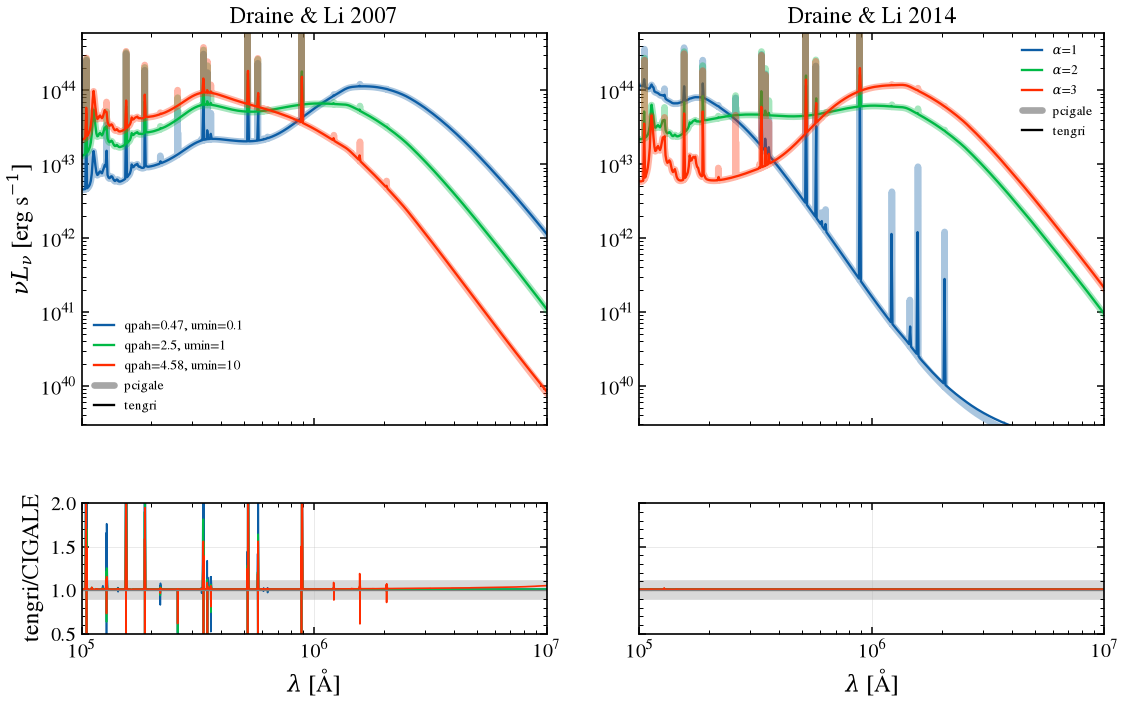
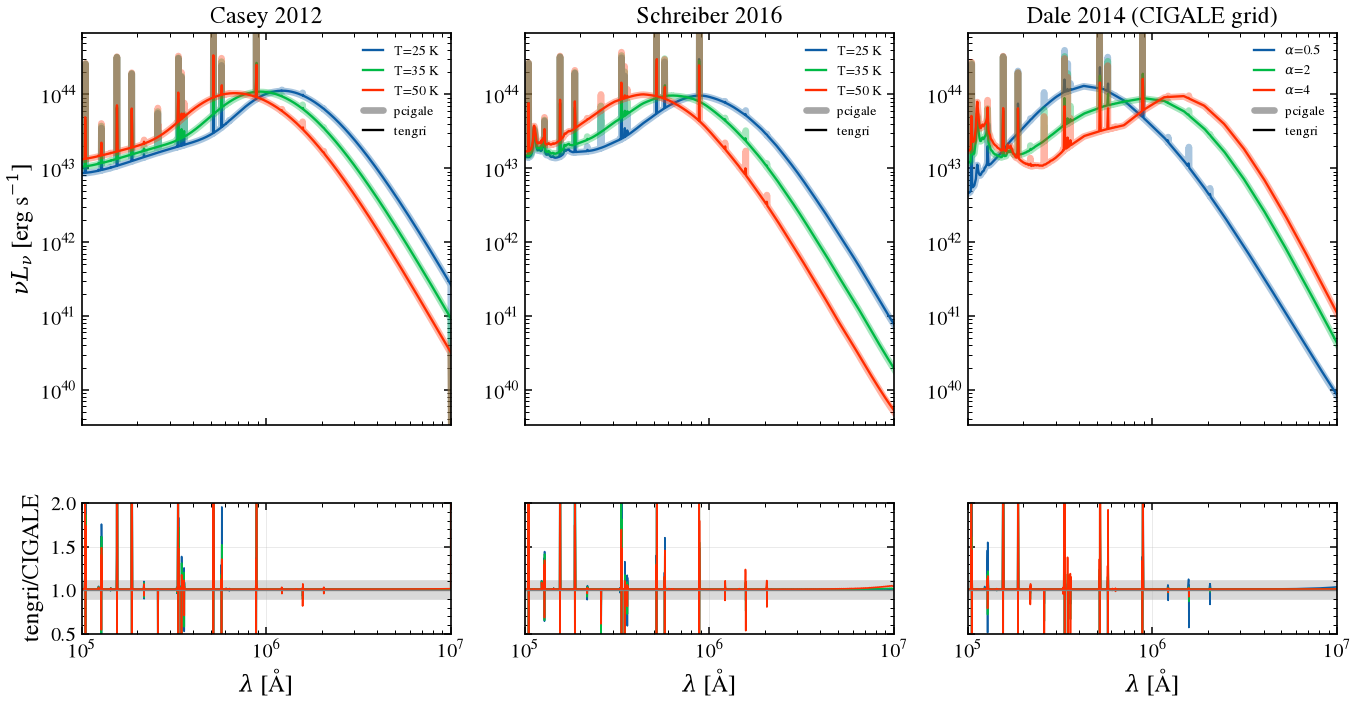
§6d Single-temperature dust: CIGALE mbb¶
CIGALE module mbb (epsilon_mbb = 1, beta_mbb = 1.5, energy balance on) ↔ tengri dust_emission={"type": "graybody"} with dust_beta_ir = 1.5 and dust_lambda_0_um = 200. CIGALE’s modified black body is the general-opacity form \((1 - e^{-(\lambda_0/\lambda)^\beta})\,\nu^3/(e^{h\nu/kT} - 1)\) with \(\lambda_0 = 200\ \mu\)m, normalized to the absorbed energy. tengri has two single-temperature emitters. graybody is that general-opacity form and is the one that
matches mbb. The tengri type named mbb (alias modified_blackbody) is the optically thin \(\nu^\beta B_\nu(T)\), a different spectrum that carries more flux per unit energy at 100–1000 μm: the name is shared and the model is not. Use graybody to reproduce CIGALE’s mbb.
The cell sets T = 25, 35 and 50 K on the §6c fiducial (1e11 M☉, single-screen Calzetti attenuation), so the absorbed-energy anchor of §6 sits under every ratio. The left panel overlays the two codes (pcigale as the wide band, tengri graybody as the line), the dotted line is tengri’s optically thin mbb, and the lower panel gives the ratios. The comparison is of dust emission alone, each code’s total minus its own twin without dust emission, as in §6c. The graybody medians over 8–1000
μm are 1.0108×, 1.0112× and 1.0114× at 25, 35 and 50 K, the same 1.1 % as the §6 anchor, with a worst filter of 1.015×, 1.015× and 1.016× and no band outside 5 %. The optically thin mbb has 8–1000 μm medians of 1.0465×, 1.0466× and 0.789×, and over 100–1000 μm 0.532×, 0.377× and 0.245×.
[17]:
from tengri.components.stellar.component import SFHBeyondOldestTemplateWarning

_T_MBB = (25.0, 35.0, 50.0)
_MBB_BETA = 1.5
_MBB_TENGRI = {
    "graybody": dict(
        T=Uniform(10.0, 80.0, default=35.0),
        beta_ir=Fixed(_MBB_BETA),
        lambda_0_um=Fixed(200.0),
    ),
    "mbb": dict(T=Uniform(10.0, 80.0, default=35.0), beta_ir=Fixed(_MBB_BETA)),
}
with warnings.catch_warnings():
    # The grid's oldest template (13.70 Gyr) is younger than the universe at z = 0, which sets
    # the warning; these galaxies are 5 Gyr old, so no star sits beyond the oldest template.
    warnings.simplefilter("ignore", SFHBeyondOldestTemplateWarning)
    _m_mbb = {_k: _knob_model(_k, **_kw) for _k, _kw in _MBB_TENGRI.items()}
_p_mbb = {_k: dict(_m.spec.sample(jax.random.PRNGKey(0))) for _k, _m in _m_mbb.items()}
# Dust emission alone: each code's total minus its own twin without dust emission (as §6c).
_w_twin_mbb_c, _L_twin_mbb_c = C.to_lnu(
    C.run_chain([_SFH_CHAIN, _BC03_CHAIN, NEB_FIDUCIAL_CIGALE, _DUSTATT_CHAIN])
)
_w_twin_mbb_t, _L_twin_mbb_t = _w_twin_t, _L_twin_t  # the "none" twin built in §6c

fig = plt.figure(figsize=(8, 5.6))
gs = fig.add_gridspec(2, 1, height_ratios=[3, 1], hspace=0.08)
ax = fig.add_subplot(gs[0])
ax_r = fig.add_subplot(gs[1], sharex=ax)
_peaks_mbb = []
_cases_mbb = []
print("§6d mbb, dust emission alone (tengri / CIGALE, median over 8-1000 µm and 100-1000 µm):")
for _T, _c in zip(_T_MBB, ["C0", "C1", "C3"]):
    _sed_mbb = C.run_chain(
        [
            _SFH_CHAIN,
            _BC03_CHAIN,
            NEB_FIDUCIAL_CIGALE,
            _DUSTATT_CHAIN,
            (
                "mbb",
                dict(epsilon_mbb=1.0, t_mbb=_T, beta_mbb=_MBB_BETA, energy_balance=True),
            ),
        ]
    )
    _w_c_raw, _L_c_tot = C.to_lnu(_sed_mbb)
    _L_c_dust = (_L_c_tot - U.regrid(_w_twin_mbb_c, _L_twin_mbb_c, _w_c_raw)) * _KNOB_MASS
    w_c, nl_c = _nu_lnu(_w_c_raw, _L_c_dust)
    ax.loglog(w_c, nl_c, color=_c, **_REF_KW)
    _row = {}
    for _kind, _ls in (("graybody", "-"), ("mbb", ":")):
        _o = _m_mbb[_kind].predict_rest_sed({**_p_mbb[_kind], "dust_T": jnp.float64(_T)})
        _w_t_raw = np.asarray(_o.wavelength)
        _L_t_dust = np.asarray(_o.sed) - U.regrid(_w_twin_mbb_t, _L_twin_mbb_t, _w_t_raw)
        w_t, nl_t = _nu_lnu(_w_t_raw, _L_t_dust)
        _rk = U.regrid(w_t, nl_t, w_c) / np.where(nl_c > 0, nl_c, np.nan)
        _row[_kind] = (_band_median(_rk, w_c, 8.0, 1000.0), _band_median(_rk, w_c, 100.0, 1000.0))
        _pos = (w_c >= 2e5) & (w_c > 0)
        ax_r.plot(w_c[_pos], _rk[_pos], color=_c, ls=_ls, linewidth=1.1)
        if _kind == "graybody":
            ax.loglog(w_t, nl_t, color=_c, lw=_TNG_LW, label=rf"T = {_T:g} K")
            _peaks_mbb.append(float(np.nanmax(nl_t)))
            _cases_mbb.append(
                (f"mbb T={_T:g} K (graybody, dust only)", _w_c_raw, _L_c_dust, _w_t_raw, _L_t_dust)
            )
        else:
            ax.loglog(w_t, nl_t, color=_c, lw=_TNG_LW, ls=":")
    print(
        f"    T={_T:g} K: graybody {_row['graybody'][0]:.4f}× / {_row['graybody'][1]:.4f}×; "
        f"optically thin mbb {_row['mbb'][0]:.4f}× / {_row['mbb'][1]:.4f}×"
    )
    assert 0.98 < _row["graybody"][0] < 1.04 and 0.98 < _row["graybody"][1] < 1.04, _row
ax.plot([], [], "k-", **_REF_KW, label="pcigale `mbb`")
ax.plot([], [], "k-", lw=_TNG_LW, label="tengri `graybody`")
ax.plot([], [], "k:", lw=_TNG_LW, label="tengri `mbb` (optically thin)")
ax.set(xlim=(2e5, 1e7), ylabel=r"$\nu L_\nu$ [erg s$^{-1}$]")
ax.set_ylim(max(_peaks_mbb) * 1e-3, max(_peaks_mbb) * 2.0)
ax.legend(fontsize=8, frameon=False, loc="lower center")
ax.tick_params(labelbottom=False)
ax_r.axhspan(0.9, 1.1, color="0.85", zorder=0)
ax_r.axhline(1.0, color="0.5", linewidth=0.8)
ax_r.set(xlim=(2e5, 1e7), ylim=(0.1, 3.0), xlabel=r"$\lambda$ [Å]", ylabel="tengri/CIGALE")
ax_r.set_yscale("log")
ax_r.set_yticks([0.2, 0.5, 1.0, 2.0])
ax_r.set_yticklabels(["0.2", "0.5", "1", "2"])
ax_r.minorticks_off()
ax_r.grid(True, alpha=0.3)
fig.tight_layout()
save_fig("cigale_06e_mbb_graybody.png")

for _label, _w_ref, _L_ref, _w_t, _L_t in _cases_mbb:
    _rows = V.filter_rows_native(
        np.asarray(_w_t), np.asarray(_L_t), _w_ref, _L_ref, filters=V.IR_BANDS
    )
    V.print_filter_table(_rows, ref_name="CIGALE", title=f"§6d {_label}", compact=True)
§6d mbb, dust emission alone (tengri / CIGALE, median over 8-1000 µm and 100-1000 µm):
    T=25 K: graybody 1.0108× / 1.0108×; optically thin mbb 1.0465× / 0.5316×
    T=35 K: graybody 1.0112× / 1.0112×; optically thin mbb 1.0466× / 0.3769×
    T=50 K: graybody 1.0114× / 1.0113×; optically thin mbb 0.7890× / 0.2454×
  §6d mbb T=25 K (graybody, dust only)                 median 1.011x  worst 1.015x  0/5 outside 5%
  §6d mbb T=35 K (graybody, dust only)                 median 1.011x  worst 1.015x  0/5 outside 5%
  §6d mbb T=50 K (graybody, dust only)                 median 1.011x  worst 1.016x  0/7 outside 5%
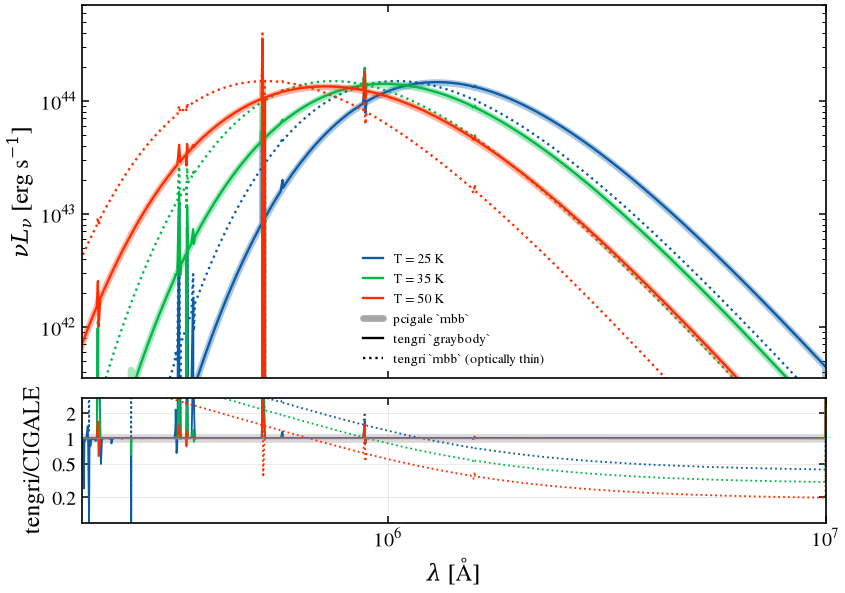
§7 Panchromatic SED¶
The §6 model from the Lyman continuum to 1 m: stellar SED convolved with the τ-delayed SFH, dust attenuation and Dale+2014 IR re-emission. X-ray and radio blocks arrive in §10 and §11.
Far-UV (λ < 912 Å). Calzetti+2000 was fit on 1200–22000 Å; tengri’s polynomial extrapolates below that, while CIGALE’s dustatt_modified_starburst drops to zero at 912 Å. Setting dust_attenuation={'lyman_cutoff': True} applies the same 912 Å clip on both sides.
Beyond 1 mm. Both Cue and CIGALE’s nebular modules carry thermal free-free into the radio, and this panel shows the comparison when both grids extend to 1 m (tengri with the nebular tail, CIGALE’s native reach). Both codes’ Dale 2014 templates end at 6 mm. The nebular continuum there is Q_H times a per-photon continuum, so its ratio is §3’s Q_H ratio times the Cue-against-Cloudy ratio per ionizing photon that §11b measures.
Bands. The ratios printed below are energy-weighted, ∫L_ν dν over each band. The 1250–3000 Å band starts at 1250 Å, outside the Lyα window: the SSPs’ Lyα region differs by a large factor between the two grids at a few points and would otherwise set the band.
[18]:
# Two panels on independent y-axes read as agreement whatever they contain,
# so the band-by-band ratio is printed beside them. The §6 model, seen from
# the Lyman continuum to the submillimeter.
_L_t_pan = U.regrid(np.asarray(s_ir.wave), np.asarray(s_ir.sed_intrinsic), w_c_ir)
# ``regrid`` zero-fills outside tengri's grid, and a zero divided by CIGALE's
# model is a ratio of 0.000 that reads as total disagreement rather than as
# "the model stops here". Count the points where *both* codes carry a model
# and say so, so the mm tail is reported as missing coverage and not as a
# residual.
_L_c_ir_floor = 1e-6 * L_c_ir.max()
_cov_pan = (L_c_ir > _L_c_ir_floor) & (_L_t_pan > 0)
print("§7 panchromatic energy-weighted ratio, ∫L_ν dν per band (tengri / CIGALE):")
for _lo, _hi, _wname in (
    (200.0, 912.0, "200–912 Å (LyC) "),
    (912.0, 1200.0, "912–1200 Å      "),
    (1250.0, 3000.0, "1250–3000 Å     "),
    (3000.0, 10000.0, "0.3–1 µm        "),
    (3.0e4, 8.0e4, "3–8 µm          "),
    (1.0e5, 1.0e6, "10–100 µm       "),
    (1.0e6, 1.0e7, "100–1000 µm     "),
):
    _band = (w_c_ir >= _lo) & (w_c_ir <= _hi)
    _n_c = int((_band & (L_c_ir > 0)).sum())
    _n_both = int((_band & _cov_pan).sum())
    if _n_both:
        print(
            f"    {_wname}: "
            f"{_band_energy_ratio(w_c_ir[_cov_pan], L_c_ir[_cov_pan], np.asarray(s_ir.wave), np.asarray(s_ir.sed_intrinsic), _lo, _hi):.4f}×  "
            f"({_n_both}/{_n_c} points where both grids carry a model)"
        )
    else:
        print(f"    {_wname}: tengri's grid does not reach this band ({_n_c} CIGALE points)")

fig, ax, ax_r, ratio = V.overlay_ratio_fig(
    w_c_ir,
    L_c_ir,
    np.asarray(s_ir.wave),
    np.asarray(s_ir.sed_intrinsic),
    xlabel=r"$\lambda$ [Å]",
    title="§7 panchromatic SED (τ=1 Gyr, age=5 Gyr, with Dale+2014 dust IR)",
    ref_label="pcigale",
    label_t="tengri",
    xlim=(1e2, 3e6),
)
ax.set_ylabel(r"$L_\nu$ [erg/s/Hz]")
fig.tight_layout()
fig.savefig(str(figs_dir / "cigale_07_panchromatic_full.png"), dpi=150, bbox_inches="tight")
plt.show()
§7 panchromatic energy-weighted ratio, ∫L_ν dν per band (tengri / CIGALE):
    200–912 Å (LyC) : tengri's grid does not reach this band (3 CIGALE points)
    912–1200 Å      : 1.0616×  (29/29 points where both grids carry a model)
    1250–3000 Å     : 1.0614×  (409/409 points where both grids carry a model)
    0.3–1 µm        : 1.0125×  (932/932 points where both grids carry a model)
    3–8 µm          : 1.0081×  (340/340 points where both grids carry a model)
    10–100 µm       : 1.0127×  (448/448 points where both grids carry a model)
    100–1000 µm     : 1.0118×  (375/375 points where both grids carry a model)
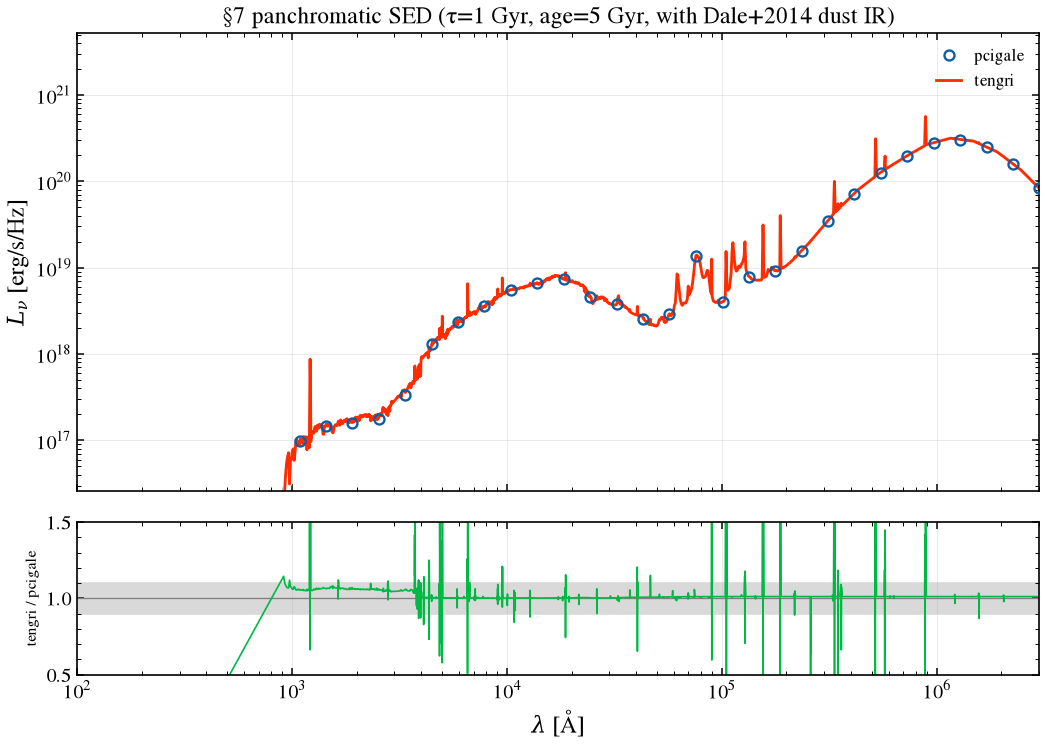
§8 Nebular emission¶
CIGALE uses static CLOUDY grids (pcigale.sed_modules.nebular). tengri uses Cue (Li et al. 2025), a neural emulator of the same physics that exposes logU, gas metallicity and IMF as continuous parameters. Cue requires the bare-stellar SSP this notebook loaded.
Fiducial choice: young population. Sections §3–§7 use a 5 Gyr quiescent τ=1 Gyr galaxy (Boquien+2019 reference), which has almost no ionizing budget. Nebular emission lives in stars ≲ 100 Myr old, so §8 swaps to a τ=300 Myr, age=100 Myr delayed SFH where Hα and the metal-line forest are physically strong. Only the SFH changes.
The two emitters see the same H II region: logU = −2.0, Z_gas = 0.02 (Cue’s neb_logZ_gas pinned to log10(0.02/Z_⊙) ≈ +0.149, the same absolute metallicity as CIGALE’s zgas = 0.02 and as the stars on both sides), f_esc = 0, n_H = 100 cm⁻³ (gas_logn = 2.0), solar N/O and C/O (gas_logno = gas_logco = 0). The Q_H reaching Cue is the integral of the SSP-convolved ionizing spectrum below 911.76 Å, published by the stellar component on every forward pass.
Read the ionizing budget before the line ratios. Every line scales with the Q_H handed to the emitter, so the cell prints Q_H first: CIGALE’s stellar.n_ly against tengri’s nion, both on the shared BC03 grid. There the ratio is §3’s age convention alone, 1.146× for this population. Both emitters see the same stellar population, and the lines are compared on that shared grid: tengri’s from Cue’s catalogue, which returns each line’s integrated luminosity independent of any wavelength
grid, and CIGALE’s from a window integral over its own line-resolved grid.
Raw ratios and ratios per ionizing photon. The raw line ratio contains Q_H; line / Q_H takes it out and leaves the emitter. Hα and Hβ are 1.12× raw, which is the 1.146× of Q_H less the emitter’s deficit, and 0.974× and 0.978× per photon: Cue’s Balmer emission per ionizing photon is 2–3 % below CIGALE’s Cloudy grid, a difference between two photoionization models. [O III] is 0.96× raw and 0.834× per photon.
[O III] and the U definition. Two conventions set the [O III] per photon, and neither is a normalization error. First, Cue’s ionizing spectrum enters as a shape fitted to the stellar population, and the fitted shape of this population is soft: §8b prints how strongly Cue’s [O III]/Hβ response to logU depends on it. Second, the two codes may not define the ionization parameter at the same radius. Cue’s neb_logU is \(U = Q_{\rm H}/(4\pi R_{\rm inner}^2 n_{\rm H} c)\) at the inner face
of the cloud, with \(R_{\rm inner}\) at the 10¹⁹ cm default of the Cue package’s logQ function (Li et al. 2025). CIGALE’s nebular module reads a precomputed Cloudy grid in logU, metallicity and density; the module’s documentation (its docstring and parameter text, pcigale 2025.1) does not state the radius at which logU is evaluated. Other nebular grids fix it elsewhere: Gutkin et al. (2016) define it at the Strömgren radius. The offset between such definitions depends on the cloud, so it
is not quantified here, and the same logU = −2 need not be the same nebula. The higher-ionization lines move the most.
Each line is quantified with the integrated luminosity (continuum-subtracted, width-independent), not a single-bin peak ratio, which would measure line width and grid resolution (CIGALE broadens to lines_width = 300 km/s) rather than physics.
Grid coverage. Cue’s native grid runs ~915 Å – 10⁸ Å, with a thermal free-free tail extending to 10¹⁰ Å (radio); CIGALE’s CLOUDY grid extends to far-IR fine-structure lines ([O III] 88 μm, [C II] 158 μm, [S III] 18.7 μm, [Ne III] 15.6 μm out to ~10⁶ Å), which is why the left panel shows line spikes the Cue panel does not. For a CLOUDY-vs-CLOUDY match, tengri exposes its own static grid via neb={'type': 'cloudy'} (data/cloudy_grid_*.h5, 166 lines to 6.1×10⁶ Å).
Verification Status: PARTIAL (1/10): Cue nebular emulator
[19]:
# §8 young fiducial: τ=300 Myr, age=100 Myr — Hα-bright. CIGALE accepts
# Myr values directly; tengri takes Gyr via tau_gyr/age_gyr.
_TAU_MAIN_YOUNG_MYR = 300
_AGE_MAIN_YOUNG_MYR = 100
_sfh_args = (
    "sfhdelayed",
    dict(
        tau_main=_TAU_MAIN_YOUNG_MYR,
        age_main=_AGE_MAIN_YOUNG_MYR,
        tau_burst=50,
        age_burst=20,
        f_burst=0.0,
        sfr_A=1.0,
        normalise=True,
    ),
)
sed_c_st = C.run_chain(
    [
        _sfh_args,
        ("bc03", dict(imf=1, metallicity=0.02, separation_age=10)),
    ]
)
w_c_st, L_c_st = C.to_lnu(sed_c_st)

sed_c_neb = C.run_chain(
    [
        _sfh_args,
        ("bc03", dict(imf=1, metallicity=0.02, separation_age=10)),
        (
            "nebular",
            dict(
                logU=-2.0,
                zgas=0.02,
                ne=100,
                f_esc=0.0,
                f_dust=0.0,
                lines_width=300.0,
                emission=True,
                line_list="",
            ),
        ),
    ]
)
w_c_neb, L_c_neb = C.to_lnu(sed_c_neb)

_neb_sfh_kw = {
    "type": "delayed",
    "tau_gyr": Fixed(_TAU_MAIN_YOUNG_MYR / 1000),
    "age_gyr": Fixed(_AGE_MAIN_YOUNG_MYR / 1000),
    "log_total_mass": Fixed(0.0),
    "all_params": Fixed(DEFAULT),
}

m_neb = SEDModel.build(
    ssp_data=ssp,
    met=MET_FIDUCIAL,
    sfh=_neb_sfh_kw,
    neb=NEB_FIDUCIAL_TENGRI,  # ionspec_* slopes stay at their SSP-derived Fixed values
    dust_attenuation={
        "law": "power_law",
        "type": "two_component",
        "tau_bc": Fixed(0.0),
        "tau_diff": Fixed(0.0),
        "all_params": Fixed(DEFAULT),
    },
    redshift=Fixed(0.0),
)
s_neb = m_neb.predict_state({})

fig, ax_l, ax_r = U.two_panel_fig()
U.panel(ax_l, ax_r, label_l="pcigale  CLOUDY nebular", label_r="tengri  Cue nebular (Li+2024)")
# CIGALE side — dashed stellar + solid (stellar+nebular) + dotted
# nebular-only (the line forest + smooth continuum that CLOUDY adds).
L_c_neb_only = np.maximum(L_c_neb - U.regrid(w_c_st, L_c_st, w_c_neb), 1e-30)
ax_l.plot(w_c_st, L_c_st, "k--", linewidth=1.0, alpha=0.5, label="stellar only")
ax_l.plot(w_c_neb, L_c_neb, "C0-", linewidth=1.4, alpha=0.7, label="stellar + CLOUDY nebular")
ax_l.plot(w_c_neb, L_c_neb_only, "C0:", linewidth=1.4, label="CLOUDY nebular only")
ax_l.legend(fontsize=8)
# tengri side — same three traces (stellar dashed, stellar+Cue solid,
# Cue-only dotted). Agreement is limited by the two emitters' Cloudy
# models (Cue: Cloudy 22.00), bare-stellar vs wNE-SSP path, and line-broadening kernel;
# see the integrated-line-luminosity ratio printed below.
# ``derived["sed_nebular"]`` publishes the photoionized continuum + lines
# directly, so the stellar-only trace is read off the same nebular-on build
# by subtracting it back out -- no separate stellar-only model needed (every
# build on this page carries the nebular fiducial; see Setup).
L_t_neb_only = np.maximum(np.asarray(s_neb.derived["sed_nebular"]), 1e-30)
_s_stellar_on_neb = np.maximum(np.asarray(s_neb.sed_intrinsic) - L_t_neb_only, 1e-30)
ax_r.plot(s_neb.wave, _s_stellar_on_neb, "k--", linewidth=1.0, alpha=0.5, label="stellar only")
ax_r.plot(s_neb.wave, s_neb.sed_intrinsic, "C1-", linewidth=1.4, alpha=0.7, label="stellar + Cue")
ax_r.plot(s_neb.wave, L_t_neb_only, "C1:", linewidth=1.4, label="Cue nebular only")
ax_r.legend(fontsize=8)
_xmin_n = float(min(w_c_neb.min(), float(np.asarray(s_neb.wave).min())))
_xmax_n = float(max(w_c_neb.max(), float(np.asarray(s_neb.wave).max())))
_ymax_n = max(float(L_c_neb.max()), float(np.asarray(s_neb.sed_intrinsic).max()))
for ax in (ax_l, ax_r):
    ax.set_xlim(_xmin_n, _xmax_n)
    ax.set_ylim(_ymax_n * 1e-6, _ymax_n * 2)
    ax.grid(True, alpha=0.3)
fig.tight_layout()
plt.close(fig)  # superseded by §8b's logU x Z_gas x f_esc grid, which replaces this panel

# Quantify the residual by integrated line luminosity (width- and grid-
# independent). A single-bin peak ratio measures line width, not luminosity:
# CIGALE broadens its lines (lines_width = 300 km/s) while Cue applies its own.
# Both emitters run on the shared BC03 SSP, so the only difference in the
# ionizing budget reaching them is §3's age convention.
def _tengri_line_lum(state, lo_aa: float, hi_aa: float) -> float:
    """Integrated luminosity [erg/s] of the catalogued Cue lines in [lo_aa, hi_aa] (vacuum Å).

    Cue returns each line's integrated luminosity directly, so the value does not
    depend on the wavelength grid of the SSP the model was built on. CIGALE's side
    is the window integral over its own line-resolved grid.
    """
    _lw = np.asarray(state.derived["line_waves"])
    _ll = np.asarray(state.derived["line_lums"])
    _sel = (_lw >= lo_aa) & (_lw <= hi_aa)
    assert _sel.any(), (lo_aa, hi_aa)
    return float(_ll[_sel].sum())


_LINE_WINDOWS = {  # centre [Å] -> (lo, hi) catalogue window
    6564.61: (6563.6, 6565.6),
    5008.24: (5007.2, 5009.2),
    4862.68: (4861.7, 4863.7),
    3728.48: (3726.0, 3730.5),  # the [O II] doublet, 3727.09 + 3729.87
}


# The ionizing budget first. Every line scales with the Q_H handed to the
# emitter, so a line ratio read without it cannot separate "different line
# physics" from "different number of ionizing photons". CIGALE publishes it
# as ``stellar.n_ly``; tengri as ``derived["nion"]``. Both sides form 1 M☉.
_n_ly_c = float(sed_c_neb.info["stellar.n_ly"])
_q_h_neb = float(np.asarray(s_neb.derived["nion"]))
print("§8 ionizing photon rate Q_H reaching the emitter [ph/s per M☉ formed]:")
print(f"    CIGALE  stellar.n_ly on BC03      {_n_ly_c:.4e}")
print(f"    tengri  nion on the shared BC03   {_q_h_neb:.4e}  → {_q_h_neb / _n_ly_c:.3f}×")

# Raw ratios and ratios per ionizing photon, side by side. Dividing each code's
# line by its own Q_H removes the Q_H term and leaves the emitter.
print("§8 integrated line luminosity, tengri Cue / CIGALE Cloudy, shared BC03 SSP:")
_neb_line_rows = {}
for _c, _name in [(6564.61, "Hα"), (5008.24, "[O III]"), (4862.68, "Hβ")]:
    _lc = U.line_lum(w_c_neb, L_c_neb_only, _c)
    _lt = _tengri_line_lum(s_neb, *_LINE_WINDOWS[_c])
    if _lc > 0:
        _neb_line_rows[_name] = (_lt / _lc, (_lt / _q_h_neb) / (_lc / _n_ly_c))
        print(
            f"    {_name} {_c:.0f} Å: CIGALE {_lc:.2e}, tengri {_lt:.2e} erg/s → "
            f"raw {_lt / _lc:.2f}×; per ionizing photon CIGALE {_lc / _n_ly_c:.3e}, "
            f"tengri {_lt / _q_h_neb:.3e} erg → {_neb_line_rows[_name][1]:.3f}×"
        )
    else:
        # Not skipped silently: an empty CIGALE window is a grid-resolution
        # failure of the measurement, not an absent line.
        print(f"    {_name} {_c:.0f} Å: CIGALE window holds < 2 grid points — not measurable here")
src/tengri/forward/sed_model.py:13601: SFHBeyondOldestTemplateWarning: The SSP grid's oldest template is 13.700 Gyr but the universe is 13.787 Gyr old at redshift 0. Stars formed in that gap are older than every template, so both age kernels assign them to the oldest one: the formed mass is conserved, and those stars carry the colors of a 13.700 Gyr population. Use a grid whose oldest template reaches 13.787 Gyr (e.g. MIST) to remove the approximation.
  return cls(
§8 ionizing photon rate Q_H reaching the emitter [ph/s per M☉ formed]:
    CIGALE  stellar.n_ly on BC03      2.5888e+45
    tengri  nion on the shared BC03   2.9656e+45  → 1.146×
§8 integrated line luminosity, tengri Cue / CIGALE Cloudy, shared BC03 SSP:
    Hα 6565 Å: CIGALE 3.68e+33, tengri 4.11e+33 erg/s → raw 1.12×; per ionizing photon CIGALE 1.423e-12, tengri 1.386e-12 erg → 0.974×
    [O III] 5008 Å: CIGALE 2.42e+33, tengri 2.31e+33 erg/s → raw 0.96×; per ionizing photon CIGALE 9.329e-13, tengri 7.783e-13 erg → 0.834×
    Hβ 4863 Å: CIGALE 1.29e+33, tengri 1.45e+33 erg/s → raw 1.12×; per ionizing photon CIGALE 4.989e-13, tengri 4.876e-13 erg → 0.978×
§8b logU × Z_gas × f_esc¶
Same young fiducial and shared BC03 SSP as above. logU ∈ {−3, −2, −1.5} at Z_gas = 0.02; Z_gas ∈ {0.004, 0.02, 0.041} (CIGALE’s nearest grid point to 0.04) at logU = −2; f_esc ∈ {0, 0.5} at the logU/Z_gas fiducial (7 cases). One tengri build with neb_logU, neb_logZ_gas, neb_fesc free, evaluated per case via predict_state; one CIGALE nebular call per case. Rows: Hα/Hβ, [O III]/Hβ, [O II]/Hβ, tengri and CIGALE side by side, and the absolute line / Q_H beneath each; a residual
here is Cue versus CLOUDY (§8), not a parity check.
Z_gas = 0.041 is degenerate in CIGALE and is not a comparison. CIGALE’s metallicity axis is a staircase: neighbouring Z nodes repeat the same model (the printed library table shows Z = 0.016, 0.019, 0.02 and 0.022 identical), and toward the high-Z end the library collapses: [O III]/Hβ is 0.0061 and [O II]/Hβ 0.0095 at Z = 0.041 and smaller beyond. The ratio-of-ratios is therefore reported at the six stable cases, with the 0.041 case printed beside it. The absolute Hβ per ionizing photon is flat to 3 % across every case in both codes, so the collapse is in the metal lines.
The f_esc rows test ratios, and ratios do not depend on f_esc. The absolute Hβ / Q_H does: both codes scale it by (1 − f)/(1 + 0.597 f), 0.385 at f = 0.5, which the cell asserts against each code’s own f = 0 value.
Reading the [O III]/Hβ response. neb_logU reaches Cue unchanged as its own ionization parameter. Cue’s [O III]/Hβ response to it depends on the ionizing spectrum Cue is fed. At the shape fitted to this population the ratio rises modestly with logU (1.154, 1.596, 1.663 in the table above, for logU = −3, −2, −1.5). A final cell evaluates the network at Cue’s own default (hard) young-starburst shape and prints the ratio for it, which rises much more steeply (3.416, 5.499, 6.085). The cell
shows that the response depends on the ionizing shape; it does not by itself reproduce CIGALE’s values, whose logU is defined at a different radius (§8).
[20]:
_m_8b = SEDModel.build(
    ssp_data=ssp,
    met=MET_FIDUCIAL,
    sfh=_neb_sfh_kw,
    neb={
        "type": "cue",
        "neb_logU": Uniform(-4.0, -1.0, default=-2.0),
        "neb_logZ_gas": Uniform(-1.0, 0.5, default=MET_LOGZSOL),
        "neb_fesc": Uniform(0.0, 1.0, default=0.0),
        "all_params": Fixed(DEFAULT),
    },
    dust_attenuation={
        "law": "power_law",
        "type": "two_component",
        "tau_bc": Fixed(0.0),
        "tau_diff": Fixed(0.0),
        "all_params": Fixed(DEFAULT),
    },
    redshift=Fixed(0.0),
)
_p_8b = dict(_m_8b.spec.sample(jax.random.PRNGKey(0)))

_8b_grid = [
    ("logU=-3", -3.0, 0.02, 0.0),
    ("logU=-2 (fid)", -2.0, 0.02, 0.0),
    ("logU=-1.5", -1.5, 0.02, 0.0),
    ("Zgas=0.004", -2.0, 0.004, 0.0),
    ("Zgas=0.041", -2.0, 0.041, 0.0),
    ("fesc=0", -2.0, 0.02, 0.0),
    ("fesc=0.5", -2.0, 0.02, 0.5),
]
_LINE_RATIOS_8B = (
    ("Ha/Hb", 6564.61, 4862.68),
    ("[OIII]/Hb", 5008.24, 4862.68),
    ("[OII]/Hb", 3728.48, 4862.68),  # center of the vacuum 3727.09 / 3729.88 doublet
)

_ABS_LINES_8B = (("Hb", 4862.68), ("[OIII]", 5008.24), ("[OII]", 3728.48))
_DEGENERATE_CASE_8B = "Zgas=0.041"  # CIGALE's grid collapses here; see the prose above

_rt_8b_all, _rc_8b_all, _at_8b_all, _ac_8b_all = [], [], [], []
print("§8b logU × Z_gas × f_esc (7 cases): line ratios to Hβ, then absolute line / Q_H.")
for _label, _logU, _zgas, _fesc in _8b_grid:
    _sed_c8b = C.run_chain(
        [
            _sfh_args,
            ("bc03", dict(imf=1, metallicity=0.02, separation_age=10)),
            (
                "nebular",
                dict(
                    logU=_logU,
                    zgas=_zgas,
                    ne=100,
                    f_esc=_fesc,
                    f_dust=0.0,
                    lines_width=300.0,
                    emission=True,
                    line_list="",
                ),
            ),
        ]
    )
    _w_c8b, _L_c8b_full = C.to_lnu(_sed_c8b)
    _L_c8b_st = U.regrid(w_c_st, L_c_st, _w_c8b)
    _L_c8b_neb = np.maximum(_L_c8b_full - _L_c8b_st, 1e-30)

    _logzgas_8b = float(np.log10(_zgas) - LOG10_ZSUN)
    _st_8b = _m_8b.predict_state(
        {
            **_p_8b,
            "neb_logU": jnp.float64(_logU),
            "neb_logZ_gas": jnp.float64(_logzgas_8b),
            "neb_fesc": jnp.float64(_fesc),
        }
    )
    _q_t8b = float(np.asarray(_st_8b.derived["nion"]))
    _q_c8b = float(_sed_c8b.info["stellar.n_ly"])

    _rt, _rc, _at, _ac = {}, {}, {}, {}
    for _name, _num, _den in _LINE_RATIOS_8B:
        _lt_n = _tengri_line_lum(_st_8b, *_LINE_WINDOWS[_num])
        _lt_d = _tengri_line_lum(_st_8b, *_LINE_WINDOWS[_den])
        _lc_n, _lc_d = U.line_lum(_w_c8b, _L_c8b_neb, _num), U.line_lum(_w_c8b, _L_c8b_neb, _den)
        _rt[_name] = _lt_n / _lt_d if _lt_d > 0 else float("nan")
        _rc[_name] = _lc_n / _lc_d if _lc_d > 0 else float("nan")
    for _name, _wl in _ABS_LINES_8B:
        _at[_name] = _tengri_line_lum(_st_8b, *_LINE_WINDOWS[_wl]) / _q_t8b
        _ac[_name] = U.line_lum(_w_c8b, _L_c8b_neb, _wl) / _q_c8b
    _flag = "  [CIGALE grid collapsed: degenerate]" if _label == _DEGENERATE_CASE_8B else ""
    print(
        f"    {_label:<14} tengri Ha/Hb {_rt['Ha/Hb']:.3f}, [OIII]/Hb {_rt['[OIII]/Hb']:.3f}, "
        f"[OII]/Hb {_rt['[OII]/Hb']:.3f}  |  CIGALE Ha/Hb {_rc['Ha/Hb']:.3f}, "
        f"[OIII]/Hb {_rc['[OIII]/Hb']:.3f}, [OII]/Hb {_rc['[OII]/Hb']:.3f}{_flag}"
    )
    print(
        "    " + " " * 14 + " line/Q_H [1e-13 erg], tengri | CIGALE: "
        + ", ".join(f"{_n} {_at[_n] * 1e13:.3f} | {_ac[_n] * 1e13:.3f}" for _n, _ in _ABS_LINES_8B)
    )
    _rt_8b_all.append(_rt)
    _rc_8b_all.append(_rc)
    _at_8b_all.append(_at)
    _ac_8b_all.append(_ac)

# The ratio-of-ratios is reported at the stable nodes only; the degenerate
# Z_gas = 0.041 case is printed beside it so the reader sees what is excluded.
_stable_8b = [i for i, g in enumerate(_8b_grid) if g[0] != _DEGENERATE_CASE_8B]
_degen_8b = [i for i, g in enumerate(_8b_grid) if g[0] == _DEGENERATE_CASE_8B][0]
for _name, _, _ in _LINE_RATIOS_8B:
    _rr_all = [_t[_name] / _c[_name] for _t, _c in zip(_rt_8b_all, _rc_8b_all)]
    _j = max(_stable_8b, key=lambda i: abs(np.log(_rr_all[i])))
    print(
        f"§8b {_name}: largest tengri/CIGALE ratio-of-ratios over the six stable cases "
        f"{_rr_all[_j]:.2f}× at {_8b_grid[_j][0]}; at the degenerate {_DEGENERATE_CASE_8B} "
        f"{_rr_all[_degen_8b]:.2f}×"
    )

# The f_esc rows test ratios, which f_esc leaves untouched. The absolute Hβ per
# ionizing photon tests f_esc itself: each code's Hβ/Q_H at f_esc = 0.5 over its
# own value at f_esc = 0 against the closed form (1 - f)/(1 + 0.597 f).
_k_fesc = (1.0 - 0.5) / (1.0 + 0.597 * 0.5)
_i0 = [g[0] for g in _8b_grid].index("fesc=0")
_i5 = [g[0] for g in _8b_grid].index("fesc=0.5")
_k_t = _at_8b_all[_i5]["Hb"] / _at_8b_all[_i0]["Hb"]
_k_c = _ac_8b_all[_i5]["Hb"] / _ac_8b_all[_i0]["Hb"]
print(
    f"§8b Hβ/Q_H at f_esc = 0.5 over f_esc = 0: tengri {_k_t:.4f}, CIGALE {_k_c:.4f}; "
    f"(1 - f)/(1 + 0.597 f) = {_k_fesc:.4f}"
)
assert abs(_k_t / _k_fesc - 1.0) < 0.01 and abs(_k_c / _k_fesc - 1.0) < 0.01

# CIGALE's metallicity axis, read straight from its line library at logU = -2,
# n_e = 100 cm^-3: neighbouring Z nodes repeat the same model, which is why the
# 0.041 case above is not a point on a smooth curve.
from pcigale.data import SimpleDatabase as _CigaleLineDB

print("§8b CIGALE nebular line library, Z axis at logU = -2, n_e = 100 cm^-3:")
with _CigaleLineDB("nebular_lines") as _line_db:
    for _z in (0.014, 0.016, 0.019, 0.02, 0.022, 0.025, 0.03, 0.033, 0.037, 0.041, 0.046):
        _rec = _line_db.get(Z=_z, logU=-2.0, ne=100.0)
        _d = {str(n): v for n, v in zip(_rec.name, _rec.spec)}
        print(
            f"    Z = {_z:<6g} Hβ {_d['H-beta']:.4e}  [O III] 500.7/Hβ "
            f"{_d['OIII-500.7'] / _d['H-beta']:.4f}  [O II] 372.6+372.9/Hβ "
            f"{(_d['OII-372.6'] + _d['OII-372.9']) / _d['H-beta']:.4f}"
        )

fig, (ax_l, ax_r) = plt.subplots(1, 2, figsize=(11, 4.2), sharey=True)
_x_8b = np.arange(len(_8b_grid))
for _ax, _rows, _title in (
    (ax_l, _rc_8b_all, "CIGALE (CLOUDY)"),
    (ax_r, _rt_8b_all, "tengri (Cue)"),
):
    for _name, _color in zip(("Ha/Hb", "[OIII]/Hb", "[OII]/Hb"), ("C0", "C1", "C3")):
        _ax.plot(_x_8b, [r[_name] for r in _rows], "o-", color=_color, label=_name)
    _ax.set_xticks(_x_8b)
    _ax.set_xticklabels([g[0] for g in _8b_grid], rotation=60, fontsize=8)
    _ax.set_title(_title)
    _ax.set_yscale("log")
    _ax.grid(True, alpha=0.3)
ax_l.set_ylabel("line ratio (to Hβ)")
ax_l.legend(fontsize=8)
fig.suptitle("§8b logU × Z_gas × f_esc — line ratios")
fig.tight_layout()
save_fig("cigale_08b_neb_grid.png")
src/tengri/forward/sed_model.py:13601: SFHBeyondOldestTemplateWarning: The SSP grid's oldest template is 13.700 Gyr but the universe is 13.787 Gyr old at redshift 0. Stars formed in that gap are older than every template, so both age kernels assign them to the oldest one: the formed mass is conserved, and those stars carry the colors of a 13.700 Gyr population. Use a grid whose oldest template reaches 13.787 Gyr (e.g. MIST) to remove the approximation.
  return cls(
§8b logU × Z_gas × f_esc (7 cases): line ratios to Hβ, then absolute line / Q_H.
    logU=-3        tengri Ha/Hb 2.819, [OIII]/Hb 1.154, [OII]/Hb 2.655  |  CIGALE Ha/Hb 2.861, [OIII]/Hb 0.559, [OII]/Hb 0.627
                   line/Q_H [1e-13 erg], tengri | CIGALE: Hb 4.787 | 4.911, [OIII] 5.523 | 2.747, [OII] 12.709 | 3.080
    logU=-2 (fid)  tengri Ha/Hb 2.841, [OIII]/Hb 1.596, [OII]/Hb 0.880  |  CIGALE Ha/Hb 2.852, [OIII]/Hb 1.870, [OII]/Hb 0.322
                   line/Q_H [1e-13 erg], tengri | CIGALE: Hb 4.876 | 4.989, [OIII] 7.783 | 9.329, [OII] 4.289 | 1.604
    logU=-1.5      tengri Ha/Hb 2.847, [OIII]/Hb 1.663, [OII]/Hb 0.577  |  CIGALE Ha/Hb 2.849, [OIII]/Hb 2.309, [OII]/Hb 0.148
                   line/Q_H [1e-13 erg], tengri | CIGALE: Hb 4.888 | 5.012, [OIII] 8.128 | 11.569, [OII] 2.822 | 0.742
    Zgas=0.004     tengri Ha/Hb 2.774, [OIII]/Hb 4.882, [OII]/Hb 1.372  |  CIGALE Ha/Hb 2.769, [OIII]/Hb 8.040, [OII]/Hb 0.681
                   line/Q_H [1e-13 erg], tengri | CIGALE: Hb 4.774 | 4.872, [OIII] 23.307 | 39.172, [OII] 6.551 | 3.318
    Zgas=0.041     tengri Ha/Hb 2.917, [OIII]/Hb 0.120, [OII]/Hb 0.475  |  CIGALE Ha/Hb 2.989, [OIII]/Hb 0.006, [OII]/Hb 0.011  [CIGALE grid collapsed: degenerate]
                   line/Q_H [1e-13 erg], tengri | CIGALE: Hb 4.894 | 5.012, [OIII] 0.588 | 0.032, [OII] 2.324 | 0.054
    fesc=0         tengri Ha/Hb 2.841, [OIII]/Hb 1.596, [OII]/Hb 0.880  |  CIGALE Ha/Hb 2.852, [OIII]/Hb 1.870, [OII]/Hb 0.322
                   line/Q_H [1e-13 erg], tengri | CIGALE: Hb 4.876 | 4.989, [OIII] 7.783 | 9.329, [OII] 4.289 | 1.604
    fesc=0.5       tengri Ha/Hb 2.841, [OIII]/Hb 1.596, [OII]/Hb 0.880  |  CIGALE Ha/Hb 2.842, [OIII]/Hb 1.865, [OII]/Hb 0.323
                   line/Q_H [1e-13 erg], tengri | CIGALE: Hb 1.878 | 1.927, [OIII] 2.997 | 3.593, [OII] 1.652 | 0.622
§8b Ha/Hb: largest tengri/CIGALE ratio-of-ratios over the six stable cases 0.99× at logU=-3; at the degenerate Zgas=0.041 0.98×
§8b [OIII]/Hb: largest tengri/CIGALE ratio-of-ratios over the six stable cases 2.06× at logU=-3; at the degenerate Zgas=0.041 18.87×
§8b [OII]/Hb: largest tengri/CIGALE ratio-of-ratios over the six stable cases 4.23× at logU=-3; at the degenerate Zgas=0.041 44.38×
§8b Hβ/Q_H at f_esc = 0.5 over f_esc = 0: tengri 0.3851, CIGALE 0.3862; (1 - f)/(1 + 0.597 f) = 0.3851
§8b CIGALE nebular line library, Z axis at logU = -2, n_e = 100 cm^-3:
    Z = 0.014  Hβ 4.9431e-20  [O III] 500.7/Hβ 3.0165  [O II] 372.6+372.9/Hβ 0.5168
    Z = 0.016  Hβ 4.9694e-20  [O III] 500.7/Hβ 1.8741  [O II] 372.6+372.9/Hβ 0.3196
    Z = 0.019  Hβ 4.9694e-20  [O III] 500.7/Hβ 1.8741  [O II] 372.6+372.9/Hβ 0.3196
    Z = 0.02   Hβ 4.9694e-20  [O III] 500.7/Hβ 1.8741  [O II] 372.6+372.9/Hβ 0.3196
    Z = 0.022  Hβ 4.9694e-20  [O III] 500.7/Hβ 1.8741  [O II] 372.6+372.9/Hβ 0.3196
    Z = 0.025  Hβ 4.9797e-20  [O III] 500.7/Hβ 0.7816  [O II] 372.6+372.9/Hβ 0.1400
    Z = 0.03   Hβ 4.9797e-20  [O III] 500.7/Hβ 0.7816  [O II] 372.6+372.9/Hβ 0.1400
    Z = 0.033  Hβ 4.9877e-20  [O III] 500.7/Hβ 0.1878  [O II] 372.6+372.9/Hβ 0.0407
    Z = 0.037  Hβ 4.9877e-20  [O III] 500.7/Hβ 0.1878  [O II] 372.6+372.9/Hβ 0.0407
    Z = 0.041  Hβ 4.9923e-20  [O III] 500.7/Hβ 0.0061  [O II] 372.6+372.9/Hβ 0.0095
    Z = 0.046  Hβ 4.9751e-20  [O III] 500.7/Hβ 0.0005  [O II] 372.6+372.9/Hβ 0.0008
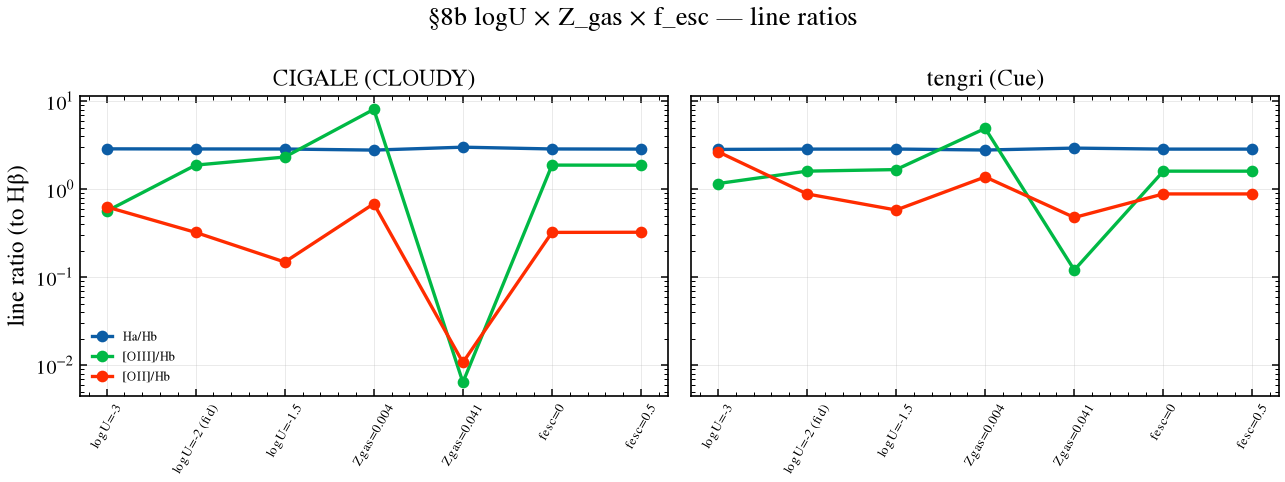
[21]:
# Cue's [O III]/Hβ response to logU at Cue's own default (hard) young-starburst
# ionizing shape, from the same network `neb_logU` feeds. Only the ionizing
# spectrum differs from the table above. Density (`gas_logn`) and `gas_logqion` are
# left at Cue's own defaults (`gas_logn = 2.0`, the value the table uses;
# `default_gas_logqion = 49.1`), and Z_gas is the table's 0.02.
from tengri._data_setup import data_path as _data_path
from tengri.components.nebular.cue import CueBackend

_cue_hard = CueBackend(str(_data_path("cue_weights.npz")))
_HARD_SHAPE = dict(CueBackend._IONSPEC_DEFAULTS)


def _catalog_line(wave, lum, center_vac, tol=2.0):
    """Luminosity of the catalogued line nearest ``center_vac`` (vacuum Å)."""
    i = int(np.argmin(np.abs(wave - center_vac)))
    assert abs(wave[i] - center_vac) < tol, (center_vac, wave[i])
    return lum[i]


_o3_hard = {}
for _logU in (-3.0, -2.0, -1.5):
    _w_h, _l_h = _cue_hard.predict_nebular_line_luminosities(
        gas_logu=_logU,
        gas_logz=float(np.log10(0.02) - LOG10_ZSUN),
        **_HARD_SHAPE,
    )
    _w_h, _l_h = np.asarray(_w_h), np.asarray(_l_h)
    _o3_hard[_logU] = _catalog_line(_w_h, _l_h, 5008.24) / _catalog_line(_w_h, _l_h, 4862.68)
print(
    "§8b Cue [OIII]/Hb at Cue's default hard shape, logU = -3 / -2 / -1.5: "
    + " / ".join(f"{_o3_hard[k]:.3f}" for k in (-3.0, -2.0, -1.5))
)
§8b Cue [OIII]/Hb at Cue's default hard shape, logU = -3 / -2 / -1.5: 3.416 / 5.499 / 6.085
§9 AGN¶
CIGALE module skirtor2016 ↔ tengri agn={"type": "composable", "disc": schartmann2005, "torus": skirtor, "atten": polar_dust} at the SKIRTOR fiducial (i = 30°, τ_9.7 = 7, oa = 40°, p = q = 1). The figure overlays the stellar + dust + AGN SEDs of the two codes; §9c prints the disc, torus and polar-dust luminosities separately.
Disc. disc.schartmann2005 matches CIGALE’s skirtor2016 disk_type=1 default: the Schartmann (2005) piecewise power law with the 1200 Å bend that CIGALE substitutes for the FITS-bundled disc. tengri also ships disc.skirtor (CIGALE disk_type=0, §9b) and disc.adaf_lopez2024 (disk_type=2). For a differentiable (M_BH, ṁ, spin) disc use disc={"type": "multicolor", ...}; its UV continuum differs from CIGALE’s, so this notebook uses disc.schartmann2005.
Three components, and all three have to be selected. CIGALE’s skirtor2016 emits a disc, a torus and a Casey-2012 polar-dust graybody, and publishes them separately. tengri’s composable AGN has the same three, but the polar graybody is a standalone atten block, and derived["sed_agn_polar"] is a zeros array whenever the block is not selected. The build names all three at CIGALE’s defaults (oa = 40°, τ_9.7 = 7, p = q = 1, i = 30°, agn_polar_ebv = 0.03, T = 100 K, β = 1.6).
Inclination and polar cone. agn_cos_inc is the one inclination of every torus (cos 30° here). The polar cone shares the opening angle of the selected torus (agn_oa_skirtor), so the cone’s share of the disc follows the torus geometry.
Polar-dust extinction law. CIGALE’s law=0 is the Bongiorno et al. (2012) power law k = 1.39 (λ/μm)^−1.2 above 100 nm, with the SMC-bar shape of Weingartner & Draine (2001) below it. tengri’s polar_law="bongiorno" is that curve and is what the builds here use. tengri’s default, polar_law="smc" (Pei 1992), is a different curve; §9d prints how far apart they are.
The polar component is disc-shaped by construction. Both codes set its luminosity from g(oa) × ∫ disc(1 − e^−τ_polar) dλ, the disc’s own spectrum seen through the polar screen, so it moves with the disc’s UV shape even at fixed oa, agn_polar_ebv, T and β. §9c and §9b print each code’s polar share of its own AGN dust budget beside the component ratios: pcigale’s share moves between its two disc types, and tengri’s moves with it.
Energy-balance normalization. CIGALE ties disc, torus and polar dust to a single agn_power reference through the fixed SKIRTOR template ratios. tengri’s default agn_norm='cigale_joint' does the same: the tie sets the disc (below the library’s 10 Å edge it takes the library ratio times the X-ray transmission, §9f; a corona, when the disc block carries one, rides on top; the Schartmann disc has none), with the disc set to agn_power × R, where R = η(i)·∫disc/∫dust and
η(i) = cos i (1+2cos i)/3 is the Stalevski+2016 anisotropy factor. With agn_ir_frac set, agn_power is derived from L_absorbed × f/(1−f), as CIGALE derives it from fracAGN, so §6’s energy anchor enters the AGN normalization too. agn_log_lbol, the angle-integrated accretion power, is then not a free input: setting both is two statements of one power, and the build refuses it. Use agn_norm='independent' and agn_log_lbol for a model with no agn_ir_frac. To keep
agn_log_lbol as the AGN power and still state an AGN dust fraction, use agn_norm='conserving': there agn_ir_frac sets only the covering factor agn_torus_frac. The torus re-emits that share of the accretion power and the disc keeps the rest, so the pieces add up to agn_log_lbol. The AGN dust is the fraction f of the total (or of the light in ir_frac_window) wherever the accretion power can supply it. A covering factor cannot pass 1, so a total fraction above
r L_bol / (r L_bol + L_absorbed) is out of reach (r = agn_lum_ratio); there the torus covers the whole disc, agn_ir_frac_saturated is 1 and agn_ir_frac_realized gives the fraction the model reaches.
Verification Status: CROSSVAL: SKIRTOR torus (mean 3-param)
[22]:
# CIGALE's polar dust (`law=0`, E(B-V) = 0.03) is tengri's `polar_dust` block with
# `polar_law="bongiorno"`; the default `polar_law="smc"` is Pei (1992), a
# different curve (§9d prints the difference).
_POLAR_DUST_BLOCK = {
    "type": "polar_dust",
    "polar_law": "bongiorno",
    "agn_polar_ebv": Fixed(0.03),
    "all_params": Fixed(DEFAULT),
}
_sfh_args_d = (
    "sfhdelayed",
    dict(
        tau_main=1000,
        age_main=5000,
        tau_burst=50,
        age_burst=20,
        f_burst=0.0,
        sfr_A=1.0,
        normalise=True,
    ),
)
sed_c_base = C.run_chain(
    [
        _sfh_args_d,
        ("bc03", dict(imf=1, metallicity=0.02, separation_age=10)),
        NEB_FIDUCIAL_CIGALE,
        ("dustatt_modified_starburst", dict(E_BV_lines=0.3)),
    ]
)
w_base, L_base = C.to_lnu(sed_c_base)

m_agn_base = SEDModel.build(
    ssp_data=ssp,
    met=MET_FIDUCIAL,
    sfh={
        "type": "delayed",
        "tau_gyr": Fixed(1.0),
        "age_gyr": Fixed(5.0),
        "log_total_mass": Fixed(0.0),
        "all_params": Fixed(DEFAULT),
    },
    dust_attenuation={
        "type": "two_component",
        "law_bc": "leitherer02",
        "law_diff": "leitherer02",
        "tau_bc": Fixed(TAU_BC_FIDUCIAL),
        "tau_diff": Fixed(TAU_DIFF_FIDUCIAL),
        # Match CIGALE's dustatt_modified_starburst, which drops to zero at the
        # Lyman limit; §7/§11 do the same. Without it the Calzetti/Leitherer
        # polynomial extrapolates below 912 Å and the stellar+dust baseline
        # sits above CIGALE in the far-UV, muddying the AGN comparison.
        "lyman_cutoff": True,
        "all_params": Fixed(DEFAULT),
    },
    neb=NEB_FIDUCIAL_TENGRI,
    redshift=Fixed(0.0),
)
s_agn_base = m_agn_base.predict_state({})

# Full SED with and without AGN on both sides — clearer than the
# differential plot when one side has X-ray + the other doesn't.
sed_skirtor = C.run_chain(
    [
        _sfh_args_d,
        ("bc03", dict(imf=1, metallicity=0.02, separation_age=10)),
        NEB_FIDUCIAL_CIGALE,
        ("dustatt_modified_starburst", dict(E_BV_lines=0.3)),
        (
            "skirtor2016",
            dict(
                t=7,
                pl=1.0,
                q=1.0,
                oa=40,
                R=20,
                Mcl=0.97,
                i=30,
                disk_type=1,
                delta=0,
                fracAGN=0.3,
                lambda_fracAGN="0/0",
                law=0,
                EBV=0.03,
                temperature=100.0,
                emissivity=1.6,
            ),
        ),
    ]
)
w_skirt, L_skirt = C.to_lnu(sed_skirtor)

m_agn = SEDModel.build(
    ssp_data=ssp,
    met=MET_FIDUCIAL,
    sfh={
        "type": "delayed",
        "tau_gyr": Fixed(1.0),
        "age_gyr": Fixed(5.0),
        "log_total_mass": Fixed(0.0),
        "all_params": Fixed(DEFAULT),
    },
    dust_attenuation={
        "type": "two_component",
        "law_bc": "leitherer02",
        "law_diff": "leitherer02",
        "tau_bc": Fixed(TAU_BC_FIDUCIAL),
        "tau_diff": Fixed(TAU_DIFF_FIDUCIAL),
        # Match CIGALE's dustatt_modified_starburst, which drops to zero at the
        # Lyman limit; §7/§11 do the same. Without it the Calzetti/Leitherer
        # polynomial extrapolates below 912 Å and the stellar+dust baseline
        # sits above CIGALE in the far-UV, muddying the AGN comparison.
        "lyman_cutoff": True,
        "all_params": Fixed(DEFAULT),
    },
    # tengri's AGN defaults match CIGALE skirtor2016's (oa=40, tau=7, p=q=1,
    # i=30, EBV=0.03, T=100, β=1.6, disk_type=1 → ``disc.schartmann2005``),
    # except the polar-dust law, set in ``_POLAR_DUST_BLOCK``.
    agn={
        "type": "composable",
        "disc": {"type": "schartmann2005", "all_params": Fixed(DEFAULT)},
        "torus": {"type": "skirtor", "all_params": Fixed(DEFAULT)},
        # The Casey-2012 polar-dust graybody is its own attenuation block, not
        # part of the torus: without this entry ``derived["sed_agn_polar"]`` is
        # zeros. ``agn_polar_ebv = 0.03``, T = 100 K and β = 1.6 are CIGALE's
        # skirtor2016 defaults on both sides.
        "atten": _POLAR_DUST_BLOCK,
        # ``agn_ir_frac = 0.3`` mirrors CIGALE's ``fracAGN`` parameter.
        # tengri's AGN component reads ``state.derived["L_absorbed"]``
        # and computes ``agn_power = L_abs × frac/(1-frac)`` exactly
        # like CIGALE ``skirtor2016.py:498`` (lambda_fracAGN="0/0")
        # via cross-component energy coupling. That coupling *is* the AGN
        # power here, so there is no ``agn_log_lbol`` to set: the two
        # together are a contradiction the build refuses.
        "agn_ir_frac": Fixed(0.3),
        "all_params": Fixed(DEFAULT),
    },
    neb=NEB_FIDUCIAL_TENGRI,
    redshift=Fixed(0.0),
)
s_agn = m_agn.predict_state({})

fig, ax_l, ax_r = U.two_panel_fig()
U.panel(
    ax_l,
    ax_r,
    label_l="pcigale  + SKIRTOR2016 (i = 30°, τ_9.7 = 7)",
    label_r="tengri  agn[schartmann disc + skirtor torus + polar BB]",
)
# CIGALE side — full chain (stellar+dust dashed, full +SKIRTOR solid,
# AGN-only differential to show what SKIRTOR adds).
L_skirt_only = np.maximum(L_skirt - U.regrid(w_base, L_base, w_skirt), 1e-50)
ax_l.plot(w_base, L_base, "k--", linewidth=1.0, alpha=0.5, label="stellar + dust")
ax_l.plot(w_skirt, L_skirt, "C0-", linewidth=1.5, alpha=0.7, label="stellar + dust + SKIRTOR")
ax_l.plot(w_skirt, L_skirt_only, "C0:", linewidth=1.5, label="SKIRTOR component only")
ax_l.legend(fontsize=9)
ax_l.grid(True, alpha=0.3)
# tengri side — same three-line layout. ``derived['sed_agn']`` carries
# the disc + torus contribution; ``sed_intrinsic`` is the full SED with
# everything; dashed baseline is the no-AGN build.
L_t_agn_only = np.maximum(np.asarray(s_agn.derived["sed_agn"]), 1e-50)
ax_r.plot(
    s_agn_base.wave,
    s_agn_base.sed_intrinsic,
    "k--",
    linewidth=1.0,
    alpha=0.5,
    label="stellar + dust",
)
ax_r.plot(
    s_agn.wave, s_agn.sed_intrinsic, "C1-", linewidth=1.5, alpha=0.7, label="stellar + dust + AGN"
)
ax_r.plot(
    s_agn.wave, L_t_agn_only, "C1:", linewidth=1.5, label="composable disc + SKIRTOR torus only"
)
ax_r.legend(fontsize=9)
ax_r.grid(True, alpha=0.3)

# Bound both axes to the same windows so the panels are visually
# comparable. Without explicit ``set_xlim``, matplotlib auto-scales
# each panel to its widest trace's native grid — the no-AGN baseline
# (SSP grid, 91 Å – 160 µm) is shorter than the +AGN trace (SKIRTOR
# grid extends X-ray and FIR), so the two panels would show different
# x-spans for reasons that look like data but are really cosmetics.
_xmin_a = float(min(w_skirt.min(), float(np.asarray(s_agn.wave).min())))
_xmax_a = float(max(w_skirt.max(), float(np.asarray(s_agn.wave).max())))
_ymax_a = max(float(np.asarray(L_skirt).max()), float(np.asarray(s_agn.sed_intrinsic).max()))
for ax in (ax_l, ax_r):
    ax.set_xlim(_xmin_a, _xmax_a)
    ax.set_ylim(_ymax_a * 1e-6, _ymax_a * 2)

fig.tight_layout()
save_fig("cigale_09_agn_skirtor.png")
src/tengri/forward/sed_model.py:13601: SFHBeyondOldestTemplateWarning: The SSP grid's oldest template is 13.700 Gyr but the universe is 13.787 Gyr old at redshift 0. Stars formed in that gap are older than every template, so both age kernels assign them to the oldest one: the formed mass is conserved, and those stars carry the colors of a 13.700 Gyr population. Use a grid whose oldest template reaches 13.787 Gyr (e.g. MIST) to remove the approximation.
  return cls(
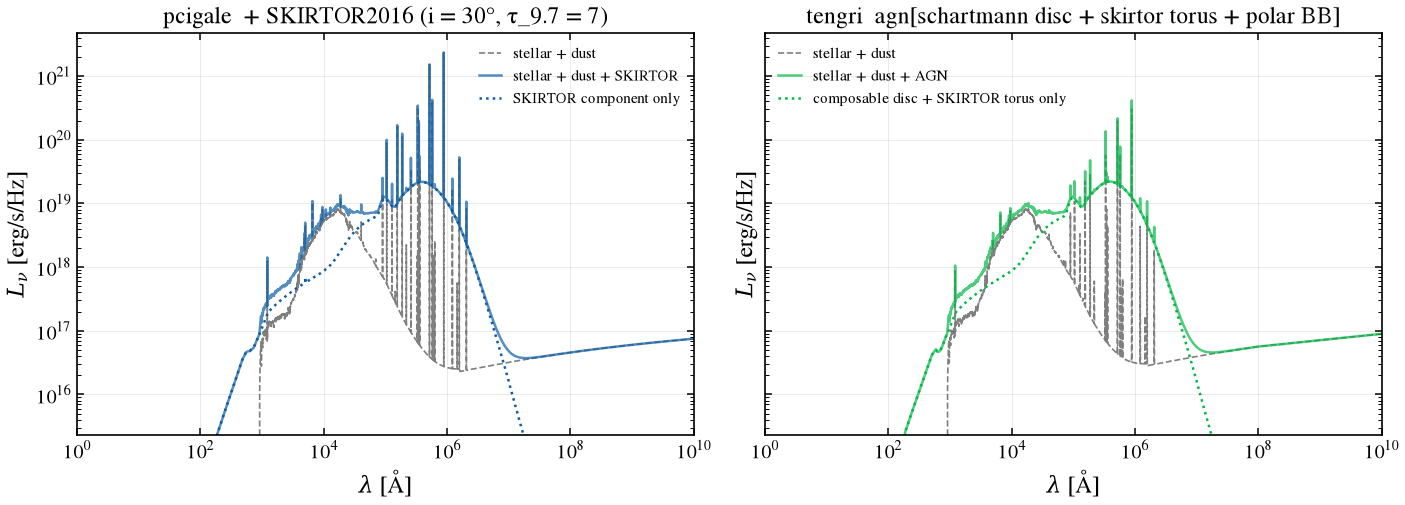
§9c AGN parity — full-spectrum ratio¶
The two stellar + dust + AGN SEDs of §9 on a shared grid, read out as energy-weighted tengri / CIGALE ratios in three bands (1500–3000 Å, 5–30 μm and 100 μm) and then component by component as integrated luminosities. A band ratio locates a residual in wavelength but cannot say which component carries it: the 1500–3000 Å band is mostly host starlight (full SED 1.027×, host alone 1.061×, disc alone 1.009×), and at 100 μm all three AGN components overlap with the host. The component ladder
separates them. Both codes publish disc, torus and polar dust separately. The printed ladder gives the three luminosity ratios (about 1 % each), the emergent disc shape deviation and each code’s polar share.
[23]:
w_c_agn, L_c_agn = w_skirt, np.asarray(L_skirt)  # CIGALE stellar+dust+SKIRTOR
w_t_agn, L_t_agn = np.asarray(s_agn.wave), np.asarray(s_agn.sed_intrinsic)  # tengri full
L_t_on_c_agn = U.regrid(w_t_agn, L_t_agn, w_c_agn)
ratio_agn = L_t_on_c_agn / np.maximum(L_c_agn, 1e-50)

fig, (ax, ax_r) = plt.subplots(
    2, 1, figsize=(10, 7), sharex=True, gridspec_kw={"height_ratios": [3, 1]}
)
ax.plot(w_c_agn, L_c_agn, "C0-", linewidth=1.6, label="CIGALE  skirtor2016")
ax.plot(w_c_agn, L_t_on_c_agn, "C1--", linewidth=1.4, label="tengri  (regridded)")
ax.set_xscale("log")
ax.set_yscale("log")
ax.set_xlim(1e3, 1e7)
_ymx_agn = float(max(np.nanmax(L_c_agn), np.nanmax(L_t_on_c_agn)))
ax.set_ylim(_ymx_agn * 1e-5, _ymx_agn * 2.0)
ax.set_ylabel(r"$L_\nu$ [erg/s/Hz]")
ax.set_title("AGN parity — CIGALE skirtor2016 vs tengri (stellar + dust + AGN)")
ax.legend(fontsize=10)
ax.grid(True, alpha=0.3)

ax_r.axhspan(0.9, 1.1, color="0.85", zorder=0)
ax_r.axhline(1.0, color="0.5", linewidth=0.8)
ax_r.plot(w_c_agn, ratio_agn, "C1-", linewidth=1.0)
ax_r.set_xscale("log")
ax_r.set_ylim(0.5, 1.5)
ax_r.set_xlabel(r"$\lambda$ [Å]")
ax_r.set_ylabel("tengri / CIGALE", fontsize=9)
ax_r.grid(True, alpha=0.3)

# Per-band AGN ratios (median over each AGN-dominated window).
print("§9 AGN per-band parity (tengri / CIGALE, full stellar+dust+AGN SED):")
for _name, _lo, _hi in [
    ("full SED 1500-3000 Å (host + disc)", 1500.0, 3000.0),
    ("full SED 5-30 µm (torus + host)   ", 5.0e4, 3.0e5),
    ("full SED 100 µm (polar + host)    ", 8.0e5, 1.2e6),
]:
    _m = (w_c_agn >= _lo) & (w_c_agn <= _hi) & (L_c_agn > 0)
    if _m.any():
        print(f"  {_name}: {_band_energy_ratio(w_c_agn[_m], L_c_agn[_m], w_t_agn, L_t_agn, _lo, _hi):.3f}×")
# The full SED in the ultraviolet is mostly host starlight, so its ratio is the
# host's, not the disc's. The disc component alone, from each code's own
# published disc spectrum:
_w_disc_c, _L_disc_c = U.wnm_to_erg_per_hz_per_aa(
    np.asarray(sed_skirtor.wavelength_grid),
    np.asarray(sed_skirtor.luminosities["agn.SKIRTOR2016_disk"]),
)
print(
    "  disc component alone 1500-3000 Å: "
    f"{_band_energy_ratio(_w_disc_c, _L_disc_c, np.asarray(s_agn.wave), np.asarray(s_agn.derived['sed_agn_disc']), 1500.0, 3000.0):.3f}×"
)
print(
    "  host component alone 1500-3000 Å (stellar + dust, no AGN): "
    f"{_band_energy_ratio(w_base, L_base, np.asarray(s_agn_base.wave), np.asarray(s_agn_base.sed_intrinsic), 1500.0, 3000.0):.3f}×"
)


# A band ratio locates a residual in wavelength; it does not say which
# component carries it, and in the FIR three of them overlap. CIGALE separates
# its SKIRTOR contributions (``agn.SKIRTOR2016_disk`` / ``_torus`` /
# ``_polar_dust``) and tengri publishes the same three on ``state.derived``,
# so the comparison can be made component by component instead.
def _agn_component_pair(sed_c, state_t, cig_key, tengri_key):
    """(CIGALE, tengri) ∫L_ν dν for one AGN component, on their shared support.

    Both codes are integrated over the same wavelength points — CIGALE's grid,
    masked to where both sides are non-zero — so the ratio is a luminosity
    comparison and not a difference in grid extent.
    """
    _wc, _Lc = U.wnm_to_erg_per_hz_per_aa(
        np.asarray(sed_c.wavelength_grid), np.asarray(sed_c.luminosities[cig_key])
    )
    _Lt_on_c = U.regrid(np.asarray(state_t.wave), np.asarray(state_t.derived[tengri_key]), _wc)
    _m = (_Lc > 0) & (_Lt_on_c > 0)
    if int(_m.sum()) < 2:
        return float("nan"), float("nan")
    return _lbol_nu(_wc[_m], _Lc[_m]), _lbol_nu(_wc[_m], _Lt_on_c[_m])


_AGN_COMPONENTS = (
    ("disc      ", "agn.SKIRTOR2016_disk", "sed_agn_disc"),
    ("torus     ", "agn.SKIRTOR2016_torus", "sed_agn_torus"),
    ("polar dust", "agn.SKIRTOR2016_polar_dust", "sed_agn_polar"),
)


def _disc_shape_dev(sed_c, state_t, lo=1000.0, hi=5000.0):
    """max |Δ| between the emergent disc shapes, each set to 1 at 2500 Å.

    Normalizing at 2500 Å removes the luminosity scale, which the component
    ladder reports separately. What is left is the *shape* of the disc that
    emerges — the analytic disc times the polar-dust screen, because both
    codes redden the disc before publishing it.
    """
    _wc, _Lc = U.wnm_to_erg_per_hz_per_aa(
        np.asarray(sed_c.wavelength_grid),
        np.asarray(sed_c.luminosities["agn.SKIRTOR2016_disk"]),
    )
    _Lt = U.regrid(np.asarray(state_t.wave), np.asarray(state_t.derived["sed_agn_disc"]), _wc)
    _j = int(np.argmin(np.abs(_wc - 2500.0)))
    _r = (_Lt / _Lt[_j]) / (_Lc / _Lc[_j])
    _m = (_wc >= lo) & (_wc <= hi) & (_Lc > 0) & (_Lt > 0)
    return float(np.abs(_r[_m] - 1.0).max()), int(_m.sum())


def _print_agn_report(header, sed_c, state_t):
    """Print the disc-shape deviation, the three component ratios and the polar share.

    The polar share -- polar / (polar + torus), each code against its own
    budget -- is what makes the polar component's disc dependence visible: it
    is a property of one code, not a comparison between them, so §9 and §9b
    printing different values for the *same* code is the disc moving it.
    """
    print(header)
    _dev, _n = _disc_shape_dev(sed_c, state_t)
    print(
        f"  disc shape, 1000–5000 Å, normalized at 2500 Å: max |Δ| = {_dev * 100:.2f}% ({_n} pts)"
    )
    _pairs = {
        _tk: _agn_component_pair(sed_c, state_t, _ck, _tk) for _, _ck, _tk in _AGN_COMPONENTS
    }
    for _name, _ck, _tk in _AGN_COMPONENTS:
        _bc, _bt = _pairs[_tk]
        print(f"  {_name}: CIGALE {_bc:.4e}, tengri {_bt:.4e} erg/s → {_bt / _bc:.4f}×")
    _tor_c, _tor_t = _pairs["sed_agn_torus"]
    _pol_c, _pol_t = _pairs["sed_agn_polar"]
    print(
        f"  polar share polar/(polar+torus): CIGALE {_pol_c / (_pol_c + _tor_c):.4f}, "
        f"tengri {_pol_t / (_pol_t + _tor_t):.4f}"
    )


_print_agn_report(
    "§9 AGN parity, component by component (∫L_ν dν; schartmann2005 disc):",
    sed_skirtor,
    s_agn,
)
fig.tight_layout()
plt.close(fig)  # superseded by §9e's SKIRTOR (τ, oa, i) grid, which replaces this panel
§9 AGN per-band parity (tengri / CIGALE, full stellar+dust+AGN SED):
  full SED 1500-3000 Å (host + disc): 1.027×
  full SED 5-30 µm (torus + host)   : 1.015×
  full SED 100 µm (polar + host)    : 1.082×
  disc component alone 1500-3000 Å: 1.009×
  host component alone 1500-3000 Å (stellar + dust, no AGN): 1.061×
§9 AGN parity, component by component (∫L_ν dν; schartmann2005 disc):
  disc shape, 1000–5000 Å, normalized at 2500 Å: max |Δ| = 1.04% (801 pts)
  disc      : CIGALE 1.5574e+33, tengri 1.5732e+33 erg/s → 1.0101×
  torus     : CIGALE 5.5435e+32, tengri 5.6063e+32 erg/s → 1.0113×
  polar dust: CIGALE 1.4710e+32, tengri 1.4887e+32 erg/s → 1.0120×
  polar share polar/(polar+torus): CIGALE 0.2097, tengri 0.2098
§9b The other disc — disc.skirtor ↔ CIGALE disk_type=0¶
CIGALE’s skirtor2016 offers two analytic discs: disk_type=0 → skirtor_disk() and disk_type=1 → schartmann2005_disk(). tengri ships both, as disc.skirtor and disc.schartmann2005; §9 pins the disk_type=1 pairing and this section swaps to disc.skirtor, the shallower SKIRTOR disc with its 1200 Å bend. Only the disc changes: the torus, the polar-dust block and the fracAGN coupling are §9’s, so the printed ladder repeats §9’s with one entry moved. The figure
overlays the two AGN SEDs as in §9.
What the disc-shape number contains. Both codes publish the disc after the polar-dust screen, so the printed deviation is the analytic disc shape and the two implementations of the same Bongiorno screen together. The screen does not cancel by comparing this section with §9: the same law integrated against a different disc spectrum is a different factor, which is why the polar share printed here differs from §9’s on both sides. §9d prints the polar reference term by term.
[24]:
sed_skirtor0 = C.run_chain(
    [
        _sfh_args_d,
        ("bc03", dict(imf=1, metallicity=0.02, separation_age=10)),
        NEB_FIDUCIAL_CIGALE,
        ("dustatt_modified_starburst", dict(E_BV_lines=0.3)),
        (
            "skirtor2016",
            dict(
                t=7,
                pl=1.0,
                q=1.0,
                oa=40,
                R=20,
                Mcl=0.97,
                i=30,
                disk_type=0,  # ← skirtor_disk ↔ tengri disc.skirtor
                delta=0,
                fracAGN=0.3,
                lambda_fracAGN="0/0",
                law=0,
                EBV=0.03,
                temperature=100.0,
                emissivity=1.6,
            ),
        ),
    ]
)
w_sk0, L_sk0 = C.to_lnu(sed_skirtor0)

m_agn_sk = SEDModel.build(
    ssp_data=ssp,
    met=MET_FIDUCIAL,
    sfh={
        "type": "delayed",
        "tau_gyr": Fixed(1.0),
        "age_gyr": Fixed(5.0),
        "log_total_mass": Fixed(0.0),
        "all_params": Fixed(DEFAULT),
    },
    dust_attenuation={
        "type": "two_component",
        "law_bc": "leitherer02",
        "law_diff": "leitherer02",
        "tau_bc": Fixed(TAU_BC_FIDUCIAL),
        "tau_diff": Fixed(TAU_DIFF_FIDUCIAL),
        # Same Lyman-limit clip as §9, so the stellar+dust floor under this
        # panel is the one §9 and the dashed baseline below already plot.
        "lyman_cutoff": True,
        "all_params": Fixed(DEFAULT),
    },
    agn={
        "type": "composable",
        "disc": {"type": "skirtor", "all_params": Fixed(DEFAULT)},  # ← the SKIRTOR analytic disc
        "torus": {"type": "skirtor", "all_params": Fixed(DEFAULT)},
        # Same polar-dust block and same fracAGN coupling as §9: only the disc
        # changes, so the two panels differ in one input.
        "atten": _POLAR_DUST_BLOCK,
        "agn_ir_frac": Fixed(0.3),
        "all_params": Fixed(DEFAULT),
    },
    neb=NEB_FIDUCIAL_TENGRI,
    redshift=Fixed(0.0),
)
s_agn_sk = m_agn_sk.predict_state({})

_print_agn_report(
    "§9b AGN parity, component by component (∫L_ν dν; skirtor disc):",
    sed_skirtor0,
    s_agn_sk,
)

fig, ax_l, ax_r = U.two_panel_fig()
U.panel(
    ax_l,
    ax_r,
    label_l="pcigale  + SKIRTOR2016 (disk_type = 0)",
    label_r="tengri  agn[skirtor disc + skirtor torus + polar BB]",
)
L_sk0_only = np.maximum(L_sk0 - U.regrid(w_base, L_base, w_sk0), 1e-50)
ax_l.plot(w_base, L_base, "k--", linewidth=1.0, alpha=0.5, label="stellar + dust")
ax_l.plot(w_sk0, L_sk0, "C0-", linewidth=1.5, alpha=0.7, label="stellar + dust + SKIRTOR (dt=0)")
ax_l.plot(w_sk0, L_sk0_only, "C0:", linewidth=1.5, label="SKIRTOR component only")
ax_l.legend(fontsize=9)
ax_l.grid(True, alpha=0.3)
L_sk_only = np.maximum(np.asarray(s_agn_sk.derived["sed_agn"]), 1e-50)
ax_r.plot(
    s_agn_base.wave,
    s_agn_base.sed_intrinsic,
    "k--",
    linewidth=1.0,
    alpha=0.5,
    label="stellar + dust",
)
ax_r.plot(
    s_agn_sk.wave,
    s_agn_sk.sed_intrinsic,
    "C1-",
    linewidth=1.5,
    alpha=0.7,
    label="stellar + dust + AGN",
)
ax_r.plot(
    s_agn_sk.wave, L_sk_only, "C1:", linewidth=1.5, label="skirtor disc + SKIRTOR torus only"
)
ax_r.legend(fontsize=9)
ax_r.grid(True, alpha=0.3)
_xmin_b = float(min(w_sk0.min(), float(np.asarray(s_agn_sk.wave).min())))
_xmax_b = float(max(w_sk0.max(), float(np.asarray(s_agn_sk.wave).max())))
_ymax_b = max(float(np.asarray(L_sk0).max()), float(np.asarray(s_agn_sk.sed_intrinsic).max()))
for ax in (ax_l, ax_r):
    ax.set_xlim(_xmin_b, _xmax_b)
    ax.set_ylim(_ymax_b * 1e-6, _ymax_b * 2)
fig.tight_layout()
save_fig("cigale_09b_disc_skirtor.png")
src/tengri/forward/sed_model.py:13601: SFHBeyondOldestTemplateWarning: The SSP grid's oldest template is 13.700 Gyr but the universe is 13.787 Gyr old at redshift 0. Stars formed in that gap are older than every template, so both age kernels assign them to the oldest one: the formed mass is conserved, and those stars carry the colors of a 13.700 Gyr population. Use a grid whose oldest template reaches 13.787 Gyr (e.g. MIST) to remove the approximation.
  return cls(
§9b AGN parity, component by component (∫L_ν dν; skirtor disc):
  disc shape, 1000–5000 Å, normalized at 2500 Å: max |Δ| = 1.57% (801 pts)
  disc      : CIGALE 1.4385e+33, tengri 1.4494e+33 erg/s → 1.0076×
  torus     : CIGALE 5.3968e+32, tengri 5.4775e+32 erg/s → 1.0150×
  polar dust: CIGALE 1.6177e+32, tengri 1.6175e+32 erg/s → 0.9998×
  polar share polar/(polar+torus): CIGALE 0.2306, tengri 0.2280
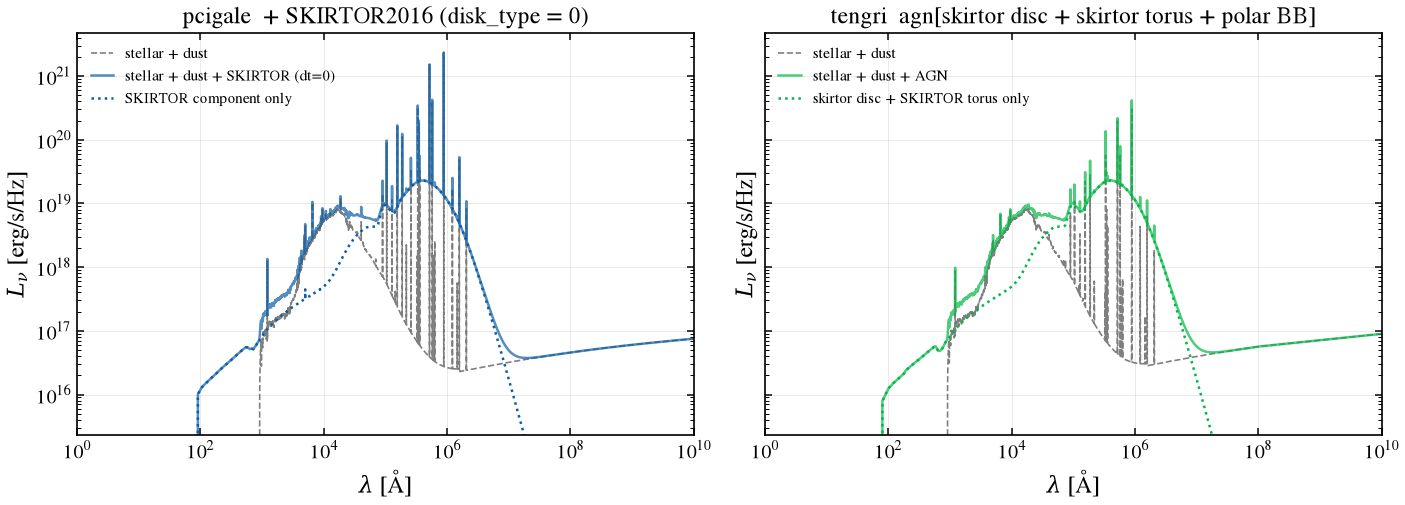
§9d What separates the polar reference¶
Both codes set the polar dust’s absorbed power from the same product, g(oa) × R_faceon × J: the polar cone’s share of the disc’s anisotropic emission, the face-on disc integral measured against the SKIRTOR dust integral, and J = ∫disc·(1 − e^−τ) dλ / ∫disc dλ, the fraction of the disc spectrum the polar screen absorbs. g(oa) is the same closed form on both sides and cancels from the comparison. The cell prints the other two and the two terms their ratio factors into, with the polar
screen set to polar_law="bongiorno" (CIGALE’s law=0) and, for contrast, to the default polar_law="smc" (Pei 1992).
R_faceon agrees: tengri reads 4.553791 off the vendored SKIRTOR grid against pcigale’s own 4.562211, a ratio of 0.998154× (−0.18 %). What separates the polar reference is the pair of terms printed beneath it.
The wavelength axis, a convention on pcigale’s side. The vendored grid carries 136 wavelengths across 10 Å – 10⁸ Å where pcigale’s carries 948, and each code integrates on its own. With CIGALE’s extinction curve held fixed, the absorbed fraction J converges to 0.221723 on a dense axis. On tengri’s 136 points it is 0.221928, +0.09 % from converged, and on pcigale’s 948 points 0.222842, +0.51 %. tengri’s axis is the closer of the two to the integral, so this term, 0.994058× (−0.59 %), is mostly pcigale’s quadrature error.
The extinction curve. With polar_law="bongiorno" the two curves coincide above 100 nm (the printed A(λ)/E(B−V) ratios are 1.000 at 2500 Å, 5500 Å and 1 μm) and differ only in the sub-100 nm SMC-bar shape (0.985 at 912 Å); the curve term is 1.002761× (+0.28 %). The default polar_law="smc" is a different curve (A(λ)/E(B−V) ratios 1.076, 1.011, 0.972 and 1.207 at 912 Å, 2500 Å, 5500 Å and 1 μm) and its curve term is 0.976712× (−2.33 %). Use polar_law="bongiorno" to compare with
CIGALE’s default polar dust.
The two terms multiply to 0.996803× with polar_law="bongiorno": tengri sets its polar dust from 0.32 % less absorbed disc power than pcigale does. With the default polar_law="smc" the product is 0.970908×.
[25]:
from pcigale.data import SimpleDatabase as _CigaleDB
from pcigale.sed_modules.skirtor2016 import k_ext as _cigale_k_ext
from pcigale.sed_modules.skirtor2016 import schartmann2005_disk as _cigale_disc

from tengri.components.agn.disc_cigale import schartmann2005_disk_spectrum
from tengri.components.agn.polar_dust import bongiorno2012_extinction_curve
from tengri.components.agn.skirtor import load_skirtor_bundle, skirtor_disc_dust_ratio
from tengri.components.dust.attenuation import smc as _tengri_smc

_OA_SKIRTOR, _EBV_POLAR, _RV_SMC = 40.0, 0.03, 2.93
_COS_I_FIDUCIAL = float(np.cos(np.deg2rad(30.0)))

# tengri's face-on reference, straight off the vendored grid. The tie is given
# an unreddened disc (`ext_fac = 1`), exactly as the composable AGN calls it:
# the polar screen enters through J below, not through R_faceon.
_w_tie = np.logspace(1.0, 7.0, 20000)
_tie = skirtor_disc_dust_ratio(
    _w_tie,
    schartmann2005_disk_spectrum(_w_tie / 10.0),  # the disc spectrum takes nm
    np.ones_like(_w_tie),
    _template=load_skirtor_bundle().disc_dust,
    agn_oa_skirtor=_OA_SKIRTOR,
    agn_cos_inc=_COS_I_FIDUCIAL,
)
_R_faceon_t = float(_tie.R_faceon)
_wave_native = np.asarray(_tie.wave_native)
_disc_shape_t = np.asarray(_tie.faceon_shape_native)

# pcigale's own, rebuilt from its database the way skirtor2016._init_code does:
# the i = 0 record carried onto the observer record's luminosity scale by
# norm(0)/norm(i), divided by that record's dust integral.
with _CigaleDB("skirtor2016") as _db:
    _sk_i = _db.get(t=7, pl=1.0, q=1.0, oa=40, R=20, Mcl=0.97, i=30)
    _sk_0 = _db.get(t=7, pl=1.0, q=1.0, oa=40, R=20, Mcl=0.97, i=0)
_wave_c_nm = np.asarray(_sk_i.wl)
_R_faceon_c = float(
    np.trapezoid(np.asarray(_sk_0.disk) * (_sk_0.norm / _sk_i.norm), x=np.asarray(_sk_0.wl))
    / np.trapezoid(np.asarray(_sk_i.dust), x=_wave_c_nm)
)

# The curves on one dense axis. `k_ext` rescales its sub-100 nm branch to meet
# the power law at the last grid point below that boundary, so it has to be
# evaluated once on an axis that resolves the boundary rather than sampled point
# by point. tengri's `polar_law="bongiorno"` is the curve the notebook's builds
# use; the default `polar_law="smc"` (Pei 1992 SMC bar, R_V = 2.93) is shown for
# contrast.
_w_dense = np.logspace(1.0, 6.0, 20001)
_k_cigale_dense = _cigale_k_ext(_w_dense / 10.0, 0)
_k_tengri_dense = np.asarray(bongiorno2012_extinction_curve(jnp.asarray(_w_dense)))
_k_pei_dense = np.asarray(_tengri_smc(_w_dense)) * _RV_SMC


def _absorbed_fraction(disc_shape, wave_aa, k_lambda):
    """J = ∫disc·(1 − 10^(−0.4·k·E(B−V))) dλ / ∫disc dλ [dimensionless]."""
    _transmitted = 10.0 ** (-0.4 * k_lambda * _EBV_POLAR)
    return float(
        np.trapezoid(disc_shape * (1.0 - _transmitted), wave_aa)
        / np.trapezoid(disc_shape, wave_aa)
    )


_J_t = _absorbed_fraction(
    _disc_shape_t, _wave_native, np.interp(_wave_native, _w_dense, _k_tengri_dense)
)
_J_pei = _absorbed_fraction(
    _disc_shape_t, _wave_native, np.interp(_wave_native, _w_dense, _k_pei_dense)
)
# CIGALE's curve on tengri's axis: the control that separates the two terms.
_J_c_on_native = _absorbed_fraction(
    _disc_shape_t, _wave_native, np.interp(_wave_native, _w_dense, _k_cigale_dense)
)
_J_c = _absorbed_fraction(
    _cigale_disc(_wave_c_nm), _wave_c_nm * 10.0, _cigale_k_ext(_wave_c_nm, 0)
)

_term_quadrature = (_R_faceon_t * _J_c_on_native) / (_R_faceon_c * _J_c)
_term_curve = _J_t / _J_c_on_native
_polar_reference_ratio = (_R_faceon_t * _J_t) / (_R_faceon_c * _J_c)

print("§9d polar reference g(oa)·R_faceon·J, tengri against pcigale (i = 30°):")
print(
    f"  R_faceon = ∫disc(face-on)/∫dust: tengri {_R_faceon_t:.6f}, "
    f"pcigale {_R_faceon_c:.6f} → {_R_faceon_t / _R_faceon_c:.6f}× "
    f"({(_R_faceon_t / _R_faceon_c - 1) * 100:+.2f}%)"
)
print(
    f"  wavelength axis: vendored grid {_wave_native.size} points, "
    f"pcigale {_wave_c_nm.size}, same 10 Å–10⁸ Å span"
)
print(
    f"  J absorbed fraction: tengri {_J_t:.6f}, pcigale {_J_c:.6f} "
    f"(CIGALE's curve on the vendored axis: {_J_c_on_native:.6f})"
)
print(
    f"  term 1, wavelength quadrature: {_term_quadrature:.6f}× "
    f"({(_term_quadrature - 1) * 100:+.2f}%)"
)
print(
    f"  term 2, polar_law='bongiorno' extinction curve: {_term_curve:.6f}× "
    f"({(_term_curve - 1) * 100:+.2f}%)"
)
print(
    f"  product {_term_quadrature * _term_curve:.6f}× = polar reference ratio "
    f"{_polar_reference_ratio:.6f}× ({(_polar_reference_ratio - 1) * 100:+.2f}%)"
)
_CURVE_POINTS = ((912.0, "912 Å"), (2500.0, "2500 Å"), (5500.0, "5500 Å"), (1e4, "1 µm"))
for _curve_name, _k_dense in (
    ("bongiorno", _k_tengri_dense),
    ("smc (Pei 1992, default)", _k_pei_dense),
):
    print(
        f"  A(λ)/E(B−V), pcigale / tengri polar_law='{_curve_name}': "
        + ", ".join(
            f"{float(np.interp(_x, _w_dense, _k_cigale_dense)) / float(np.interp(_x, _w_dense, _k_dense)):.3f} at {_label}"
            for _x, _label in _CURVE_POINTS
        )
    )
# Which quadrature is closer to the integral? CIGALE's extinction curve on three
# axes: tengri's vendored axis carrying tengri's face-on disc shape (`_J_c_on_native`
# above), pcigale's own axis carrying pcigale's disc, and a dense axis for each
# code's analytic disc, which gives the converged value.
_w_conv = np.logspace(1.0, 8.0, 400001)
_k_conv = _cigale_k_ext(_w_conv / 10.0, 0)
_J_conv_c = _absorbed_fraction(_cigale_disc(_w_conv / 10.0), _w_conv, _k_conv)
_J_conv_t = _absorbed_fraction(
    np.asarray(schartmann2005_disk_spectrum(_w_conv / 10.0)), _w_conv, _k_conv
)
print(
    f"  J with CIGALE's curve, converged: CIGALE's disc {_J_conv_c:.6f}, tengri's disc {_J_conv_t:.6f}"
)
print(
    f"  J on tengri's {_wave_native.size}-point axis {_J_c_on_native:.6f} "
    f"({(_J_c_on_native / _J_conv_t - 1) * 100:+.2f}% from converged); on pcigale's "
    f"{_wave_c_nm.size}-point axis {_J_c:.6f} ({(_J_c / _J_conv_c - 1) * 100:+.2f}%)"
)
assert abs(_J_c_on_native / _J_conv_t - 1.0) < abs(_J_c / _J_conv_c - 1.0)
print(
    f"  for contrast, the default polar_law='smc': J = {_J_pei:.6f}, term 2 = "
    f"{_J_pei / _J_c_on_native:.6f}× ({(_J_pei / _J_c_on_native - 1) * 100:+.2f}%), "
    f"polar reference ratio {(_R_faceon_t * _J_pei) / (_R_faceon_c * _J_c):.6f}×"
)
§9d polar reference g(oa)·R_faceon·J, tengri against pcigale (i = 30°):
  R_faceon = ∫disc(face-on)/∫dust: tengri 4.553791, pcigale 4.562211 → 0.998154× (-0.18%)
  wavelength axis: vendored grid 136 points, pcigale 948, same 10 Å–10⁸ Å span
  J absorbed fraction: tengri 0.222541, pcigale 0.222842 (CIGALE's curve on the vendored axis: 0.221928)
  term 1, wavelength quadrature: 0.994058× (-0.59%)
  term 2, polar_law='bongiorno' extinction curve: 1.002761× (+0.28%)
  product 0.996803× = polar reference ratio 0.996803× (-0.32%)
  A(λ)/E(B−V), pcigale / tengri polar_law='bongiorno': 0.985 at 912 Å, 1.000 at 2500 Å, 1.000 at 5500 Å, 1.000 at 1 µm
  A(λ)/E(B−V), pcigale / tengri polar_law='smc (Pei 1992, default)': 1.076 at 912 Å, 1.011 at 2500 Å, 0.972 at 5500 Å, 1.207 at 1 µm
  J with CIGALE's curve, converged: CIGALE's disc 0.221723, tengri's disc 0.221723
  J on tengri's 136-point axis 0.221928 (+0.09% from converged); on pcigale's 948-point axis 0.222842 (+0.51%)
  for contrast, the default polar_law='smc': J = 0.216760, term 2 = 0.976712× (-2.33%), polar reference ratio 0.970908×
§9e AGN dust grids: SKIRTOR (τ, oa, i) and Fritz¶
CIGALE modules skirtor2016 and fritz2006 ↔ tengri’s torus.skirtor and torus.fritz with the same polar-dust block as §9. Each panel compares AGN dust emission, torus plus polar screen summed; the two figures overlay the sums and show the tengri/CIGALE ratio. The sum is independent of how each code partitions the two: pcigale subtracts the polar re-emission from the torus dust, while tengri rescales the torus against a shared budget and carries the polar term separately.
SKIRTOR: τ_9.7 ∈ {3, 7, 11}, oa ∈ {20°, 40°, 60°}, i ∈ {0°, 30°, 70°}, each varied one at a time from §9’s fiducial (7, 40°, 30°). The printed IR-band table gives a median ratio of 1.011–1.012× in every case, with no band outside 5 % and a worst band of at most 1.013×: optical depth, opening angle and inclination all agree.
Fritz 2006: (τ, opening angle, ψ) ∈ {(1, 60°, 0.001°), (1, 100°, 40.1°), (6, 60°, 89.99°)}, with r_ratio=60, β=−0.5, γ=4, a Schartmann disc, fracAGN=0.3 and EBV=0.03. agn_cos_inc is the one inclination: the library’s viewing elevation is ψ = 90° − i, so the cell passes agn_cos_inc = sin ψ. CIGALE’s opening angle is the full angle and maps to tengri’s half-angle via agn_fritz_oa = (180 − opening_angle) / 2. Under cigale_joint the Fritz torus carries the same agn_ir_frac tie as
SKIRTOR. Its tied disc is the library’s isotropic ratio, as in pcigale’s fritz2006, and it continues below the library’s 10 Å edge with the X-ray transmission, where pcigale has no disc (§9f). CIGALE’s fritz2006 carries a disc-slope parameter δ whose default is −0.36; the cell passes delta=0.0, which is the Schartmann disc of §9 and of the SKIRTOR runs, so the disc under the torus is the same on both sides.
The Fritz comparison agrees in these three cases. The printed table gives band medians of 1.011×, 1.009× and 1.010×, worst bands 0.975×, 0.974× and 0.974×, and none of 12 IR bands outside 5 %. Under cigale_joint the tied Fritz torus plus polar dust carries agn_power at every ψ, as pcigale’s fritz2006 does: pcigale divides the dust by its own integral at the chosen ψ and multiplies it by agn_power, so the library’s per-inclination dust flux does not enter the total. The cell
prints the torus plus polar luminosity as a multiple of agn_power, 1.011× at each of ψ = 0.001°, 40.1° and 89.99°, the same flat value as the SKIRTOR cases above. The per-sightline spectral shape of the torus is the library’s; only the total is held. The untied path (agn_ir_frac = 0) and agn_norm="independent" keep the library’s anisotropy.
[26]:
_AGN_SFH_9E = {
    "type": "delayed",
    "tau_gyr": Fixed(1.0),
    "age_gyr": Fixed(5.0),
    "log_total_mass": Fixed(0.0),
    "all_params": Fixed(DEFAULT),
}
_AGN_DUSTATT_9E = {
    "type": "two_component",
    "law_bc": "leitherer02",
    "law_diff": "leitherer02",
    "tau_bc": Fixed(TAU_BC_FIDUCIAL),
    "tau_diff": Fixed(TAU_DIFF_FIDUCIAL),
    "lyman_cutoff": True,
    "all_params": Fixed(DEFAULT),
}


def _cigale_skirtor_sed(t, oa, i):
    return C.run_chain(
        [
            _sfh_args_d,
            ("bc03", dict(imf=1, metallicity=0.02, separation_age=10)),
            NEB_FIDUCIAL_CIGALE,
            ("dustatt_modified_starburst", dict(E_BV_lines=0.3)),
            (
                "skirtor2016",
                dict(
                    t=t,
                    pl=1.0,
                    q=1.0,
                    oa=oa,
                    R=20,
                    Mcl=0.97,
                    i=i,
                    disk_type=1,
                    delta=0,
                    fracAGN=0.3,
                    lambda_fracAGN="0/0",
                    law=0,
                    EBV=0.03,
                    temperature=100.0,
                    emissivity=1.6,
                ),
            ),
        ]
    )


m_skirtor_sweep = SEDModel.build(
    ssp_data=ssp,
    met=MET_FIDUCIAL,
    sfh=_AGN_SFH_9E,
    dust_attenuation=_AGN_DUSTATT_9E,
    agn={
        "type": "composable",
        "disc": {"type": "schartmann2005", "all_params": Fixed(DEFAULT)},
        "torus": {
            "type": "skirtor",
            "tau_skirtor": Uniform(3.0, 11.0, default=7.0),
            "oa_skirtor": Uniform(10.0, 80.0, default=40.0),
            "cos_inc": Uniform(0.0, 1.0, default=float(np.cos(np.deg2rad(30.0)))),
            "all_params": Fixed(DEFAULT),
        },
        "atten": _POLAR_DUST_BLOCK,
        "agn_ir_frac": Fixed(0.3),
        "all_params": Fixed(DEFAULT),
    },
    neb=NEB_FIDUCIAL_TENGRI,
    redshift=Fixed(0.0),
)
p_sk_sweep = dict(m_skirtor_sweep.spec.sample(jax.random.PRNGKey(0)))

_skirtor_grid = [
    (3, 40, 30),
    (7, 40, 30),
    (11, 40, 30),
    (7, 20, 30),
    (7, 60, 30),
    (7, 40, 0),
    (7, 40, 70),
]
_cases_9e_sk = []
for _tau, _oa, _i in _skirtor_grid:
    _sed_c9e = _cigale_skirtor_sed(_tau, _oa, _i)
    _w_c9e, _L_torus_c9e = C.to_lnu_contribution(_sed_c9e, "agn.SKIRTOR2016_torus")
    _, _L_polar_c9e = C.to_lnu_contribution(_sed_c9e, "agn.SKIRTOR2016_polar_dust")
    _L_c9e = _L_torus_c9e + _L_polar_c9e  # Sum torus + polar (partition-independent)
    _pred_9e = m_skirtor_sweep.predict(
        {
            **p_sk_sweep,
            "agn_tau_skirtor": jnp.float64(_tau),
            "agn_oa_skirtor": jnp.float64(_oa),
            "agn_cos_inc": jnp.float64(np.cos(np.deg2rad(_i))),
        }
    )
    _w_t_9e = np.asarray(_pred_9e.sed.components["wavelength"])
    _L_torus_t_9e = np.asarray(_pred_9e.sed.components["sed_agn_torus"])
    _L_polar_t_9e = np.asarray(_pred_9e.sed.components["sed_agn_polar"])
    _L_t_9e = _L_torus_t_9e + _L_polar_t_9e  # Sum torus + polar
    _cases_9e_sk.append((f"τ={_tau}, oa={_oa}°, i={_i}°", _w_c9e, _L_c9e, _w_t_9e, _L_t_9e))
    _AGN_POWER_9e = float(_sed_c9e.info["agn.total_dust_luminosity"])
    print(
        f"§9e skirtor τ={_tau}, oa={_oa}°, i={_i}°: tengri torus + polar / agn_power = "
        f"{_lbol_nu(_w_t_9e, _L_t_9e) / 1e7 / _AGN_POWER_9e:.3f}"
    )
    _assert_comparable(_L_c9e, _L_t_9e, name=f"§9e skirtor {_tau},{_oa},{_i}")

fig, (ax, ax_r), _ratios_9e_sk = V.sweep_fig(
    _cases_9e_sk, ref_label="CIGALE", title="§9e SKIRTOR (τ, oa, i) grid", xlim=(1e3, 1e7)
)
fig.tight_layout()
save_fig("cigale_09e_skirtor_grid.png")
print("§9e SKIRTOR (τ, oa, i) grid (IR_BANDS):")
for _label, _w_ref, _L_ref, _w_t, _L_t in _cases_9e_sk:
    _rows = V.filter_rows_native(
        np.asarray(_w_t), np.asarray(_L_t), _w_ref, _L_ref, filters=V.IR_BANDS
    )
    V.print_filter_table(_rows, ref_name="CIGALE", title=f"§9e {_label}", compact=True)


def _cigale_fritz_sed(tau, oa, psy):
    return C.run_chain(
        [
            _sfh_args_d,
            ("bc03", dict(imf=1, metallicity=0.02, separation_age=10)),
            NEB_FIDUCIAL_CIGALE,
            ("dustatt_modified_starburst", dict(E_BV_lines=0.3)),
            (
                "fritz2006",
                dict(
                    r_ratio=60.0,
                    tau=tau,
                    beta=-0.5,
                    gamma=4.0,
                    opening_angle=oa,
                    psy=psy,
                    disk_type=1,
                    # δ = 0 matches the Schartmann disc and the SKIRTOR runs; the
                    # module's own default is −0.36.
                    delta=0.0,
                    fracAGN=0.3,
                    EBV=0.03,
                    temperature=100.0,
                    emissivity=1.6,
                ),
            ),
        ]
    )


# Under `agn_norm='cigale_joint'` the Fritz torus carries the same fracAGN tie as
# SKIRTOR: `agn_ir_frac = 0.3` sets P_AGN = L_absorbed x f/(1-f) and ties the disc
# to the library's disc-to-dust ratio at the viewing angle, as CIGALE's
# `fritz2006` does.
m_fritz_sweep = SEDModel.build(
    ssp_data=ssp,
    met=MET_FIDUCIAL,
    sfh=_AGN_SFH_9E,
    dust_attenuation=_AGN_DUSTATT_9E,
    agn={
        "type": "composable",
        "disc": {"type": "schartmann2005", "all_params": Fixed(DEFAULT)},
        "torus": {
            "type": "fritz",
            "fritz_tau": Uniform(0.1, 10.0, default=1.0),
            "fritz_oa": Uniform(20.0, 60.0, default=60.0),
            "agn_cos_inc": Uniform(0.0, 1.0, default=0.7071),
            "fritz_r_ratio": Fixed(60.0),
            "fritz_beta": Fixed(-0.5),
            "fritz_gamma": Fixed(4.0),
            "all_params": Fixed(DEFAULT),
        },
        "atten": _POLAR_DUST_BLOCK,
        "agn_ir_frac": Fixed(0.3),
        "all_params": Fixed(DEFAULT),
    },
    neb=NEB_FIDUCIAL_TENGRI,
    redshift=Fixed(0.0),
)
p_fritz_sweep = dict(m_fritz_sweep.spec.sample(jax.random.PRNGKey(0)))

_fritz_grid = [(1.0, 60.0, 0.001), (1.0, 100.0, 40.1), (6.0, 60.0, 89.99)]
_cases_9e_fr = []
for _tau, _oa, _psy in _fritz_grid:
    _sed_c9f = _cigale_fritz_sed(_tau, _oa, _psy)
    _w_c9f, _L_torus_c9f = C.to_lnu_contribution(_sed_c9f, "agn.fritz2006_torus")
    _, _L_polar_c9f = C.to_lnu_contribution(_sed_c9f, "agn.fritz2006_polar_dust")
    _L_c9f = _L_torus_c9f + _L_polar_c9f  # Sum torus + polar (partition-independent)
    _oa_half = (180.0 - _oa) / 2.0
    _pred_9f = m_fritz_sweep.predict(
        {
            **p_fritz_sweep,
            "agn_fritz_tau": jnp.float64(_tau),
            "agn_fritz_oa": jnp.float64(_oa_half),
            # One inclination: the library elevation psi = 90 deg - i, cos i = sin psi.
            "agn_cos_inc": jnp.float64(np.sin(np.radians(_psy))),
        }
    )
    _w_t_9f = np.asarray(_pred_9f.sed.components["wavelength"])
    _L_torus_t_9f = np.asarray(_pred_9f.sed.components["sed_agn_torus"])
    _L_polar_t_9f = np.asarray(_pred_9f.sed.components["sed_agn_polar"])
    _L_t_9f = _L_torus_t_9f + _L_polar_t_9f  # Sum torus + polar
    _cases_9e_fr.append((f"τ={_tau}, oa={_oa}°, ψ={_psy}°", _w_c9f, _L_c9f, _w_t_9f, _L_t_9f))
    _AGN_POWER_9f = float(_sed_c9f.info["agn.total_dust_luminosity"])
    print(
        f"§9e fritz τ={_tau}, oa={_oa}°, ψ={_psy}°: tengri torus + polar / agn_power = "
        f"{_lbol_nu(_w_t_9f, _L_t_9f) / 1e7 / _AGN_POWER_9f:.3f}"
    )
    _assert_comparable(_L_c9f, _L_t_9f, name=f"§9e fritz {_tau},{_oa},{_psy}")

fig, (ax, ax_r), _ratios_9e_fr = V.sweep_fig(
    _cases_9e_fr,
    ref_label="CIGALE",
    title="§9e Fritz 2006 (τ, opening angle, ψ) grid",
    xlim=(1e3, 1e7),
)
fig.tight_layout()
save_fig("cigale_09f_fritz_grid.png")
print("§9e Fritz 2006 (τ, opening angle, ψ) grid (IR_BANDS):")
for _label, _w_ref, _L_ref, _w_t, _L_t in _cases_9e_fr:
    _rows = V.filter_rows_native(
        np.asarray(_w_t), np.asarray(_L_t), _w_ref, _L_ref, filters=V.IR_BANDS
    )
    V.print_filter_table(_rows, ref_name="CIGALE", title=f"§9e {_label}", compact=True)
src/tengri/forward/sed_model.py:13601: SFHBeyondOldestTemplateWarning: The SSP grid's oldest template is 13.700 Gyr but the universe is 13.787 Gyr old at redshift 0. Stars formed in that gap are older than every template, so both age kernels assign them to the oldest one: the formed mass is conserved, and those stars carry the colors of a 13.700 Gyr population. Use a grid whose oldest template reaches 13.787 Gyr (e.g. MIST) to remove the approximation.
  return cls(
§9e skirtor τ=3, oa=40°, i=30°: tengri torus + polar / agn_power = 1.011
§9e skirtor τ=7, oa=40°, i=30°: tengri torus + polar / agn_power = 1.011
§9e skirtor τ=11, oa=40°, i=30°: tengri torus + polar / agn_power = 1.011
§9e skirtor τ=7, oa=20°, i=30°: tengri torus + polar / agn_power = 1.011
§9e skirtor τ=7, oa=60°, i=30°: tengri torus + polar / agn_power = 1.011
§9e skirtor τ=7, oa=40°, i=0°: tengri torus + polar / agn_power = 1.011
§9e skirtor τ=7, oa=40°, i=70°: tengri torus + polar / agn_power = 1.011
§9e SKIRTOR (τ, oa, i) grid (IR_BANDS):
  §9e τ=3, oa=40°, i=30°                               median 1.012x  worst 1.013x  0/13 outside 5%
  §9e τ=7, oa=40°, i=30°                               median 1.012x  worst 1.013x  0/13 outside 5%
  §9e τ=11, oa=40°, i=30°                              median 1.011x  worst 1.013x  0/13 outside 5%
  §9e τ=7, oa=20°, i=30°                               median 1.011x  worst 1.013x  0/13 outside 5%
  §9e τ=7, oa=60°, i=30°                               median 1.011x  worst 1.012x  0/13 outside 5%
  §9e τ=7, oa=40°, i=0°                                median 1.012x  worst 1.013x  0/13 outside 5%
  §9e τ=7, oa=40°, i=70°                               median 1.011x  worst 1.013x  0/13 outside 5%
src/tengri/forward/sed_model.py:13601: SFHBeyondOldestTemplateWarning: The SSP grid's oldest template is 13.700 Gyr but the universe is 13.787 Gyr old at redshift 0. Stars formed in that gap are older than every template, so both age kernels assign them to the oldest one: the formed mass is conserved, and those stars carry the colors of a 13.700 Gyr population. Use a grid whose oldest template reaches 13.787 Gyr (e.g. MIST) to remove the approximation.
  return cls(
§9e fritz τ=1.0, oa=60.0°, ψ=0.001°: tengri torus + polar / agn_power = 1.011
§9e fritz τ=1.0, oa=100.0°, ψ=40.1°: tengri torus + polar / agn_power = 1.011
§9e fritz τ=6.0, oa=60.0°, ψ=89.99°: tengri torus + polar / agn_power = 1.011
§9e Fritz 2006 (τ, opening angle, ψ) grid (IR_BANDS):
  §9e τ=1.0, oa=60.0°, ψ=0.001°                        median 1.011x  worst 0.975x  0/12 outside 5%
  §9e τ=1.0, oa=100.0°, ψ=40.1°                        median 1.009x  worst 0.974x  0/12 outside 5%
  §9e τ=6.0, oa=60.0°, ψ=89.99°                        median 1.010x  worst 0.974x  0/12 outside 5%
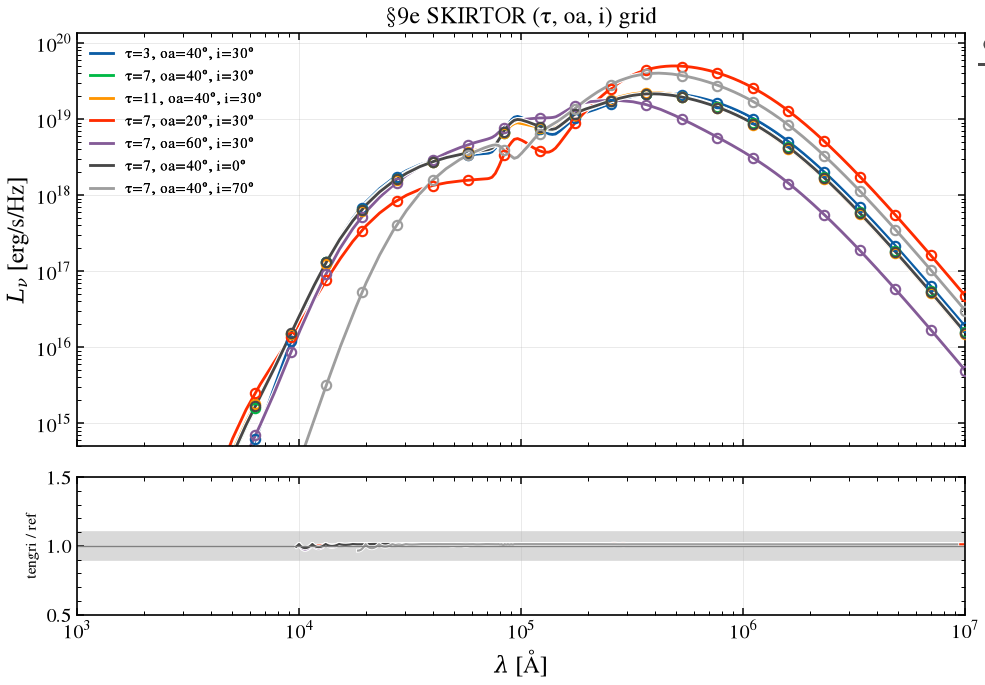
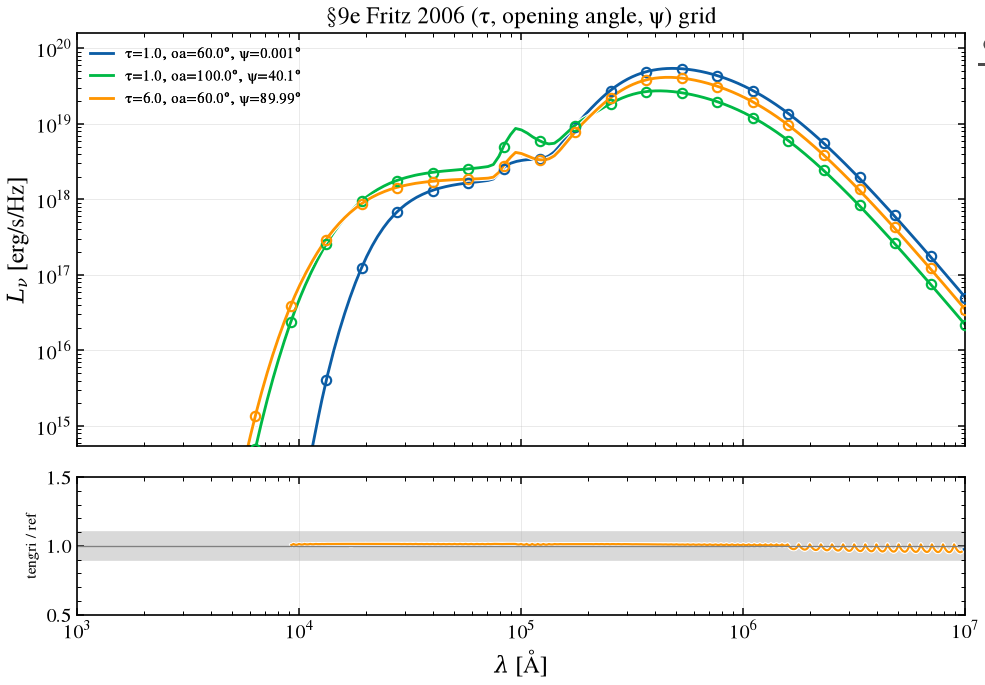
§9f The tied disc below the X-ray library edge¶
The Fritz (2006) and SKIRTOR (Stalevski et al. 2016) libraries tabulate the disc against inclination, and the first wavelength node of both is 10 Å (1.24 keV). pcigale’s fritz2006 and skirtor2016 write their AGN spectrum on the library’s wavelength grid, so neither has a disc shortward of that node: the grid has no point there. tengri extends the tied disc below the edge with absorption. Under agn_norm='cigale_joint' the tied disc factor is the library’s own inclination ratio above
10 Å. Below it, the factor is the ratio held at the edge times the X-ray transmission \(T_X\) of the sightline (Morrison & McCammon 1983 cross-section, column \(N_{\rm H} = 2.21\times10^{21}\,{\rm cm^{-2}}\,A_V\), with \(A_V\) from the torus’s own optical transmission). The tied disc is therefore continuous across the edge up to \(T_X\), and the library’s angular law carries across with it. The Fritz ratio is close to 1 for cos i ≥ 0.70 and 0.39 at cos i = 0.30. The SKIRTOR ratio
is anisotropic, \(\eta(i) = \cos i\,(1 + 2\cos i)/3\), which is 0.90, 0.56 and 0.16 at \(\cos i\) = 0.94, 0.70 and 0.30. An untied disc has no library ratio, and follows \(2\cos i\) times the transmission (\(T\) above the edge, \(T_X\) below it), which steps at the edge where the library transmission and \(T_X\) differ.
The figure shows the tied factor (solid) and the untied factor (dashed) for Fritz on the left and SKIRTOR on the right, at the three inclinations. The table prints the step across the edge between 0.999 and 1.001 times 10 Å, \(F(10^-)/[F(10^+)\,T_X]\), which is between 1.0000 and 1.0032 for the tied disc of both tori at every inclination (the 0.2 % separation of the two sample wavelengths accounts for the spread), and then the shortest AGN wavelength of each pcigale module with the tied disc factor tengri carries at 3 Å: pcigale has no grid point shortward of 10 Å, and tengri carries 0.37 (SKIRTOR) and 0.999 (Fritz) at cos i = 0.70.
[27]:
from tengri.components.agn.blocks import torus_library_transmission as _tlt

_COS_EDGE = (0.94, 0.70, 0.30)
_FRITZ_EDGE_PARAMS = {"agn_fritz_oa": 60.0}
_wave_edge = jnp.asarray(np.geomspace(3.0, 30.0, 600))


def _edge_sightline(torus, wave, cos_inc):
    params = _FRITZ_EDGE_PARAMS if torus == "fritz" else {}
    return _tlt.library_torus_sightline(torus, wave, cos_inc=cos_inc, params=params)


print("§9f tied disc across the 10 Å library edge, F(10-)/[F(10+) T_X]:")
print(
    f"  {'torus':8s} {'cos i':>5s} {'library ratio':>13s} {'T_X':>8s} {'tied step':>10s} "
    f"{'2cos i':>7s} {'eta(i)':>7s}"
)
fig, axes = plt.subplots(1, 2, figsize=(9, 3.8), sharey=True)
for _ax, _torus, _title in zip(axes, ("fritz", "skirtor"), ("Fritz 2006", "SKIRTOR")):
    _edge = _tlt.library_edge_wavelength(_torus)
    _w_pair = jnp.asarray([_edge * 0.999, _edge * 1.001])
    for _ci, _col in zip(_COS_EDGE, ("C0", "C1", "C3")):
        _s_pair = _edge_sightline(_torus, _w_pair, _ci)
        _tied_pair = np.asarray(
            _tlt.tied_incl_with_library_edge(_s_pair.ratio, _w_pair, _s_pair, _torus)
        )
        _t_x = float(np.asarray(_s_pair.transmission)[0])
        _ratio_edge = float(np.asarray(_s_pair.ratio)[1])
        _step = _tied_pair[0] / (_tied_pair[1] * _t_x)
        _eta = _ci * (1.0 + 2.0 * _ci) / 3.0
        print(
            f"  {_torus:8s} {_ci:5.2f} {_ratio_edge:13.5g} {_t_x:8.4f} {_step:10.4f} "
            f"{2.0 * _ci:7.2f} {_eta:7.3f}"
        )
        assert abs(_step - 1.0) < 1e-2, (_torus, _ci, _step)
        _sight = _edge_sightline(_torus, _wave_edge, _ci)
        _tied = np.asarray(
            _tlt.tied_incl_with_library_edge(_sight.ratio, _wave_edge, _sight, _torus)
        )
        _ax.plot(
            np.asarray(_wave_edge),
            _tied,
            color=_col,
            lw=1.5,
            label=rf"tied, $\cos i$ = {_ci:g}",
        )
        _ax.plot(
            np.asarray(_wave_edge),
            np.asarray(_sight.disc_factor),
            color=_col,
            lw=1.1,
            ls="--",
        )
    _ax.axvline(_edge, color="0.4", lw=0.9, ls=":")
    _ax.set(xscale="log", yscale="log", xlabel=r"$\lambda$ [Å]", title=_title)
    _ax.set_xticks([3, 5, 10, 20, 30])
    _ax.set_xticklabels(["3", "5", "10", "20", "30"])
    _ax.minorticks_off()
    _ax.set_ylim(1e-6, 4.0)
    _ax.grid(True, alpha=0.3)
axes[0].set_ylabel("disc inclination factor")
axes[0].plot([], [], "k--", lw=1.1, label=r"untied, $2\cos i\,T$")
axes[0].legend(fontsize=8, frameon=False, loc="lower right")
fig.tight_layout()
save_fig("cigale_09_tied_disc_edge.png")

# pcigale's AGN spectrum lives on the library grid: count the wavelength points it has
# shortward of the first node, and the tied disc tengri carries there at 3 Å.
_sed_fr_edge = _cigale_fritz_sed(1.0, 100.0, 40.1)
for _name, _sed_e, _torus in (
    ("skirtor2016", sed_skirtor0, "skirtor"),
    ("fritz2006", _sed_fr_edge, "fritz"),
):
    _w_e = np.asarray(_sed_e.wavelength_grid) * 10.0
    _edge = _tlt.library_edge_wavelength(_torus)
    _w3 = jnp.asarray([3.0])
    _s3 = _edge_sightline(_torus, _w3, 0.70)
    _t3 = float(np.asarray(_tlt.tied_incl_with_library_edge(_s3.ratio, _w3, _s3, _torus))[0])
    print(
        f"  pcigale {_name}: shortest AGN wavelength {_w_e.min():.2f} Å, "
        f"{int((_w_e < _edge).sum())} points below the {_edge:g} Å node; "
        f"tengri tied disc factor at 3 Å, cos i = 0.70: {_t3:.4g}"
    )
§9f tied disc across the 10 Å library edge, F(10-)/[F(10+) T_X]:
  torus    cos i library ratio      T_X  tied step  2cos i  eta(i)
  fritz     0.94       0.99991   0.9999     1.0000    1.88   0.902
  fritz     0.70       0.99944   0.9997     1.0000    1.40   0.560
  fritz     0.30        0.3941   0.1600     1.0020    0.60   0.160
  skirtor   0.94       0.90236   1.0000     1.0000    1.88   0.902
  skirtor   0.70       0.37357   0.6095     1.0011    1.40   0.560
  skirtor   0.30    7.3227e-06   0.1249     1.0032    0.60   0.160
  pcigale skirtor2016: shortest AGN wavelength 10.00 Å, 0 points below the 10 Å node; tengri tied disc factor at 3 Å, cos i = 0.70: 0.3655
  pcigale fritz2006: shortest AGN wavelength 10.00 Å, 0 points below the 10 Å node; tengri tied disc factor at 3 Å, cos i = 0.70: 0.9994
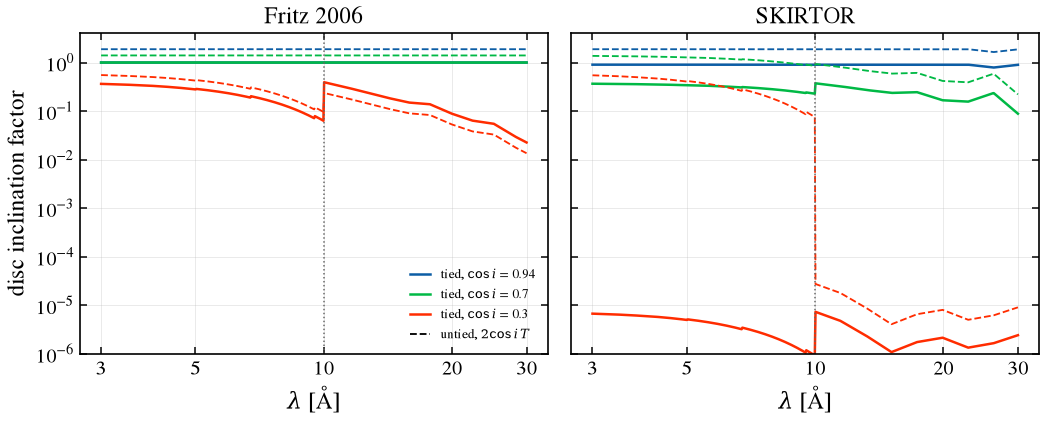
§9g SKIRTOR normalization and the AGN-only shape¶
Two checks on the SKIRTOR template as a stand-alone AGN, against skirtor2016 with disk_type=0 (SKIRTOR’s own disc, the one the library stores), at the §9 fiducial (i = 30°, τ_9.7 = 7, oa = 40°, fracAGN = 0.3, lambda_fracAGN="0/0").
Normalization mapping. pcigale sets agn_power = fracAGN/(1 − fracAGN) × L_dust,host and publishes the angle-integrated accretion power \(P_{\rm acc} = \frac{7/18}{\eta(30^\circ)}\,L_{\rm intrin,disc}\,{\rm agn\_power}
= 0.493\,L_{\rm intrin,disc}\,{\rm agn\_power}\). Here \(\eta(i) = \cos i\,(1+2\cos i)/3\) (Stalevski et al. 2016) and 7/18 is its mean over the sphere. tengri’s agn_log_lbol is that same angle-integrated accretion power, so agn_log_lbol = log10(P_acc / L_sun). The cell prints each link of the chain; the bolometric ratio below then tests the mapping against pcigale’s own sightline luminosity.
AGN-only shape. The AGN-only SED is each code’s AGN minus the same host without it. For tengri it is the SKIRTOR template’s disc plus torus (create_skirtor_components_from_grid, the library torus.skirtor reads) at agn_log_lbol and agn_cos_inc = cos 30°, with no host, so no host quantity enters. The shape is the mean \(L_\nu\) over 1.0–1.2 μm divided by the mean over 5400–5600 Å, and the bolometric ratio compares the AGN-only \(\int L_\nu\,d\nu\). pcigale reddens the
type-1 disc by \(E(B-V) = 0.03\) and re-emits that energy as polar dust, which this tengri model does not carry. The first row is therefore pcigale at its default EBV = 0.03; the second row sets EBV = 0 so the two share the disc and torus alone.
The printed mapping factor is 0.4931, and pcigale’s agn_power equals its agn.total_dust_luminosity exactly. The product (7/18)/η(30°) × lumin_intrin_disk × agn_power, with lumin_intrin_disk read from the module, reproduces the published accretion power to better than 0.1 %. lumin_intrin_disk is 2.77 at EBV = 0.03 and 3.60 at EBV = 0 (printed): pcigale normalizes the template so that the dust plus polar re-emission integrates to one, and the polar re-emission only
exists when E(B−V) > 0, so the same agn_power corresponds to a smaller intrinsic disc when the polar screen is on.
At the default EBV = 0.03 the AGN-only NIR/V shape of tengri is 0.960× of pcigale’s, with the V level at 1.013×, the 1.0–1.2 μm level at 0.972× and the bolometric ratio at 1.062×. At EBV = 0 the shape is 1.005×, the levels 0.936× and 0.940× and the bolometric ratio 0.921×. The first row’s bolometric agreement is therefore partly the polar-dust re-emission pcigale adds, which the composable model of §9 and §9c carries through its polar_dust block. The origin of the 0.92–0.94× offset
at EBV = 0 is not traced here; the shape is unaffected.
[28]:
from tengri.components.agn.skirtor import create_skirtor_components_from_grid

_SK_I = 30.0
_COS_SK = float(np.cos(np.radians(_SK_I)))
_ETA_SK = _COS_SK * (1.0 + 2.0 * _COS_SK) / 3.0
_K_ACC = (7.0 / 18.0) / _ETA_SK


def _skirtor_dt0_params(ebv):
    return dict(
        t=7,
        pl=1.0,
        q=1.0,
        oa=40,
        R=20,
        Mcl=0.97,
        i=int(_SK_I),
        disk_type=0,
        delta=0,
        fracAGN=0.3,
        lambda_fracAGN="0/0",
        law=0,
        EBV=ebv,
        temperature=100.0,
        emissivity=1.6,
    )


def _cigale_skirtor_dt0(ebv):
    return C.run_chain(
        [
            _sfh_args_d,
            ("bc03", dict(imf=1, metallicity=0.02, separation_age=10)),
            NEB_FIDUCIAL_CIGALE,
            ("dustatt_modified_starburst", dict(E_BV_lines=0.3)),
            ("skirtor2016", _skirtor_dt0_params(ebv)),
        ]
    )


_SKIRTOR_TEMPLATE_FN = create_skirtor_components_from_grid(
    str(_CIGALE_DALE_PARENT / "data" / "skirtor_templates_v3.h5")
)
_W_TEMPLATE = np.logspace(2.0, 7.0, 6000)


def _tengri_skirtor_template(log_lbol):
    """(wavelength [Å], disc + torus L_ν [erg/s/Hz]) of the SKIRTOR template at i = 30°."""
    parts = _SKIRTOR_TEMPLATE_FN(
        _W_TEMPLATE,
        agn_log_lbol=log_lbol,
        frac_agn=1.0,
        agn_tau_skirtor=7.0,
        agn_p_skirtor=1.0,
        agn_q_skirtor=1.0,
        agn_oa_skirtor=40.0,
        agn_radius_ratio=20.0,
        agn_cos_inc=_COS_SK,
    )
    return _W_TEMPLATE, np.asarray(parts.total)


def _window_mean(w, l_nu, lo, hi):
    sel = (w >= lo) & (w <= hi)
    return float(np.mean(l_nu[sel]))


print(f"§9g mapping factor 0.493 = (7/18)/eta(30°) = {_K_ACC:.4f} (eta(30°) = {_ETA_SK:.4f})")
_rows_9g = []
for _ebv in (0.03, 0.0):
    _sed_9g = _cigale_skirtor_dt0(_ebv)
    _agn_power = 0.3 / 0.7 * float(_sed_9g.info["dust.luminosity"])  # W
    _p_acc = float(_sed_9g.info["agn.accretion_power"])  # W
    # lumin_intrin_disk is the module's own attribute, read from the module and not
    # backed out of its output.
    _mod_9g = C._get_module_class("skirtor2016")(name="skirtor2016", **_skirtor_dt0_params(_ebv))
    _lintr = float(_mod_9g.lumin_intrin_disk)
    _p_formula = _K_ACC * _lintr * _agn_power
    assert abs(_p_formula / _p_acc - 1.0) < 1e-3, (_p_formula, _p_acc)
    _log_lbol = float(np.log10(_p_acc * 1e7 / L_SUN))
    print(
        f"  EBV = {_ebv}: agn_power {_agn_power:.4e} W "
        f"({_agn_power / float(_sed_9g.info['agn.total_dust_luminosity']):.4f} "
        "of agn.total_dust_luminosity), "
        f"lumin_intrin_disk {_lintr:.4f}, P_acc published {_p_acc:.4e} W, "
        f"(7/18)/η(30°) × lumin_intrin_disk × agn_power {_p_formula:.4e} W, "
        f"agn_log_lbol = {_log_lbol:.4f}"
    )
    _w_t_9g, _L_agn_t = _tengri_skirtor_template(_log_lbol)
    _w_s, _L_s = C.to_lnu(_sed_9g)
    _L_agn_c = _L_s - U.regrid(w_base, L_base, _w_s)
    _L_agn_t_on_c = U.regrid(_w_t_9g, _L_agn_t, _w_s)
    _nir_c = _window_mean(_w_s, _L_agn_c, 1.0e4, 1.2e4)
    _v_c = _window_mean(_w_s, _L_agn_c, 5400.0, 5600.0)
    _nir_t = _window_mean(_w_s, _L_agn_t_on_c, 1.0e4, 1.2e4)
    _v_t = _window_mean(_w_s, _L_agn_t_on_c, 5400.0, 5600.0)
    _bol_c = _lbol_nu(_w_s, _L_agn_c)
    _bol_t = _lbol_nu(_w_t_9g, _L_agn_t)
    _rows_9g.append(
        (
            _ebv,
            (_nir_t / _v_t) / (_nir_c / _v_c),
            _v_t / _v_c,
            _nir_t / _nir_c,
            _bol_t / _bol_c,
            _bol_c / 1e7 / float(_sed_9g.info["agn.luminosity"]),
        )
    )
    if _ebv == 0.03:
        _plot_9g = (_w_s, _L_agn_c, _w_t_9g, _L_agn_t)
print("§9g AGN-only SKIRTOR template, tengri / pcigale:")
print(f"  {'EBV':>5s} {'NIR/V shape':>12s} {'V level':>8s} {'NIR level':>10s} {'bolometric':>11s}")
for _e, _sh, _lv, _ln, _bl, _chk in _rows_9g:
    print(f"  {_e:5.2f} {_sh:12.3f} {_lv:8.3f} {_ln:10.3f} {_bl:11.3f}")
    assert abs(_chk - 1.0) < 2e-2, _chk  # pcigale's own sightline luminosity closes
# Regression pins around the printed values (±0.03 on the shape, ±0.05 on the bolometric
# ratio), to catch a change in either code; they are not a physics tolerance.
for _row_9g, _shape, _bol in zip(_rows_9g, (0.960, 1.005), (1.062, 0.921)):
    assert abs(_row_9g[1] - _shape) < 0.03 and abs(_row_9g[4] - _bol) < 0.05, _row_9g

_wp_c, _Lp_c, _wp_t, _Lp_t = _plot_9g
fig, ax, ax_r, _ratio_9g = U.overlay_ratio_fig(
    _wp_c,
    _Lp_c,
    _wp_t,
    _Lp_t,
    title="§9g SKIRTOR AGN-only (i = 30°, τ_9.7 = 7)",
    label_c="pcigale  skirtor2016 − host",
    label_t="tengri  SKIRTOR template",
    ratio_ylim=(0.5, 1.5),
    xlim=(1e3, 1e6),
    dyn_range=1e-4,
    figsize=(8, 5.6),
)
for _lo, _hi in ((1.0e4, 1.2e4), (5400.0, 5600.0)):
    ax.axvspan(_lo, _hi, color="0.8", alpha=0.5, lw=0)
fig.tight_layout()
save_fig("cigale_09_skirtor_agn_only.png")
§9g mapping factor 0.493 = (7/18)/eta(30°) = 0.4931 (eta(30°) = 0.7887)
  EBV = 0.03: agn_power 7.0146e+25 W (1.0000 of agn.total_dust_luminosity), lumin_intrin_disk 2.7683, P_acc published 9.5734e+25 W, (7/18)/η(30°) × lumin_intrin_disk × agn_power 9.5751e+25 W, agn_log_lbol = -0.6019
  EBV = 0.0: agn_power 7.0146e+25 W (1.0000 of agn.total_dust_luminosity), lumin_intrin_disk 3.5981, P_acc published 1.2443e+26 W, (7/18)/η(30°) × lumin_intrin_disk × agn_power 1.2445e+26 W, agn_log_lbol = -0.4880
§9g AGN-only SKIRTOR template, tengri / pcigale:
    EBV  NIR/V shape  V level  NIR level  bolometric
   0.03        0.960    1.013      0.972       1.062
   0.00        1.005    0.936      0.940       0.921
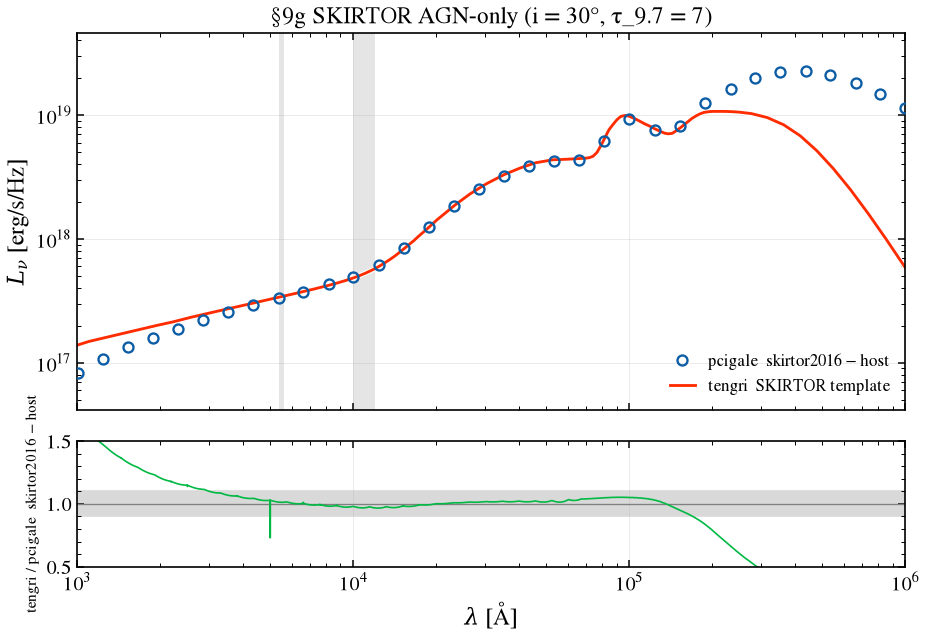
§10 X-ray¶
CIGALE module xray (Yang et al. 2020: an AGN corona power law plus X-ray binaries and hot gas) ↔ tengri xray={"type": "yang20"}. The figure overlays the two coronas against photon energy, with the tengri/CIGALE ratio below. Three conventions are matched: α_ox is derived from L_2500 (Just et al. 2007, L_2keV = L_2500 · 10^(α_ox/0.3838)) on both sides at log₁₀ L_2500 = 29.47; inclination follows Yang+2020 at i = 30° (agn_cos_inc); and N_H is pinned to zero on both sides. The disc
power is set through agn_log_lbol (the angle-integrated accretion power), solved so that both codes’ intrinsic L_2500 agree to the printed digits. At log N_H = 0 tengri’s Ricci et al. (2017) scattered floor is 1 % of an unabsorbed corona and is not what the printed residual is. The cell prints the ratio at 2 keV and as a median over 0.5–10 keV.
The binary and hot-gas templates. pcigale normalizes its hot-gas (0.5–2 keV), LMXB (2–10 keV) and HMXB (0.5–8 keV) templates with a trapezoid sum over its own wavelength grid, restricted to the grid points inside each band (pcigale/sed_modules/yang20.py). The band edges fall between grid points, so the band integral CIGALE normalizes to is a truncated one. The 0.99× of the capstone’s X-ray rows, where the galaxy carries these templates and no corona, is that convention.
Verification Status: PARTIAL (3/16): Radio, X-ray and AGN
[29]:
_LOG_L2500_TARGET = (2.638 + 1.4) / 0.137  # Just+2007 == CIGALE's -1.4


def _cigale_xray(sfr_a, incl):
    return C.run_chain(
        [
            (
                "sfhdelayed",
                dict(
                    tau_main=1000,
                    age_main=5000,
                    tau_burst=50,
                    age_burst=20,
                    f_burst=0.0,
                    sfr_A=sfr_a,
                    normalise=False,
                ),
            ),
            ("bc03", dict(imf=1, metallicity=0.02, separation_age=10)),
            NEB_FIDUCIAL_CIGALE,
            ("dustatt_modified_starburst", dict(E_BV_lines=0.3)),
            ("dale2014", dict(alpha=2.0)),
            (
                "skirtor2016",
                dict(
                    t=7,
                    pl=1.0,
                    q=1.0,
                    oa=40,
                    R=20,
                    Mcl=0.97,
                    i=incl,
                    disk_type=1,
                    delta=-0.36,
                    fracAGN=0.3,
                    law=0,
                    EBV=0.0,
                    temperature=100,
                    emissivity=1.6,
                ),
            ),
            (
                "yang20",
                dict(
                    gam=1.8,
                    E_cut=300.0,
                    alpha_ox=-1.4,
                    max_dev_alpha_ox=0.2,
                    angle_coef="0.5 & 0",
                    det_lmxb=0.0,
                    det_hmxb=0.0,
                ),
            ),
        ]
    )


def _cigale_corona(sed):
    """CIGALE's corona-only component in tengri units (erg/s/Hz, Å)."""
    return U.wnm_to_erg_per_hz_per_aa(
        np.asarray(sed.wavelength_grid), np.asarray(sed.luminosities["xray.agn"])
    )


def _cigale_l2500(sed):
    """Intrinsic disc L_2500 [erg/s/Hz]; CIGALE stores W/Hz."""
    return float(sed.info["agn.intrin_Lnu_2500A_30deg"]) * 1e7


def _tengri_xray(log_lbol, cos_inc):
    return SEDModel.build(
        ssp_data=ssp,
        met=MET_FIDUCIAL,
        sfh={
            "type": "delayed",
            "tau_gyr": Fixed(1.0),
            "age_gyr": Fixed(5.0),
            "log_total_mass": Fixed(0.0),
            "all_params": Fixed(DEFAULT),
        },
        dust_attenuation={
            "type": "two_component",
            "law_bc": "leitherer02",
            "law_diff": "leitherer02",
            "tau_bc": Fixed(TAU_BC_FIDUCIAL),
            "tau_diff": Fixed(TAU_DIFF_FIDUCIAL),
            # Lyman-limit clip (CIGALE parity) — match §5/§6
            "lyman_cutoff": True,
            "all_params": Fixed(DEFAULT),
        },
        agn={
            "type": "composable",
            "disc": {"type": "schartmann2005", "all_params": Fixed(DEFAULT)},
            "torus": {"type": "skirtor", "all_params": Fixed(DEFAULT)},
            # Polar dust off, matching the ``EBV=0.0`` in this section's
            # skirtor2016 call — stated rather than left to omission, since it
            # is the one AGN input §9 and §10 deliberately differ on.
            # ``type='none'`` and not ``polar_dust`` with ebv = 0: the block
            # refuses to be selected with no extinction to apply.
            "atten": {"type": "none"},
            # No ``agn_ir_frac`` here: this section solves for the disc power
            # directly, so ``agn_log_lbol`` is the knob that acts.
            "agn_log_lbol": Fixed(log_lbol),
            "agn_cos_inc": Fixed(cos_inc),
            "all_params": Fixed(DEFAULT),
        },
        xray={"type": "yang20", "log_nh": Fixed(0.0), "all_params": Fixed(DEFAULT)},
        neb=NEB_FIDUCIAL_TENGRI,
        redshift=Fixed(0.0),
    )


_COS30 = float(np.cos(np.radians(30.0)))

# Solve both codes onto log10 L_2500 = 29.47 from one trial run each —
# the disc scales linearly with sfr_A (CIGALE, via fracAGN) and with
# 10**agn_log_lbol (tengri, schartmann2005 has an L_bol-independent shape).
_trial_c = _cigale_xray(1e8, 30)
_SFR_A_XRAY = 1e8 * 10.0**_LOG_L2500_TARGET / _cigale_l2500(_trial_c)
sed_x = _cigale_xray(_SFR_A_XRAY, 30)
w_x, L_x = _cigale_corona(sed_x)
_l2500_c = _cigale_l2500(sed_x)

_trial_t = _tengri_xray(11.5, _COS30).predict_state({})
_AGN_LOG_LBOL_XRAY = 11.5 + float(
    np.log10(_l2500_c / float(np.asarray(_trial_t.derived["L_2500_intrinsic"])))
)
state_x = _tengri_xray(_AGN_LOG_LBOL_XRAY, _COS30).predict_state({})
_l2500_t = float(np.asarray(state_x.derived["L_2500_intrinsic"]))
print(
    f"§10 matched disc L_2500: CIGALE log10={np.log10(_l2500_c):.4f}  "
    f"tengri log10={np.log10(_l2500_t):.4f}"
)

w_t = np.asarray(state_x.wave)
sed_t = np.asarray(state_x.derived["sed_xray"])
e_kev_c = 12.398 / w_x
e_kev_t = 12.398 / w_t

m_c = (e_kev_c >= 0.3) & (e_kev_c <= 300) & (L_x > 0)
_order = np.argsort(e_kev_c[m_c])
_e = e_kev_c[m_c][_order]
_Lc = L_x[m_c][_order]
_Lt = U.regrid(e_kev_t, sed_t, _e)
_ratio = _Lt / np.maximum(_Lc, 1e-300)
_assert_comparable(_Lc, _Lt, name="§10 corona")

fig, (ax, ax_r) = plt.subplots(
    2, 1, figsize=(10, 7), sharex=True, gridspec_kw={"height_ratios": [3, 1]}
)
ax.plot(_e, _Lc, "C0-", linewidth=1.6, label="CIGALE  xray.agn corona (Yang+2020)")
ax.plot(_e, _Lt, "C1--", linewidth=1.4, label="tengri  xray.yang20 corona")
ax.set_xscale("log")
ax.set_yscale("log")
ax.set_ylabel(r"$L_\nu$ [erg s$^{-1}$ Hz$^{-1}$]")
ax.set_title(
    r"X-ray corona at matched disc $L_{2500}$ "
    r"($\log_{10} L_{2500} = 29.47$, $i = 30°$)"
)
ax.legend(fontsize=10)
ax.grid(True, alpha=0.3)
ax_r.axhspan(0.9, 1.1, color="0.85", zorder=0)
ax_r.axhline(1.0, color="0.5", linewidth=0.8)
ax_r.plot(_e, _ratio, "C1-", linewidth=1.0)
ax_r.set_xscale("log")
ax_r.set_yscale("log")
ax_r.set_ylim(0.5, 2.0)
ax_r.set_xlabel(r"$E$ [keV]")
ax_r.set_ylabel("tengri / CIGALE", fontsize=9)
ax_r.grid(True, alpha=0.3)
_soft = (_e >= 0.5) & (_e <= 10.0)
print(
    f"§10 corona parity (tengri/CIGALE): 2 keV = "
    f"{_ratio[np.argmin(np.abs(_e - 2.0))]:.3f}x, "
    f"median 0.5-10 keV = {float(np.median(_ratio[_soft])):.3f}x"
)
fig.tight_layout()
save_fig("cigale_10_xray_corona.png")
src/tengri/forward/sed_model.py:13601: SFHBeyondOldestTemplateWarning: The SSP grid's oldest template is 13.700 Gyr but the universe is 13.787 Gyr old at redshift 0. Stars formed in that gap are older than every template, so both age kernels assign them to the oldest one: the formed mass is conserved, and those stars carry the colors of a 13.700 Gyr population. Use a grid whose oldest template reaches 13.787 Gyr (e.g. MIST) to remove the approximation.
  return cls(
§10 matched disc L_2500: CIGALE log10=29.4745  tengri log10=29.4745
§10 corona parity (tengri/CIGALE): 2 keV = 1.010x, median 0.5-10 keV = 1.010x
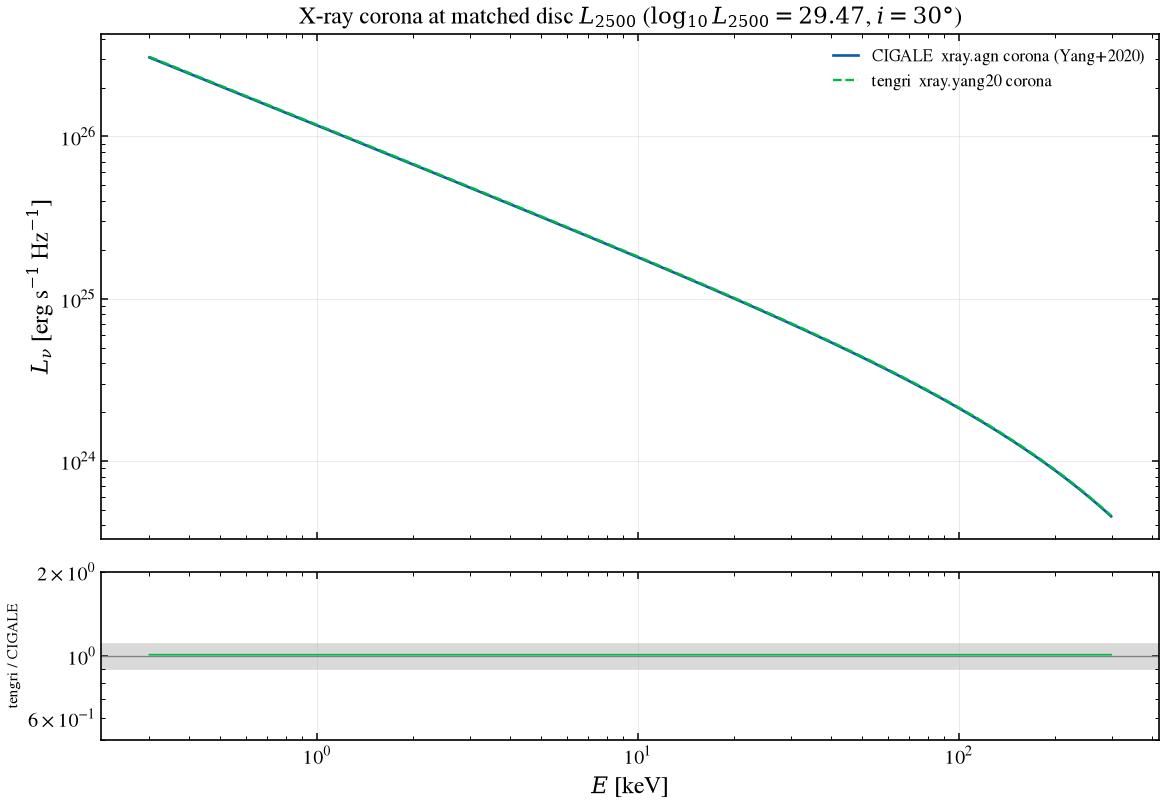
§10b Inclination sweep¶
The Yang et al. (2022) corona anisotropy f(μ) = (a₁μ + 1 − a₁) / (1 − 0.13397 a₁) with a₁ = 0.5 equals 1 at the 30° anchor. Both codes apply the same f(cos i) tilt; the sweep rescales each angle to hold the corona anchor at the α_ox crossing.
[30]:
fig, (ax, ax_r) = plt.subplots(
    2, 1, figsize=(10, 7), sharex=True, gridspec_kw={"height_ratios": [3, 1]}
)
print(" i     f(mu)   log10 L_2500,c   tengri/CIGALE @ 2 keV")
for _i_deg, _col in zip((0, 30, 60, 80), ("C0", "C2", "C3", "C4")):
    # hold the corona anchor at the alpha_ox crossing: fracAGN raises the
    # intrinsic disc as the torus hides it, so rescale sfr_A per angle
    _probe_i = _cigale_xray(_SFR_A_XRAY, _i_deg)
    sed_i = _cigale_xray(_SFR_A_XRAY * 10.0**_LOG_L2500_TARGET / _cigale_l2500(_probe_i), _i_deg)
    w_ci, L_ci = _cigale_corona(sed_i)
    _l25_i = _cigale_l2500(sed_i)
    _mu = float(np.cos(np.radians(_i_deg)))
    st_i = _tengri_xray(
        _AGN_LOG_LBOL_XRAY + float(np.log10(_l25_i / _l2500_c)), _mu
    ).predict_state({})
    w_ti = np.asarray(st_i.wave)
    L_ti = np.asarray(st_i.derived["sed_xray"])
    e_ci = 12.398 / w_ci
    _mm = (e_ci >= 0.3) & (e_ci <= 300) & (L_ci > 0)
    _oo = np.argsort(e_ci[_mm])
    _ee = e_ci[_mm][_oo]
    _LLc = L_ci[_mm][_oo]
    _LLt = U.regrid(12.398 / w_ti, L_ti, _ee)
    ax.plot(_ee, _LLc, color=_col, linewidth=1.5, label=f"i = {_i_deg}°")
    ax.plot(_ee, _LLt, color=_col, linewidth=1.2, linestyle="--")
    ax_r.plot(_ee, _LLt / np.maximum(_LLc, 1e-300), color=_col, linewidth=1.0)
    _f_mu = (0.5 * _mu + 0.5) / (1.0 - 0.13397 * 0.5)
    _r2 = float(_LLt[np.argmin(np.abs(_ee - 2.0))] / _LLc[np.argmin(np.abs(_ee - 2.0))])
    print(f" {_i_deg:2d}    {_f_mu:.4f}   {np.log10(_l25_i):.4f}          {_r2:.4f}")
ax.set_xscale("log")
ax.set_yscale("log")
ax.set_ylabel(r"$L_\nu$ [erg s$^{-1}$ Hz$^{-1}$]")
ax.set_title("Corona vs inclination — CIGALE solid, tengri dashed")
ax.legend(fontsize=10, ncol=2)
ax.grid(True, alpha=0.3)
ax_r.axhspan(0.9, 1.1, color="0.85", zorder=0)
ax_r.axhline(1.0, color="0.5", linewidth=0.8)
ax_r.set_xscale("log")
ax_r.set_ylim(0.8, 1.25)
ax_r.set_xlabel(r"$E$ [keV]")
ax_r.set_ylabel("tengri / CIGALE", fontsize=9)
ax_r.grid(True, alpha=0.3)
fig.tight_layout()
save_fig("cigale_10b_xray_inclination.png")
i f(mu) log10 L_2500,c tengri/CIGALE @ 2 keV
src/tengri/forward/sed_model.py:13601: SFHBeyondOldestTemplateWarning: The SSP grid's oldest template is 13.700 Gyr but the universe is 13.787 Gyr old at redshift 0. Stars formed in that gap are older than every template, so both age kernels assign them to the oldest one: the formed mass is conserved, and those stars carry the colors of a 13.700 Gyr population. Use a grid whose oldest template reaches 13.787 Gyr (e.g. MIST) to remove the approximation.
  return cls(
0 1.0718 29.4745 1.0100
src/tengri/forward/sed_model.py:13601: SFHBeyondOldestTemplateWarning: The SSP grid's oldest template is 13.700 Gyr but the universe is 13.787 Gyr old at redshift 0. Stars formed in that gap are older than every template, so both age kernels assign them to the oldest one: the formed mass is conserved, and those stars carry the colors of a 13.700 Gyr population. Use a grid whose oldest template reaches 13.787 Gyr (e.g. MIST) to remove the approximation.
  return cls(
30 1.0000 29.4745 1.0100
src/tengri/forward/sed_model.py:13601: SFHBeyondOldestTemplateWarning: The SSP grid's oldest template is 13.700 Gyr but the universe is 13.787 Gyr old at redshift 0. Stars formed in that gap are older than every template, so both age kernels assign them to the oldest one: the formed mass is conserved, and those stars carry the colors of a 13.700 Gyr population. Use a grid whose oldest template reaches 13.787 Gyr (e.g. MIST) to remove the approximation.
  return cls(
60 0.8038 29.4745 1.0100
src/tengri/forward/sed_model.py:13601: SFHBeyondOldestTemplateWarning: The SSP grid's oldest template is 13.700 Gyr but the universe is 13.787 Gyr old at redshift 0. Stars formed in that gap are older than every template, so both age kernels assign them to the oldest one: the formed mass is conserved, and those stars carry the colors of a 13.700 Gyr population. Use a grid whose oldest template reaches 13.787 Gyr (e.g. MIST) to remove the approximation.
  return cls(
80 0.6290 29.4745 1.0100
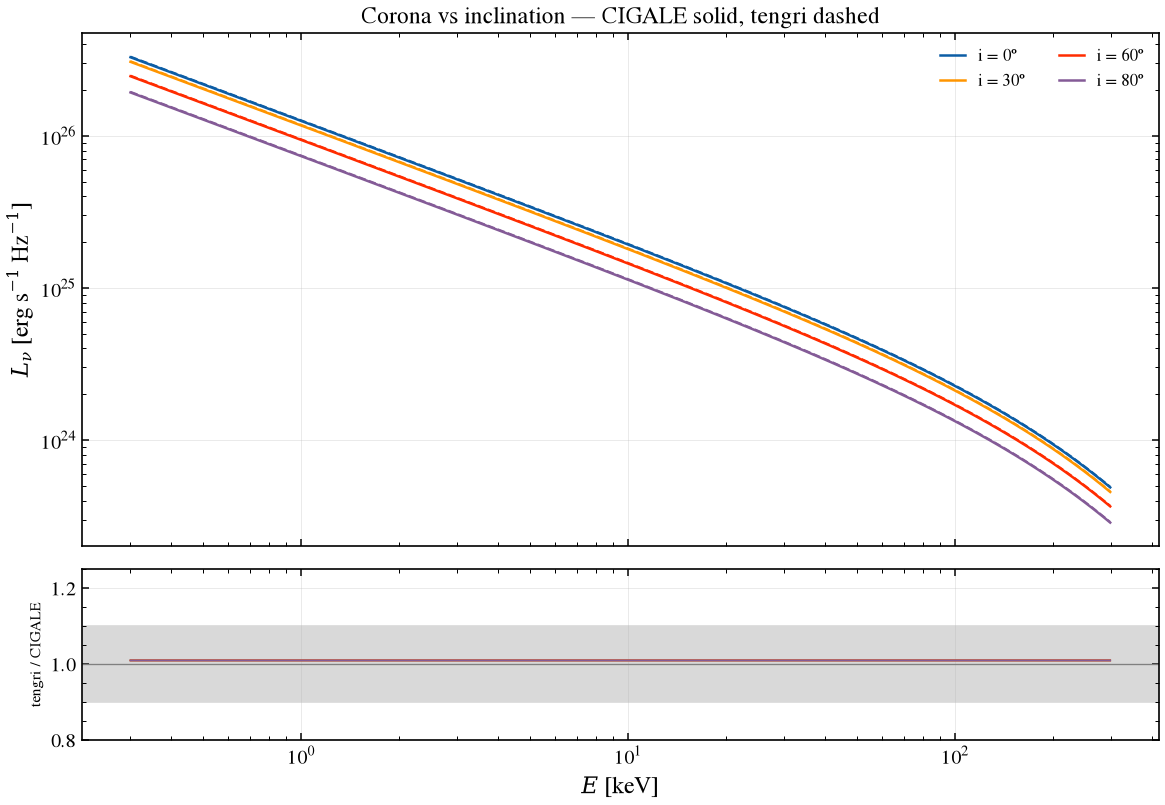
§10c The lopez24 X-ray module¶
CIGALE’s lopez24 and tengri’s xray={"type": "lopez24"} are the same kind of model, an X-ray module, and not a dust emitter. Both build the host’s hot-gas, high-mass and low-mass X-ray-binary emission from the star-formation rate, stellar mass, age and metallicity, and set the AGN corona from the AGN’s mid-infrared luminosity rather than from its UV disc (Lopez et al. 2024): \(L_X(2\text{–}10\,{\rm keV}) = \nu L_\nu(12\,\mu{\rm m})
/ 10^{\alpha_{\rm IRX}}\) (Asmus et al. 2015), with a power law of Γ = 1.8 and a 300 keV cutoff. alpha_irx is the one AGN-side knob; the AGN’s 12 μm luminosity comes from the AGN component of each code.
The cell builds the §9 AGN on both sides (SKIRTOR torus, Schartmann disc, fracAGN = agn_ir_frac = 0.3, i = 30°, no polar dust) on a 1e11 M☉ host, and sweeps alpha_irx ∈ {0, 0.3, 0.6} with N_H = 0 and no binary offsets. The corona is each code’s X-ray SED with and without the AGN (tengri) or its xray.agn component (pcigale). The table prints the host (hot gas plus binaries) and corona ratios at 2 keV and as a median over 0.5–10 keV, beside the ratio of the two codes’ 12 μm
luminosities. The corona ratio follows the 12 μm ratio at the 0.1 % level, so what separates the two codes is the AGN’s mid-infrared luminosity (§9, torus 1.011×) and not the X-ray module.
[31]:
_LOPEZ_MASS = 1e11
_LOPEZ_ALPHAS = (0.0, 0.3, 0.6)


def _cigale_lopez24(alpha_irx):
    return C.run_chain(
        [
            _SFH_CHAIN,
            _BC03_CHAIN,
            NEB_FIDUCIAL_CIGALE,
            _DUSTATT_CHAIN,
            ("dale2014", dict(alpha=2.0)),
            (
                "skirtor2016",
                dict(
                    t=7,
                    pl=1.0,
                    q=1.0,
                    oa=40,
                    R=20,
                    Mcl=0.97,
                    i=30,
                    disk_type=1,
                    delta=0.0,
                    fracAGN=0.3,
                    lambda_fracAGN="0/0",
                    law=0,
                    EBV=0.0,
                    temperature=100.0,
                    emissivity=1.6,
                ),
            ),
            (
                "lopez24",
                dict(gam=1.8, E_cut=300.0, alpha_irx=alpha_irx, det_lmxb=0.0, det_hmxb=0.0),
            ),
        ]
    )


def _tengri_lopez24(alpha_irx, with_agn):
    with warnings.catch_warnings():
        # Same as §6d: the 5 Gyr host has no star beyond the grid's oldest template.
        warnings.simplefilter("ignore", SFHBeyondOldestTemplateWarning)
        return _build_tengri_lopez24(alpha_irx, with_agn)


def _build_tengri_lopez24(alpha_irx, with_agn):
    agn = (
        {
            "type": "composable",
            "disc": {"type": "schartmann2005", "all_params": Fixed(DEFAULT)},
            "torus": {"type": "skirtor", "all_params": Fixed(DEFAULT)},
            "atten": {"type": "none"},
            "agn_ir_frac": Fixed(0.3),
            "agn_cos_inc": Fixed(_COS30),
            "all_params": Fixed(DEFAULT),
        }
        if with_agn
        else {"type": "none"}
    )
    return SEDModel.build(
        ssp_data=ssp,
        met=MET_FIDUCIAL,
        sfh={
            "type": "delayed",
            "tau_gyr": Fixed(1.0),
            "age_gyr": Fixed(5.0),
            "log_total_mass": Fixed(float(np.log10(_LOPEZ_MASS))),
            "all_params": Fixed(DEFAULT),
        },
        dust_attenuation=_AGN_DUSTATT_9E,
        agn=agn,
        xray={
            "type": "lopez24",
            "log_nh": Fixed(0.0),
            "alpha_irx": Fixed(alpha_irx),
            "all_params": Fixed(DEFAULT),
        },
        neb=NEB_FIDUCIAL_TENGRI,
        redshift=Fixed(0.0),
    ).predict_state({})


def _cigale_xray_component(sed, key):
    """(E [keV], L_nu [erg/s/Hz]) of a pcigale X-ray component at the 1e11 M☉ mass."""
    w, l_nu = U.wnm_to_erg_per_hz_per_aa(
        np.asarray(sed.wavelength_grid), np.asarray(sed.luminosities[key])
    )
    return 12.398 / w, l_nu * _LOPEZ_MASS


def _on_energy(state, e_ref):
    e_t = 12.398 / np.asarray(state.wave)
    order = np.argsort(e_t)
    return np.interp(e_ref, e_t[order], np.asarray(state.derived["sed_xray"])[order])


def _ratio_stats(e_ref, l_c, l_t):
    sel = (e_ref >= 0.5) & (e_ref <= 10.0) & (l_c > 0)
    ratio = l_t / np.where(l_c > 0, l_c, np.nan)
    return float(ratio[np.argmin(np.abs(e_ref - 2.0))]), float(np.nanmedian(ratio[sel]))


fig = plt.figure(figsize=(8, 5.6))
gs = fig.add_gridspec(2, 1, height_ratios=[3, 1], hspace=0.08)
ax = fig.add_subplot(gs[0])
ax_r = fig.add_subplot(gs[1], sharex=ax)
print("§10c lopez24, tengri / pcigale (2 keV, median 0.5-10 keV):")
print(
    f"  {'alpha_irx':>9s} {'L_12um':>7s} {'corona 2 keV':>13s} {'corona med':>11s} "
    f"{'corona/L_12um':>14s} {'host 2 keV':>11s} {'host med':>9s}"
)
_gal_t = _tengri_lopez24(0.3, with_agn=False)
for _alpha, _col in zip(_LOPEZ_ALPHAS, ("C0", "C1", "C3")):
    _sed_l = _cigale_lopez24(_alpha)
    _st_l = _tengri_lopez24(_alpha, with_agn=True)
    _e_g, _L_g = _cigale_xray_component(_sed_l, "xray.galaxy")
    _e_a, _L_a = _cigale_xray_component(_sed_l, "xray.agn")
    _corona_t = _on_energy(_st_l, _e_a) - _on_energy(_gal_t, _e_a)
    _host_t = _on_energy(_gal_t, _e_g)
    _r12 = 10.0 ** (
        float(np.asarray(_st_l.derived["log_L_12um"]))
        - float(np.log10(float(_sed_l.info["agn.L_12um"]) * _LOPEZ_MASS * 1e7))
    )
    _cor2, _corm = _ratio_stats(_e_a, _L_a, _corona_t)
    _host2, _hostm = _ratio_stats(_e_g, _L_g, _host_t)
    print(
        f"  {_alpha:9.1f} {_r12:7.4f} {_cor2:13.4f} {_corm:11.4f} {_cor2 / _r12:14.4f} "
        f"{_host2:11.4f} {_hostm:9.4f}"
    )
    assert abs(_cor2 / _r12 - 1.0) < 5e-3, (_alpha, _cor2, _r12)
    _o = np.argsort(_e_a)
    ax.plot(_e_a[_o], _L_a[_o], color=_col, **_REF_KW)
    ax.plot(
        _e_a[_o],
        _corona_t[_o],
        color=_col,
        lw=_TNG_LW,
        label=rf"$\alpha_{{\rm IRX}}$ = {_alpha:g}",
    )
    _pos = _corona_t[_o] > 0
    ax_r.plot(_e_a[_o][_pos], (_corona_t[_o] / _L_a[_o])[_pos], color=_col, lw=1.1)
ax.plot([], [], "k-", **_REF_KW, label="pcigale `lopez24` corona")
ax.plot([], [], "k-", lw=_TNG_LW, label="tengri `lopez24` corona")
ax.set(xscale="log", yscale="log", ylabel=r"$L_\nu$ [erg s$^{-1}$ Hz$^{-1}$]")
ax.set_xlim(0.3, 300.0)
ax.set_ylim(1e22, 1e27)
ax.legend(fontsize=8, frameon=False)
ax.tick_params(labelbottom=False)
ax.grid(True, alpha=0.3)
ax_r.axhspan(0.9, 1.1, color="0.85", zorder=0)
ax_r.axhline(1.0, color="0.5", linewidth=0.8)
ax_r.set(xscale="log", ylim=(0.8, 1.25), xlabel=r"$E$ [keV]", ylabel="tengri/CIGALE")
ax_r.grid(True, alpha=0.3)
fig.tight_layout()
save_fig("cigale_10c_xray_lopez24.png")
§10c lopez24, tengri / pcigale (2 keV, median 0.5-10 keV):
  alpha_irx  L_12um  corona 2 keV  corona med  corona/L_12um  host 2 keV  host med
        0.0  1.0115        1.0124      1.0124         1.0009      0.9922    0.9935
        0.3  1.0115        1.0124      1.0124         1.0009      0.9922    0.9935
        0.6  1.0115        1.0124      1.0124         1.0009      0.9922    0.9935
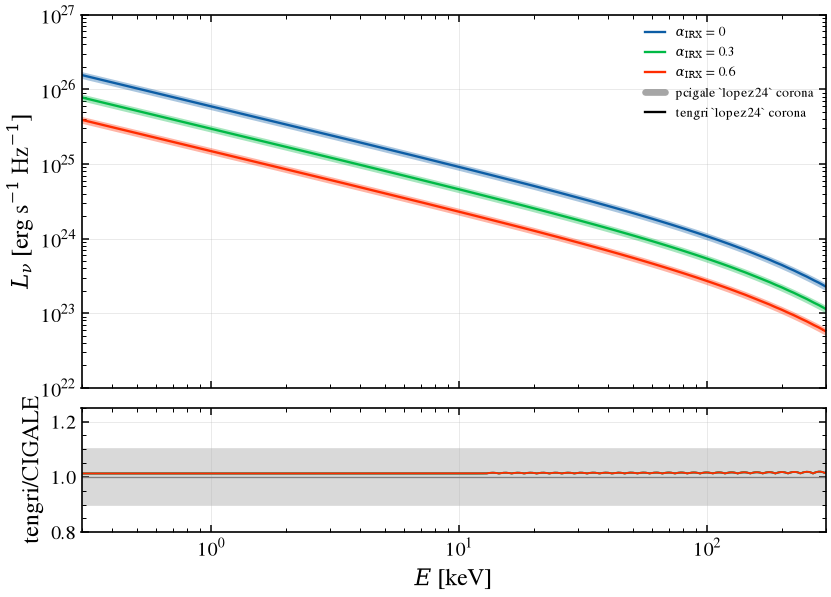
§11 Radio¶
CIGALE module radio (qir_sf, alpha_sf) ↔ tengri radio={"sf": {"type": "bell2003", "freefree": False, "nu_ref": "21cm", "ir_window": "total"}, "radio_q_ir": 2.5, "radio_alpha_sf": 0.8}. The figure overlays the star-forming radio spectrum of both codes; the lower panel is the tengri/CIGALE ratio.
What ``q_IR`` calibrates. pcigale’s radio module is synchrotron only: its qir_sf sets the 21 cm non-thermal luminosity, L_ref = L_dust / (3.75e12 · 10^q_IR), and CIGALE’s thermal free-free comes from its nebular module. tengri’s radio_q_ir is by default Bell (2003)’s total 1.4 GHz calibration (synchrotron plus thermal): the synchrotron is the non-thermal share 1 − f_th of that total, and the thermal part comes from the nebular continuum or, with
freefree: True, from the Murphy et al. (2011) free-free term. freefree: False switches to CIGALE’s convention: q_IR calibrates the non-thermal term alone, the synchrotron carries all of it, and the thermal free-free is whatever the nebular continuum supplies. The like-for-like comparison below therefore uses freefree: False; tengri’s default (Bell 2003: TIR 8–1000 μm, 1.4 GHz, thermal from the nebular continuum) is overlaid as the dash-dot curve.
Conventions. tengri’s defaults are Bell (2003)’s: q_IR defined at 1.4 GHz and the IR luminosity integrated over the model’s own paper window (TIR, 8–1000 μm). pcigale normalizes the relation at 21 cm (1.4276 GHz) and feeds it the total dust luminosity. The comparison builds therefore set nu_ref: "21cm" and ir_window: "total" explicitly in the sf block.
Both codes anchor the amplitude on the absorbed dust power, so any mismatch in L_absorbed lands 1:1 in the radio. With the two conventions matched, the flat synchrotron ratio is predicted by the energy anchor alone (L_absorbed against CIGALE’s dust.luminosity, §6). The cell prints the measured range beside the prediction.
With freefree: False the synchrotron carries the whole q_IR. In tengri’s default the cell prints the following. The TIR input to the radio block is 0.944 of the total dust luminosity. The default synchrotron is 0.840 of the CIGALE-convention synchrotron at 1.4 GHz, which combines the thermal share removed from Bell’s total, that smaller TIR input and the 1.4 against 1.4276 GHz anchor. The remaining numbers share one base, Bell’s TIR total at exactly 1.4 GHz: the synchrotron is 0.9033 of
it and the nebular continuum 0.0583, so (synchrotron + nebular continuum) / Bell total is 0.9615. It falls below 1 because the thermal share removed from the total, which is the Murphy et al. (2011) term at the TIR input (0.0967), exceeds the nebular continuum by 0.0385.
The ratio panel also compares the two thermal terms, the nebular continuum’s free-free tail and the Murphy et al. (2011) term, with CIGALE’s synchrotron: a calibration comparison between two implementations of the same physics. §11b tests the thermal free-free itself, per ionizing photon, against an analytic reference.
Verification Status: PARTIAL (3/25): Radio, X-ray, IGM and PSD physics
[32]:
sed_r = C.run_chain(
    [
        (
            "sfhdelayed",
            dict(
                tau_main=1000,
                age_main=5000,
                tau_burst=50,
                age_burst=20,
                f_burst=0.0,
                sfr_A=1.0,
                normalise=True,
            ),
        ),
        ("bc03", dict(imf=1, metallicity=0.02, separation_age=10)),
        NEB_FIDUCIAL_CIGALE,
        ("dustatt_modified_starburst", dict(E_BV_lines=0.3)),
        ("dale2014", dict(alpha=2.0)),
        ("radio", dict(qir_sf=2.5, alpha_sf=0.8, R_agn=0.0, alpha_agn=0.7)),
    ]
)
# CIGALE's SF radio is a single synchrotron component: isolate it.
w_r, L_r = U.wnm_to_erg_per_hz_per_aa(
    np.asarray(sed_r.wavelength_grid), np.asarray(sed_r.luminosities["radio.sf_nonthermal"])
)

_dust_radio_cfg = {
    "type": "two_component",
    "law_bc": "leitherer02",
    "law_diff": "leitherer02",
    "tau_bc": Fixed(TAU_BC_FIDUCIAL),
    "tau_diff": Fixed(TAU_DIFF_FIDUCIAL),
    "lyman_cutoff": True,
    "all_params": Fixed(DEFAULT),
}


def _radio_model(sf_block):
    """The §11 galaxy with one star-forming radio configuration."""
    return SEDModel.build(
        ssp_data=ssp,
        met=MET_FIDUCIAL,
        sfh={
            "type": "delayed",
            "tau_gyr": Fixed(1.0),
            "age_gyr": Fixed(5.0),
            "log_total_mass": Fixed(0.0),
            "all_params": Fixed(DEFAULT),
        },
        dust_attenuation=_dust_radio_cfg,
        dust_emission={
            "type": "dale2014_cigale",
            "alpha_dale": Fixed(2.0),
            "all_params": Fixed(DEFAULT),
        },
        radio={
            "sf": sf_block,
            "agn": {"type": "powerlaw"},
            "radio_q_ir": Fixed(2.5),
            "radio_alpha_sf": Fixed(0.8),
            "all_params": Fixed(DEFAULT),
        },
        neb=NEB_FIDUCIAL_TENGRI,
        redshift=Fixed(0.0),
    )


# CIGALE's convention: q_IR calibrates the non-thermal term alone.
# pcigale normalizes the relation at 21 cm and feeds it the total dust luminosity;
# tengri's defaults are Bell (2003)'s 1.4 GHz and the TIR (8-1000 um) window, so
# both are set explicitly here.
_CIGALE_RADIO_SF = {
    "type": "bell2003",
    "freefree": False,
    "nu_ref": "21cm",
    "ir_window": "total",
}
state_r = _radio_model(_CIGALE_RADIO_SF).predict_state({})
w_t = np.asarray(state_r.wave)
sed_t = np.asarray(state_r.derived["sed_radio"])  # synchrotron carrying the whole q_IR

# tengri's default (Bell 2003: TIR 8-1000 um window, 1.4 GHz): q_IR calibrates Bell's
# total, and the thermal term comes from the nebular continuum.
state_r_tot = _radio_model({"type": "bell2003"}).predict_state({})
sed_t_tot = np.asarray(state_r_tot.derived["sed_radio"])  # (1 - f_th) of the total

# Shared-axis overlay + ratio panel: the main pair is non-thermal on both sides.
fig, ax, ax_r, ratio = U.overlay_ratio_fig(
    w_r,
    L_r,
    w_t,
    sed_t,
    x_of_wave=lambda w: C_AA / w / 1e9,
    xlabel=r"$\nu$ [GHz]",
    title="§11 SF radio: synchrotron calibrated as CIGALE's `qir_sf`",
    label_c="CIGALE  radio.sf_nonthermal (synchrotron only)",
    label_t="tengri  bell2003, freefree=False (q_IR calibrates the synchrotron)",
    xlim=(0.1, 100.0),
    ratio_ylim=(0.5, 2.0),
)
# Widen CIGALE into a translucent band so the thin curves read against it.
for _ln in ax.get_lines():
    if _ln.get_label().startswith("CIGALE"):
        _ln.set(linewidth=4.0, alpha=0.35, solid_capstyle="round")

# tengri's default build: synchrotron is the non-thermal share of Bell's total.
ax.plot(
    C_AA / w_t / 1e9,
    sed_t_tot,
    color="C3",
    ls="-.",
    lw=1.4,
    label="tengri  bell2003 default (TIR window, 1.4 GHz; synchrotron = 1 − f_th of Bell's total)",
)
ax.legend(fontsize=8, frameon=False)
_nu_r = C_AA / w_r / 1e9
_g14 = (_nu_r >= 1.0) & (_nu_r <= 1.5) & (L_r > 0)
print(f"§11 radio tengri/CIGALE median (1.0–1.5 GHz): {float(np.median(ratio[_g14])):.3f}×")

# With the anchor frequency and the IR window matched to pcigale's radio module,
# the synchrotron ratio reduces to the energy balance of §6.
_L_ir_t = float(np.asarray(state_r.derived["L_ir"]))
_f_lir = _L_ir_t / (float(sed_r.info["dust.luminosity"]) * 1e7)
_syn_t_on_c = U.regrid(w_t, sed_t, w_r)
_valid = (_nu_r >= 0.1) & (_nu_r <= 100.0) & (L_r > 0) & np.isfinite(ratio)
_syn_ratio = _syn_t_on_c[_valid] / L_r[_valid]
print(
    f"§11 synchrotron alone (freefree=False), tengri/CIGALE: "
    f"{_syn_ratio.min():.4f}–{_syn_ratio.max():.4f} across 0.1–100 GHz (flat)"
)
print(
    f"§11   predicted from the energy balance alone (§6 L_absorbed / dust.luminosity): "
    f"×{_f_lir:.4f}"
)

# tengri's default build (Bell 2003, TIR 8-1000 um window, 1.4 GHz): the synchrotron is
# a fixed share of Bell's calibrated total, and synchrotron + nebular thermal term is
# compared with that total at 1.4 GHz. Bell's total is formed from the TIR input the
# radio block published for this build (`radio_L_ir_input`), not from the total dust
# luminosity the CIGALE-convention build above uses.
_sed_neb = np.asarray(state_r.derived["sed_nebular"])  # nebular continuum incl. free-free tail
_W_14 = C_AA / 1.4e9  # rest wavelength of exactly 1.4 GHz [Å]


def _at_14ghz(sed):
    """``sed`` log-log interpolated to exactly 1.4 GHz."""
    return float(np.exp(np.interp(np.log(_W_14), np.log(w_t), np.log(np.maximum(sed, 1e-300)))))


_sync_14, _sync_cig_14, _neb_14 = (_at_14ghz(x) for x in (sed_t_tot, sed_t, _sed_neb))
_L_tir_in = float(np.asarray(state_r_tot.derived["radio_L_ir_input"])) * L_SUN  # Lsun → erg/s
_bell_total_14 = _L_tir_in / (3.75e12 * 10.0**2.5)
print(
    f"§11 tengri default (Bell 2003: TIR 8-1000 um, 1.4 GHz): L_TIR input / total dust "
    f"luminosity = {_L_tir_in / _L_ir_t:.4f}"
)
print(
    f"§11   default synchrotron / CIGALE-convention synchrotron = "
    f"{_sync_14 / _sync_cig_14:.4f} at 1.4 GHz (thermal share, TIR window and "
    f"the 1.4 vs 1.4276 GHz anchor together)"
)
print(
    f"§11   (default synchrotron + nebular continuum) / Bell's calibrated total from the "
    f"TIR input, L(1.4 GHz) = {(_sync_14 + _neb_14) / _bell_total_14:.3f}"
)

# The same residual in one base: every term at exactly 1.4 GHz, as a fraction of Bell's
# TIR total there. The Murphy term is evaluated directly at 1.4 GHz.
_sync_f = _sync_14 / _bell_total_14
_neb_f = _neb_14 / _bell_total_14
_murphy_tir = np.asarray(radio_freefree(jnp.asarray([_W_14]), _L_tir_in, T_e=1.0e4, alpha_ff=-0.1))
_murphy_f = float(_murphy_tir[0] / _bell_total_14)
print(
    f"§11   as fractions of Bell's TIR total at 1.4 GHz: synchrotron {_sync_f:.4f}, "
    f"nebular continuum {_neb_f:.4f}, sum {_sync_f + _neb_f:.4f}"
)
print(
    f"§11   thermal share subtracted from the total {1.0 - _sync_f:.4f}; Murphy+2011 term "
    f"at the TIR input {_murphy_f:.4f}; nebular continuum falls short of it by "
    f"{1.0 - _sync_f - _neb_f:.4f}"
)

# Thermal free-free calibration, component-wise against CIGALE's synchrotron: the
# nebular continuum's tail and the Murphy+2011 term (the free-free the radio block
# adds with `freefree: True`) evaluated at the same L_IR.
_sed_murphy = np.asarray(radio_freefree(jnp.asarray(w_t), _L_ir_t, T_e=1.0e4, alpha_ff=-0.1))
_den = np.where(L_r > 0, L_r, np.nan)
_neb_on_c = np.asarray(U.regrid(w_t, _sed_neb, w_r))
_murphy_on_c = np.asarray(U.regrid(w_t, _sed_murphy, w_r))
ax_r.plot(_nu_r, _neb_on_c / _den, color="C2", ls="--", lw=1.2, label="nebular tail / CIGALE")
ax_r.plot(_nu_r, _murphy_on_c / _den, color="C3", ls="-.", lw=1.2, label="Murphy+2011 / CIGALE")
ax_r.axhline(
    _f_lir,
    color="0.25",
    ls=":",
    lw=1.6,
    label=f"synchrotron only (energy balance = {_f_lir:.3f})",
)
ax_r.legend(fontsize=7, frameon=False, loc="upper left")
_nu_valid = np.asarray(_nu_r[_valid])
_neb_valid = _neb_on_c[_valid] / L_r[_valid]
_murphy_valid = _murphy_on_c[_valid] / L_r[_valid]
print("§11 thermal free-free, component-wise, as a fraction of CIGALE's synchrotron:")
for _f in (0.15, 1.4, 10.0, 100.0):
    _j = int(np.argmin(np.abs(_nu_valid - _f)))
    print(
        f"    {float(_nu_valid[_j]):6.2f} GHz: nebular tail ×{float(_neb_valid[_j]):.3f}, "
        f"Murphy+2011 ×{float(_murphy_valid[_j]):.3f}"
    )
fig.tight_layout()
save_fig("cigale_11_radio_synchrotron.png")
src/tengri/forward/sed_model.py:13601: SFHBeyondOldestTemplateWarning: The SSP grid's oldest template is 13.700 Gyr but the universe is 13.787 Gyr old at redshift 0. Stars formed in that gap are older than every template, so both age kernels assign them to the oldest one: the formed mass is conserved, and those stars carry the colors of a 13.700 Gyr population. Use a grid whose oldest template reaches 13.787 Gyr (e.g. MIST) to remove the approximation.
  return cls(
§11 radio tengri/CIGALE median (1.0–1.5 GHz): 1.011×
§11 synchrotron alone (freefree=False), tengri/CIGALE: 1.0114–1.0114 across 0.1–100 GHz (flat)
§11   predicted from the energy balance alone (§6 L_absorbed / dust.luminosity): ×1.0114
§11 tengri default (Bell 2003: TIR 8-1000 um, 1.4 GHz): L_TIR input / total dust luminosity = 0.9444
§11   default synchrotron / CIGALE-convention synchrotron = 0.8398 at 1.4 GHz (thermal share, TIR window and the 1.4 vs 1.4276 GHz anchor together)
§11   (default synchrotron + nebular continuum) / Bell's calibrated total from the TIR input, L(1.4 GHz) = 0.962
§11   as fractions of Bell's TIR total at 1.4 GHz: synchrotron 0.9033, nebular continuum 0.0583, sum 0.9615
§11   thermal share subtracted from the total 0.0967; Murphy+2011 term at the TIR input 0.0967; nebular continuum falls short of it by 0.0385
§11 thermal free-free, component-wise, as a fraction of CIGALE's synchrotron:
      0.15 GHz: nebular tail ×0.011, Murphy+2011 ×0.020
      1.40 GHz: nebular tail ×0.055, Murphy+2011 ×0.096
     10.02 GHz: nebular tail ×0.217, Murphy+2011 ×0.382
     99.85 GHz: nebular tail ×1.026, Murphy+2011 ×1.909
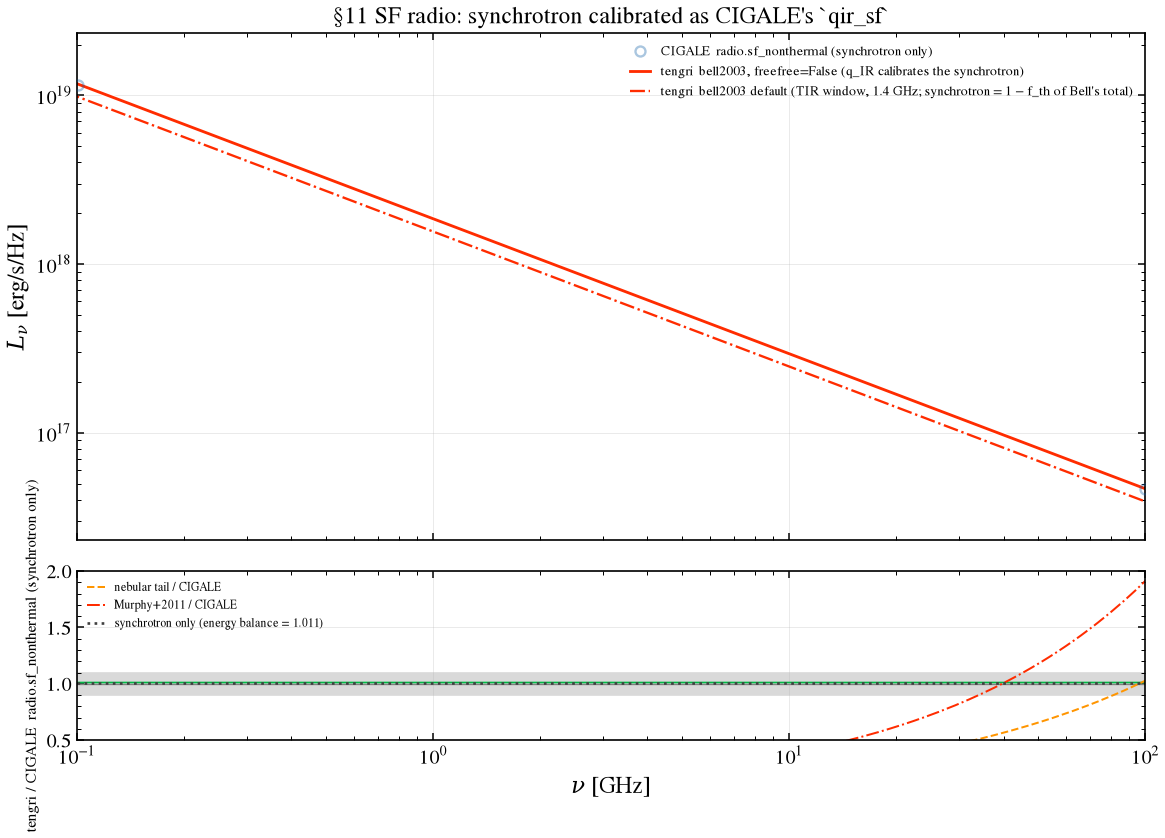
§11b Thermal free-free: four tests¶
Beyond 1 mm the nebular continuum is thermal free-free, and in the full SED at the end of the notebook it is where the two codes differ by more than the synchrotron’s 1 %. Four tests separate what is Q_H, what is the emitter and what is the radio block, on the §3 galaxy (BC03, logU = −2, Z = 0.02, f_esc = 0). Each carries an assert against the band stated here.
1. Per ionizing photon, Cue against Cloudy. Each code’s free-free continuum divided by its own Q_H, at 3 cm, 1 cm, 3 mm and 1 mm. Cue’s continuum per photon over CIGALE’s is 1.04–1.08× (1.044× at 3 cm, 1.077× at 1 cm, 1.075× at 3 mm and 1 mm), asserted to lie in 0.95–1.12×. The nebular continuum ratio of the full SED is this ratio times §3’s Q_H ratio, 1.150×: the excess there is the age convention and the emitter, and not a normalization error in either code, since lines and continuum share one Q_H.
2. An analytic reference. The optically thin free-free luminosity of a hydrogen plasma at 10⁴ K per ionizing photon, in case B, is the thermal bremsstrahlung emissivity of Rybicki & Lightman (1979, §5.2, Eqs. 5.14a and 5.14b), \(\varepsilon_\nu = \frac{2^5 \pi e^6}{3 m_e c^3}\left(\frac{2\pi}{3 k m_e}\right)^{1/2} T^{-1/2}\, n_e n_p\, e^{-h\nu/kT}\, \bar g_{\rm ff}\), divided by the recombination rate \(\alpha_B n_e n_p\) that sets Q_H. The cell evaluates the prefactor from CODATA constants, 6.84e-38 in cgs against the 6.8e-38 of their Eq. 5.14b. The Gaunt factor is the fit of Draine (2011); the cell checks it against the Hummer (1988) values tabulated by Dickinson, Davies & Davis (2003, Table 2) at 10⁴ K, and it agrees to 1.2 % at 0.4 GHz, 0.9 % at 1.4 GHz and 0.5 % at 70 GHz. \(\alpha_B\) is the Hui & Gnedin (1997) fit to the Ferland et al. (1992) case B coefficient, 2.592e-13 cm³ s⁻¹ at 10⁴ K. CIGALE’s continuum per photon is 0.78–0.80× this reference and Cue’s is 0.83–0.86×; both are asserted to lie in 0.70–1.00×. The reference is hydrogen at one temperature, so a gas at another temperature or with a different ionization structure sits off it; the cell does not separate those. CIGALE’s library adds a trend that a hydrogen plasma does not have: its continuum per photon at 1 mm falls by 3.08× from Z = 0.0004 to Z = 0.041 (printed). That is a property of the Cloudy models; that it comes from dust grains is an inference, as the library’s physics is not exposed here.
3. The radio block’s free-free. The term the radio block adds with freefree: True (Murphy et al. 2011), against Cue’s nebular free-free at the same Q_H. A history that is nearly constant over 10 Myr (τ = 20 Gyr, age 1 Gyr) makes Q_H proportional to the star formation rate over the last 10 Myr, so one SFR gives one Q_H; the radio block is evaluated at the L_IR that Murphy et al.’s Eq. 4 assigns to that SFR. The ratio of the two per unit Q_H is 0.985–1.119× (0.985× at 3 and 1 cm, 1.043× at
3 mm, 1.119× at 1 mm), asserted to lie in 0.8–1.25× at every wavelength the radio block reaches.
4. Continuity through 1 mm. The radio SED with freefree: True has no step through 1 mm when synchrotron and free-free both extend below it: the largest |d ln L_ν / d ln λ| between neighbouring points over 0.1–3 mm stays below 1.5, and the flux at 0.95 mm is within 0.9–1.2× that at 1.05 mm. The test runs only where the radio block carries emission shortward of 1 mm, which the cell reads from the data; it prints that it was skipped otherwise. Result: the radio block carries emission
below 1 mm, so the test runs. The largest |d ln L_ν / d ln λ| over 0.1–3 mm is 0.326 and the flux ratio across 1 mm is 0.9775.
[33]:
import scipy.constants as _sc

_FF_LAMBDAS = (("3 cm", 3.0e8), ("1 cm", 1.0e8), ("3 mm", 3.0e7), ("1 mm", 1.0e7))  # [Å]
_FF_BAND_CUE_VS_CLOUDY = (0.95, 1.12)  # tengri / CIGALE, per ionizing photon
_FF_BAND_VS_ANALYTIC = (0.70, 1.00)  # each code over the analytic reference


def _loglog_at(wave_aa, lnu, target_aa):
    """``lnu`` interpolated log-log to ``target_aa`` [Å]."""
    return float(
        np.exp(
            np.interp(
                np.log(target_aa), np.log(np.asarray(wave_aa)), np.log(np.maximum(lnu, 1e-300))
            )
        )
    )


# Check 1. Thermal free-free per ionizing photon, each code over its own Q_H, on
# the §3 galaxy (BC03, logU = -2, Z = 0.02, f_esc = 0). CIGALE's nebular module
# carries the continuum in its emission component; no emission line sits between
# 1 mm and 3 cm, so the sum of its young and old emission components is the
# continuum there.
_, _l_old = C.to_lnu_contribution(sed_c, "nebular.emission_old")
_w_ff_c, _l_young = C.to_lnu_contribution(sed_c, "nebular.emission_young")
_l_ff_c = np.asarray(_l_old) + np.asarray(_l_young)
_w_ff_t = np.asarray(s_stellar.wave)
_l_ff_t = np.asarray(s_stellar.derived["sed_nebular"])

# Check 2. The optically thin free-free emission of a pure hydrogen H II region
# per ionizing photon, case B, T_e = 1e4 K. The emissivity is the thermal
# bremsstrahlung expression of Rybicki & Lightman (1979, Eq. 5.14a),
#   ε_ν = [2^5 π e^6 / (3 m_e c^3)] (2π / 3 k m_e)^(1/2) T^(-1/2) n_e n_p e^(-hν/kT) g_ff,
# with the velocity-averaged Gaunt factor g_ff from the fit of Draine (2011).
# Every recombination to n >= 2 in a gas that absorbs all of Q_H gives
# Q_H = α_B n_e n_p V, so ε_ν / (α_B n_e n_p) is L_ν per ionizing photon. α_B is the
# Hui & Gnedin (1997, MNRAS 292, 27) fit to the case B coefficient of Ferland et al.
# (1992). Constants are CODATA, converted to cgs.
_E_ESU = _sc.e * _sc.c * 10.0  # elementary charge [esu]
_M_E, _C_CGS = _sc.m_e * 1e3, _sc.c * 1e2  # [g], [cm/s]
_K_B, _H_P = _sc.k * 1e7, _sc.h * 1e7  # [erg/K], [erg s]
_FF_PREFACTOR = (
    2**5
    * np.pi
    * _E_ESU**6
    / (3.0 * _M_E * _C_CGS**3)
    * np.sqrt(2.0 * np.pi / (3.0 * _K_B * _M_E))
)  # [erg cm^3 K^(1/2) / s / Hz] per (n_e n_i Z^2)


def _gaunt_ff(nu_hz, t_e=1.0e4, z_ion=1.0):
    """Velocity-averaged free-free Gaunt factor, the fit of Draine (2011)."""
    return np.log(
        np.exp(5.960 - np.sqrt(3.0) / np.pi * np.log(z_ion * nu_hz / 1e9 * (t_e / 1e4) ** -1.5))
        + np.e
    )


def _alpha_b_hydrogen(t_e=1.0e4):
    """Case B recombination coefficient of hydrogen [cm^3/s], Hui & Gnedin (1997)."""
    lam = 2.0 * 157807.0 / t_e
    return 2.753e-14 * lam**1.5 / (1.0 + (lam / 2.74) ** 0.407) ** 2.242


def _ff_per_photon_analytic(wave_aa, t_e=1.0e4):
    """Optically thin free-free L_ν per ionizing photon [erg/s/Hz per ph/s]."""
    nu = C_AA / wave_aa
    return (
        _FF_PREFACTOR
        * t_e**-0.5
        * np.exp(-_H_P * nu / (_K_B * t_e))
        * _gaunt_ff(nu, t_e)
        / _alpha_b_hydrogen(t_e)
    )


print(
    f"§11b analytic free-free: prefactor {_FF_PREFACTOR:.3e} (Rybicki & Lightman Eq. 5.14b quotes 6.8e-38), "
    f"α_B(1e4 K) = {_alpha_b_hydrogen():.3e} cm^3/s"
)
assert abs(_FF_PREFACTOR / 6.8e-38 - 1.0) < 0.01

# The Gaunt fit against the Hummer (1988) values tabulated by Dickinson, Davies &
# Davis (2003, MNRAS 341, 369, their Table 2), at 1e4 K.
_HUMMER88_GAUNT_1E4K = {0.4: 6.39, 1.4: 5.73, 70.0: 3.67}  # {ν [GHz]: g_ff}
for _nu_ghz, _g_tab in _HUMMER88_GAUNT_1E4K.items():
    _g_fit = float(_gaunt_ff(_nu_ghz * 1e9))
    print(f"    g_ff({_nu_ghz:g} GHz, 1e4 K): fit {_g_fit:.3f}, table {_g_tab:.2f} ({_g_fit / _g_tab - 1:+.1%})")
    assert abs(_g_fit / _g_tab - 1.0) < 0.02

print("§11b thermal free-free per ionizing photon [erg/s/Hz per ph/s], §3 galaxy:")
print("    λ        CIGALE      tengri Cue   Cue/CIGALE   analytic    CIGALE/analytic  Cue/analytic")
_ff_rows = []
for _name, _lam in _FF_LAMBDAS:
    _pc = _loglog_at(_w_ff_c, _l_ff_c, _lam) / _n_ly_c3
    _pt = _loglog_at(_w_ff_t, _l_ff_t, _lam) / _q_h_t3
    _pa = float(_ff_per_photon_analytic(_lam))
    _ff_rows.append((_name, _pc, _pt, _pa))
    print(
        f"    {_name:<5} {_pc:11.4e} {_pt:11.4e} {_pt / _pc:10.3f} {_pa:12.4e} "
        f"{_pc / _pa:12.3f} {_pt / _pa:14.3f}"
    )
    assert _FF_BAND_CUE_VS_CLOUDY[0] < _pt / _pc < _FF_BAND_CUE_VS_CLOUDY[1], (_name, _pt / _pc)
    assert _FF_BAND_VS_ANALYTIC[0] < _pc / _pa < _FF_BAND_VS_ANALYTIC[1], (_name, "CIGALE")
    assert _FF_BAND_VS_ANALYTIC[0] < _pt / _pa < _FF_BAND_VS_ANALYTIC[1], (_name, "Cue")

# CIGALE's continuum per photon over its metallicity axis, from its library at
# logU = -2, n_e = 100 cm^-3, at 1 mm. A hydrogen plasma at fixed T_e does not
# depend on Z, so the fall is a property of the Cloudy models, which carry dust.
_cont_z = []
with _CigaleLineDB("nebular_continuum") as _cont_db:
    for _z in (0.0004, 0.004, 0.02, 0.041):
        _rec = _cont_db.get(Z=_z, logU=-2.0, ne=100.0)
        _wl_aa, _l_nu = U.wnm_to_erg_per_hz_per_aa(np.asarray(_rec.wl), np.asarray(_rec.spec))
        _cont_z.append((_z, _loglog_at(_wl_aa, _l_nu, 1.0e7)))
print(
    "§11b CIGALE nebular continuum per ionizing photon at 1 mm vs Z: "
    + ", ".join(f"Z = {_z:g}: {_v:.3e}" for _z, _v in _cont_z)
    + f" (Z = 0.0004 over Z = 0.041: {_cont_z[0][1] / _cont_z[-1][1]:.2f}×)"
)
assert all(a[1] > b[1] for a, b in zip(_cont_z, _cont_z[1:]))
§11b analytic free-free: prefactor 6.842e-38 (Rybicki & Lightman Eq. 5.14b quotes 6.8e-38), α_B(1e4 K) = 2.592e-13 cm^3/s
    g_ff(0.4 GHz, 1e4 K): fit 6.469, table 6.39 (+1.2%)
    g_ff(1.4 GHz, 1e4 K): fit 5.783, table 5.73 (+0.9%)
    g_ff(70 GHz, 1e4 K): fit 3.688, table 3.67 (+0.5%)
§11b thermal free-free per ionizing photon [erg/s/Hz per ph/s], §3 galaxy:
    λ        CIGALE      tengri Cue   Cue/CIGALE   analytic    CIGALE/analytic  Cue/analytic
    3 cm   9.9734e-27  1.0416e-26      1.044   1.2447e-26        0.801          0.837
    1 cm   8.6639e-27  9.3326e-27      1.077   1.0900e-26        0.795          0.856
    3 mm   7.2709e-27  7.8139e-27      1.075   9.2516e-27        0.786          0.845
    1 mm   6.0688e-27  6.5236e-27      1.075   7.8193e-27        0.776          0.834
§11b CIGALE nebular continuum per ionizing photon at 1 mm vs Z: Z = 0.0004: 1.159e-26, Z = 0.004: 9.026e-27, Z = 0.02: 6.069e-27, Z = 0.041: 3.757e-27 (Z = 0.0004 over Z = 0.041: 3.08×)
[34]:
# Check 3. The free-free term the radio block adds with `freefree: True`
# (Murphy et al. 2011) against the nebular free-free it stands in for, at the same
# Q_H. A history that is nearly constant over 10 Myr (τ = 20 Gyr, age 1 Gyr) makes Q_H
# proportional to the star formation rate over the last 10 Myr, so one SFR gives
# one Q_H. The radio block is evaluated at the L_IR that Murphy et al.'s Eq. 4,
# SFR = 3.88e-44 L_IR [erg/s], assigns to that SFR; the nebular term is Cue's, with
# the nebular emitter on and no radio block.
_MURPHY11_SFR_PER_LIR = 3.88e-44  # [M☉/yr per erg/s], Murphy et al. (2011) Eq. 4
_m_ss = SEDModel.build(
    ssp_data=ssp,
    met=MET_FIDUCIAL,
    sfh={
        "type": "delayed",
        "tau_gyr": Fixed(20.0),
        "age_gyr": Fixed(1.0),
        "log_total_mass": Fixed(0.0),
        "all_params": Fixed(DEFAULT),
    },
    dust_attenuation={
        "law": "power_law",
        "type": "two_component",
        "tau_bc": Fixed(0.0),
        "tau_diff": Fixed(0.0),
        "all_params": Fixed(DEFAULT),
    },
    neb=NEB_FIDUCIAL_TENGRI,
    redshift=Fixed(0.0),
)
_s_ss = _m_ss.predict_state({})
_sfr_ss = float(np.asarray(_s_ss.derived["sfr_10myr"]))
_q_ss = float(np.asarray(_s_ss.derived["nion"]))
_w_ss = np.asarray(_s_ss.wave)
_l_ss_cue = np.asarray(_s_ss.derived["sed_nebular"])
_l_ss_radio = np.asarray(
    radio_freefree(jnp.asarray(_w_ss), _sfr_ss / _MURPHY11_SFR_PER_LIR, T_e=1.0e4, alpha_ff=-0.1)
)
print(
    f"§11b steady star formation: SFR(10 Myr) = {_sfr_ss:.3e} M☉/yr, Q_H = {_q_ss:.3e} ph/s "
    f"({_q_ss / _sfr_ss:.3e} ph/s per M☉/yr)"
)
print("    λ      radio block per Q_H   Cue per Q_H    radio block / Cue")
_FF_BAND_RADIO_VS_CUE = (0.8, 1.25)
for _name, _lam in _FF_LAMBDAS:
    _cue_pp = _loglog_at(_w_ss, _l_ss_cue, _lam) / _q_ss
    _rad_pp = _loglog_at(_w_ss, _l_ss_radio, _lam) / _q_ss
    if _rad_pp > 1e-30:
        print(f"    {_name:<5} {_rad_pp:16.4e} {_cue_pp:16.4e} {_rad_pp / _cue_pp:12.3f}")
        assert _FF_BAND_RADIO_VS_CUE[0] < _rad_pp / _cue_pp < _FF_BAND_RADIO_VS_CUE[1], _name
    else:
        print(f"    {_name:<5} the radio block's free-free term stops at a longer wavelength")

# Check 4. Continuity of the radio SED through 1 mm. The check runs only when the
# radio block extends below 1 mm, which the data decide: with `freefree: True`
# the star-forming radio SED must be nonzero at 0.5 mm.
_state_ff_on = _radio_model(
    {"type": "bell2003", "freefree": True, "nu_ref": "21cm", "ir_window": "total"}
).predict_state({})
_w_rad = np.asarray(_state_ff_on.wave)
_l_rad = np.asarray(_state_ff_on.derived["sed_radio"])
_extends_below_1mm = bool(_loglog_at(_w_rad, _l_rad, 5.0e6) > 1e-30)


def _max_abs_log_slope(wave_aa, lnu, lo_aa, hi_aa):
    """Largest |d ln L_ν / d ln λ| between neighbouring grid points in [lo_aa, hi_aa]."""
    w, y = np.asarray(wave_aa), np.asarray(lnu)
    sel = (w >= lo_aa) & (w <= hi_aa) & (y > 0)
    return float(np.max(np.abs(np.diff(np.log(y[sel])) / np.diff(np.log(w[sel])))))


if _extends_below_1mm:
    _slope_max = _max_abs_log_slope(_w_rad, _l_rad, 1.0e6, 3.0e7)
    _step_1mm = _loglog_at(_w_rad, _l_rad, 0.95e7) / _loglog_at(_w_rad, _l_rad, 1.05e7)
    print(
        f"§11b radio SED across 1 mm: largest |d ln L_ν / d ln λ| over 0.1-3 mm = {_slope_max:.3f}; "
        f"L_ν(0.95 mm) / L_ν(1.05 mm) = {_step_1mm:.4f}"
    )
    assert _slope_max < 1.5, "the radio SED has a step near 1 mm"
    assert 0.9 < _step_1mm < 1.2, "the radio SED has a step at 1 mm"
else:
    print(
        "§11b radio SED across 1 mm: skipped, the radio block carries no emission "
        "shortward of 1 mm in this build"
    )
src/tengri/forward/sed_model.py:13601: SFHBeyondOldestTemplateWarning: The SSP grid's oldest template is 13.700 Gyr but the universe is 13.787 Gyr old at redshift 0. Stars formed in that gap are older than every template, so both age kernels assign them to the oldest one: the formed mass is conserved, and those stars carry the colors of a 13.700 Gyr population. Use a grid whose oldest template reaches 13.787 Gyr (e.g. MIST) to remove the approximation.
  return cls(
§11b steady star formation: SFR(10 Myr) = 1.960e-09 M☉/yr, Q_H = 3.313e+44 ph/s (1.690e+53 ph/s per M☉/yr)
    λ      radio block per Q_H   Cue per Q_H    radio block / Cue
    3 cm        1.0216e-26       1.0376e-26        0.985
    1 cm        9.1533e-27       9.2963e-27        0.985
    3 mm        8.1150e-27       7.7824e-27        1.043
    1 mm        7.2707e-27       6.4965e-27        1.119
src/tengri/forward/sed_model.py:13601: SFHBeyondOldestTemplateWarning: The SSP grid's oldest template is 13.700 Gyr but the universe is 13.787 Gyr old at redshift 0. Stars formed in that gap are older than every template, so both age kernels assign them to the oldest one: the formed mass is conserved, and those stars carry the colors of a 13.700 Gyr population. Use a grid whose oldest template reaches 13.787 Gyr (e.g. MIST) to remove the approximation.
  return cls(
§11b radio SED across 1 mm: largest |d ln L_ν / d ln λ| over 0.1-3 mm = 0.326; L_ν(0.95 mm) / L_ν(1.05 mm) = 0.9775
§12 IGM transmission¶
CIGALE module redshifting (igm_transmission) ↔ tengri igm.meiksin06 (igm_transmission_meiksin06): Meiksin (2006) IGM attenuation, Lyman series and the diffuse-IGM Lyα forest continuum suppression. The figure plots each code’s transmission against observed wavelength at z = 3, 5 and 7.
Where they differ. CIGALE 2025.1 evaluates the n ≥ 3 Lyman-series optical depths at the source redshift (redshifting.py:63-81) and chooses Meiksin’s Eq. 2/3 for Lyα from the source redshift. tengri evaluates every line at its absorber redshift z_n = λ_obs/λ_n − 1, as Meiksin (2006) Table 1 defines. The printed |ΔT| statistics reach a few percent at z = 3 and 5. Redward of Lyβ (rest ≥ 1026 Å) only Lyα is active and the two codes agree there; the cell prints the max |ΔT| for that
region separately. Meiksin’s Table 2 gives T(1730 Å, z = 5) = 0.003277; the cell prints that literal beside both codes’ values at observed 1730 Å.
Verification Status: CROSSVAL: Inoue+2014 IGM transmission
[35]:
# Both transmission curves come straight from each code's own IGM
# function — no SED build, no flux-ratio reconstruction. CIGALE exposes
# the Meiksin (2006) transmission as
# `pcigale.sed_modules.redshifting.igm_transmission(wave_nm, z)`; tengri
# exposes `igm_transmission_meiksin06(wave_obs_AA, z)`. Same prescription,
# so the curves should overlay.
import jax.numpy as _jnp
from pcigale.sed_modules.redshifting import igm_transmission as cigale_igm

from tengri.igm import igm_transmission_meiksin06

fig, ax_l, ax_r = U.two_panel_fig()
for ax in (ax_l, ax_r):
    ax.set_xlabel(r"$\lambda_{\rm obs}$ [Å]")
    ax.set_ylabel("IGM transmission")
    ax.set_xscale("log")
    ax.set_ylim(-0.05, 1.1)
    ax.grid(True, alpha=0.3)
ax_l.set_title("pcigale  redshifting.igm_transmission (Meiksin 2006)")
ax_r.set_title("tengri  igm.meiksin06")

wave_obs_aa = np.logspace(np.log10(500.0), np.log10(1e4), 600)
print("§12 Meiksin 2006 transmission (tengri − CIGALE) on the plotted grid:")
for color, z in zip(("C0", "C1", "C2"), (3.0, 5.0, 7.0)):
    # CIGALE igm_transmission takes wavelength in nm.
    T_c = np.asarray(cigale_igm(wave_obs_aa / 10.0, z))
    T_t = np.asarray(igm_transmission_meiksin06(_jnp.asarray(wave_obs_aa), z))
    ax_l.plot(wave_obs_aa, T_c, color=color, linewidth=1.4, label=rf"$z = {z:.0f}$")
    ax_r.plot(wave_obs_aa, T_t, color=color, linewidth=1.4, label=rf"$z = {z:.0f}$")
    _dT = np.abs(T_t - T_c)
    _red = wave_obs_aa >= 1026.0 * (1.0 + z)
    print(
        f"    z = {z:.0f}: max |ΔT| redward of Lyβ (rest ≥ 1026 Å) = {float(_dT[_red].max()):.2e}; "
        f"over the whole grid max |ΔT| = {float(_dT.max()):.2e}, "
        f"median |ΔT| = {float(np.median(_dT)):.2e}, "
        f"{int((_dT > 1e-3).sum())}/{_dT.size} points above 1e-3"
    )

for _z in (3.0, 5.0):
    _t_c = float(np.asarray(cigale_igm(np.array([1730.0 / 10.0]), _z))[0])
    _t_t = float(np.asarray(igm_transmission_meiksin06(_jnp.asarray([1730.0]), _z))[0])
    print(f"    T(1730 Å) at z = {_z:.0f}: tengri {_t_t:.6f}, CIGALE {_t_c:.6f}")

# Meiksin (2006) Table 2, transmission at observed 1730 Å and z = 5 (literal from the paper).
_T_MEIKSIN06_TABLE2_1730_Z5 = 0.003277
_t_c5 = float(np.asarray(cigale_igm(np.array([1730.0 / 10.0]), 5.0))[0])
_t_t5 = float(np.asarray(igm_transmission_meiksin06(_jnp.asarray([1730.0]), 5.0))[0])
print(
    f"    T(1730 Å) at z = 5 against Meiksin (2006) Table 2 ({_T_MEIKSIN06_TABLE2_1730_Z5:.6f}, "
    f"paper literal): tengri {_t_t5:.6f}, CIGALE {_t_c5:.6f}"
)

ax_l.legend(fontsize=9)

ax_r.legend(fontsize=9)
fig.tight_layout()
save_fig("cigale_12_igm_transmission.png")
§12 Meiksin 2006 transmission (tengri − CIGALE) on the plotted grid:
    z = 3: max |ΔT| redward of Lyβ (rest ≥ 1026 Å) = 2.22e-16; over the whole grid max |ΔT| = 4.42e-02, median |ΔT| = 6.37e-04, 300/600 points above 1e-3
    z = 5: max |ΔT| redward of Lyβ (rest ≥ 1026 Å) = 2.78e-16; over the whole grid max |ΔT| = 4.63e-02, median |ΔT| = 1.53e-04, 209/600 points above 1e-3
    z = 7: max |ΔT| redward of Lyβ (rest ≥ 1026 Å) = 1.60e-16; over the whole grid max |ΔT| = 2.00e-02, median |ΔT| = 4.39e-07, 118/600 points above 1e-3
    T(1730 Å) at z = 3: tengri 0.038559, CIGALE 0.030353
    T(1730 Å) at z = 5: tengri 0.003283, CIGALE 0.000909
    T(1730 Å) at z = 5 against Meiksin (2006) Table 2 (0.003277, paper literal): tengri 0.003283, CIGALE 0.000909
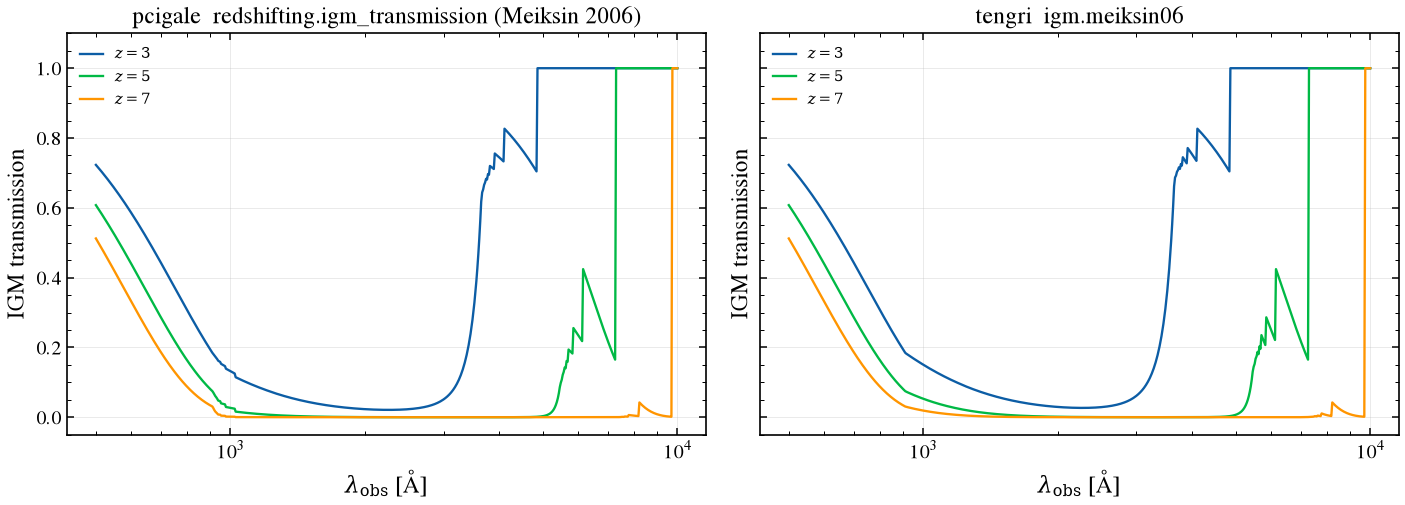
tengri in CIGALE-mode — the full X-ray → radio SED¶
The whole chain at once: tengri configured as CIGALE’s sfhdelayed + bc03 + nebular + dustatt_modified_starburst + dale2014 + xray (Yang+2020) + radio chain, overlaid on pcigale at matched parameters. The figure shows ν L_ν over eleven decades of wavelength and the tengri/CIGALE residual below. The radio block is freefree: False with q_IR = 2.5 (§11), so q_IR calibrates the synchrotron as in CIGALE’s qir_sf and the thermal free-free comes from the
nebular continuum on both sides.
The stellar-to-FIR core. Optical agreement is reported as a normalization ratio and its 16–84 % spread. With the single-screen dust mapping (tau_bc = 0) the lower panel’s shaded band marks ±25 %. The sub-912 Å excursion is the Lyman-continuum extrapolation. The 1 mm to 3 cm decade carries thermal free-free from the nebular continuum on both codes (Cue’s tail on tengri’s side, CIGALE’s nebular module on the other), and its ratio is §3’s Q_H ratio times §11b’s Cue-against-Cloudy ratio
per ionizing photon; the radio blocks add synchrotron only. The X-ray wing is XRB + hot gas with no AGN corona (alpha_ox is supplied but there is no disc for it to act on), and its 0.99× is pcigale’s truncated band normalization (§10). Every number is printed below.
[36]:
import chex

# The full X-ray -> radio SED: the §6/§7 galaxy (stellar + dust + Dale IR) plus
# the §10 X-ray (Yang+2020 XRB + hot gas, no AGN corona in this galaxy-only
# chain) and the §11 radio (`freefree=False`: q_IR = 2.5 calibrates the
# synchrotron, as CIGALE's `qir_sf`), so the master grid spans ~0.01 Å (hard
# X-ray) to ~1 m (radio).
sed_c_full = C.run_chain(
    [
        (
            "sfhdelayed",
            dict(
                tau_main=1000,
                age_main=5000,
                tau_burst=50,
                age_burst=20,
                f_burst=0.0,
                sfr_A=1.0,
                normalise=True,
            ),
        ),
        ("bc03", dict(imf=1, metallicity=0.02, separation_age=10)),
        NEB_FIDUCIAL_CIGALE,
        ("dustatt_modified_starburst", dict(E_BV_lines=0.3)),
        ("dale2014", dict(alpha=2.0)),
        (
            "yang20",
            dict(
                gam=1.8,
                E_cut=300.0,
                alpha_ox=-1.4,  # no AGN disc here -> corona is zero; XRB + hot gas only
                max_dev_alpha_ox=0.2,
                angle_coef="0.5 & 0",
                det_lmxb=0.0,
                det_hmxb=0.0,
            ),
        ),
        ("radio", dict(qir_sf=2.5, alpha_sf=0.8, R_agn=0.0, alpha_agn=0.7)),
        ("redshifting", dict(redshift=0.0)),
    ]
)
_w_full, _L_full = C.to_lnu(sed_c_full)
w_ext, L_ext = np.asarray(_w_full), np.asarray(_L_full)

m_full = SEDModel.build(
    ssp_data=ssp,
    met=MET_FIDUCIAL,
    sfh={
        "type": "delayed",
        "tau_gyr": Fixed(1.0),
        "age_gyr": Fixed(5.0),
        "log_total_mass": Fixed(0.0),
        "all_params": Fixed(DEFAULT),
    },
    dust_attenuation={
        "type": "two_component",
        "law_bc": "leitherer02",
        "law_diff": "leitherer02",
        "tau_bc": Fixed(TAU_BC_FIDUCIAL),
        "tau_diff": Fixed(TAU_DIFF_FIDUCIAL),
        "lyman_cutoff": True,
        "all_params": Fixed(DEFAULT),
    },
    dust_emission={
        "type": "dale2014_cigale",
        "alpha_dale": Fixed(2.0),
        "all_params": Fixed(DEFAULT),
    },
    xray={"type": "yang20", "all_params": Fixed(DEFAULT)},
    radio={
        "sf": {"type": "bell2003", "freefree": False, "nu_ref": "21cm", "ir_window": "total"},
        "agn": {"type": "powerlaw"},
        "radio_q_ir": Fixed(2.5),
        "radio_alpha_sf": Fixed(0.8),
        "all_params": Fixed(DEFAULT),
    },
    neb=NEB_FIDUCIAL_TENGRI,
    redshift=Fixed(0.0),
)
s_full = m_full.predict_state({})
wave_t = np.asarray(s_full.wave)
L_t = np.asarray(s_full.sed_intrinsic)

# Put tengri on CIGALE's wavelength grid so the two compare point for point.
L_t_on_ext = U.regrid(wave_t, L_t, w_ext)
chex.assert_equal_shape([L_ext, L_t_on_ext])

mask = (w_ext > 0) & (L_ext > 0) & (L_t_on_ext > 0)
resid = np.full(w_ext.shape, np.nan, dtype=float)
resid[mask] = L_t_on_ext[mask] / L_ext[mask] - 1.0

# Headline numbers: the optical normalization ratio tengri/CIGALE and its
# 16–84% spread. With the shared BC03 grid, matched mass convention and
# single-screen dust mapping the ratio sits near 1. Three things sit outside
# that window: the far-UV, which is §3's age-binning convention; the sub-912 Å
# excursion, which is the Lyman-continuum extrapolation; and the 1 mm–1 m decade,
# where both codes carry thermal free-free from the nebular continuum (Cue's tail
# extends the continuum from the 1 cm table edge to 1 m; CIGALE's `nebular`
# module's native reach) with the radio blocks calibrated on the synchrotron
# alone. The Cue-vs-CLOUDY nebular residual of §8 is part of the optical window.
opt = mask & (w_ext >= 1000.0) & (w_ext <= 10000.0)
ratio_opt = L_t_on_ext[opt] / L_ext[opt]
norm = float(np.median(ratio_opt))
p16, p84 = float(np.percentile(ratio_opt, 16)), float(np.percentile(ratio_opt, 84))
print(
    f"full-SED head-to-head tengri/CIGALE optical (1000–10000 Å): "
    f"normalization {norm:.2f}×, 16–84% spread {p16:.2f}–{p84:.2f}×"
)


def _ratio_at(target_aa: float) -> float:
    """tengri/CIGALE L_ν ratio at the CIGALE grid point nearest ``target_aa``."""
    j = int(np.argmin(np.abs(w_ext - target_aa)))
    return float(L_t_on_ext[j] / L_ext[j]) if L_ext[j] > 0 else float("nan")


_C_AA_HZ = C_AA
print(
    "  X-ray  1 keV = {:.2f}×, 5 keV = {:.2f}×  (XRB + hot gas; no AGN corona)".format(
        _ratio_at(12.398 / 1.0), _ratio_at(12.398 / 5.0)
    )
)
print(
    "  radio  1.4 GHz = {:.2f}×, 150 MHz = {:.2f}×  (SF synchrotron, q_IR = 2.5 calibrating the non-thermal term)".format(
        _ratio_at(_C_AA_HZ / 1.4e9), _ratio_at(_C_AA_HZ / 0.15e9)
    )
)
print(
    "  mm     1 mm = {:.2f}×, 3 mm = {:.2f}×, 1 cm = {:.2f}×, 3 cm = {:.2f}×  "
    "(nebular free-free on both sides, Q_H ratio × Cue-against-Cloudy per photon, §11b; "
    "the radio blocks add synchrotron only)".format(
        _ratio_at(1e7), _ratio_at(3e7), _ratio_at(1e8), _ratio_at(3e8)
    )
)
_assert_comparable(L_ext, L_t, name="full-SED head-to-head")

fig, (ax, ax_r) = plt.subplots(
    2, 1, figsize=(11, 7), sharex=True, gridspec_kw={"height_ratios": [3, 1]}
)
# nu L_nu, not L_nu. Over eleven decades of wavelength L_nu is a hopeless
# display coordinate: the synchrotron tail climbs as a power law to the grid
# edge, so the SED spans 16.2 decades in L_nu and any peak-anchored y-limit
# that keeps the stellar and dust humps legible amputates the X-ray and the
# far-UV. The same SED spans 8.5 decades in nu L_nu, so everything fits on one
# axis — and equal areas are equal energy, which is what makes the stellar and
# dust humps read as the comparable reservoirs energy balance says they are.
_nu_ext = _C_AA_HZ / w_ext
nuL_ext = _nu_ext * L_ext
# Mask where tengri's grid has run out rather than let regrid's zero-fill draw a
# vertical cliff at the grid edge — the model stops there, it does not go dark.
nuL_t_on_ext = np.where(L_t_on_ext > 0, _nu_ext * L_t_on_ext, np.nan)
ax.plot(w_ext, nuL_ext, "C0-", linewidth=1.5, label="CIGALE")
ax.plot(w_ext, nuL_t_on_ext, "C1--", linewidth=1.5, label="tengri (CIGALE-mode)")
ax.set_xscale("log")
ax.set_yscale("log")
ax.set_xlim(1e-1, 1e12)  # hard X-ray -> radio
_ymax_h = float(max(np.nanmax(nuL_ext), np.nanmax(nuL_t_on_ext)))
ax.set_ylim(_ymax_h * 1e-9, _ymax_h * 3.0)
ax.set_ylabel(r"$\nu L_\nu$ [erg/s]")
ax.set_title(r"tengri in CIGALE-mode vs CIGALE — full panchromatic SED")
ax.legend(fontsize=10)
ax.grid(True, alpha=0.3)
ax.text(
    0.02,
    0.05,
    rf"tengri/CIGALE $= {norm:.2f}\times$ (16–84%: {p16:.2f}–{p84:.2f})",
    transform=ax.transAxes,
    fontsize=10,
    va="bottom",
    bbox=dict(boxstyle="round", facecolor="wheat", alpha=0.5),
)

ax_r.axhspan(-0.25, 0.25, color="0.85", zorder=0)
ax_r.axhline(0.0, color="0.5", linewidth=0.8)
ax_r.axhline(norm - 1.0, color="C1", linestyle=":", linewidth=0.9)
ax_r.plot(w_ext, resid, "C1-", linewidth=1.0)
ax_r.set_xscale("log")
ax_r.set_xlim(1e-1, 1e12)
ax_r.set_ylim(-1.0, 1.0)
ax_r.set_xlabel(r"$\lambda$ [Å]")
ax_r.set_ylabel(r"tengri/CIGALE $-1$")
ax_r.grid(True, alpha=0.3)
fig.tight_layout()
save_fig("cigale_full_sed_headtohead.png")
plt.show()
src/tengri/forward/sed_model.py:13601: SFHBeyondOldestTemplateWarning: The SSP grid's oldest template is 13.700 Gyr but the universe is 13.787 Gyr old at redshift 0. Stars formed in that gap are older than every template, so both age kernels assign them to the oldest one: the formed mass is conserved, and those stars carry the colors of a 13.700 Gyr population. Use a grid whose oldest template reaches 13.787 Gyr (e.g. MIST) to remove the approximation.
  return cls(
full-SED head-to-head tengri/CIGALE optical (1000–10000 Å): normalization 1.02×, 16–84% spread 1.00–1.07×
  X-ray  1 keV = 0.99×, 5 keV = 0.99×  (XRB + hot gas; no AGN corona)
  radio  1.4 GHz = 1.02×, 150 MHz = 1.02×  (SF synchrotron, q_IR = 2.5 calibrating the non-thermal term)
  mm     1 mm = 1.02×, 3 mm = 1.09×, 1 cm = 1.07×, 3 cm = 1.04×  (nebular free-free on both sides, Q_H ratio × Cue-against-Cloudy per photon, §11b; the radio blocks add synchrotron only)
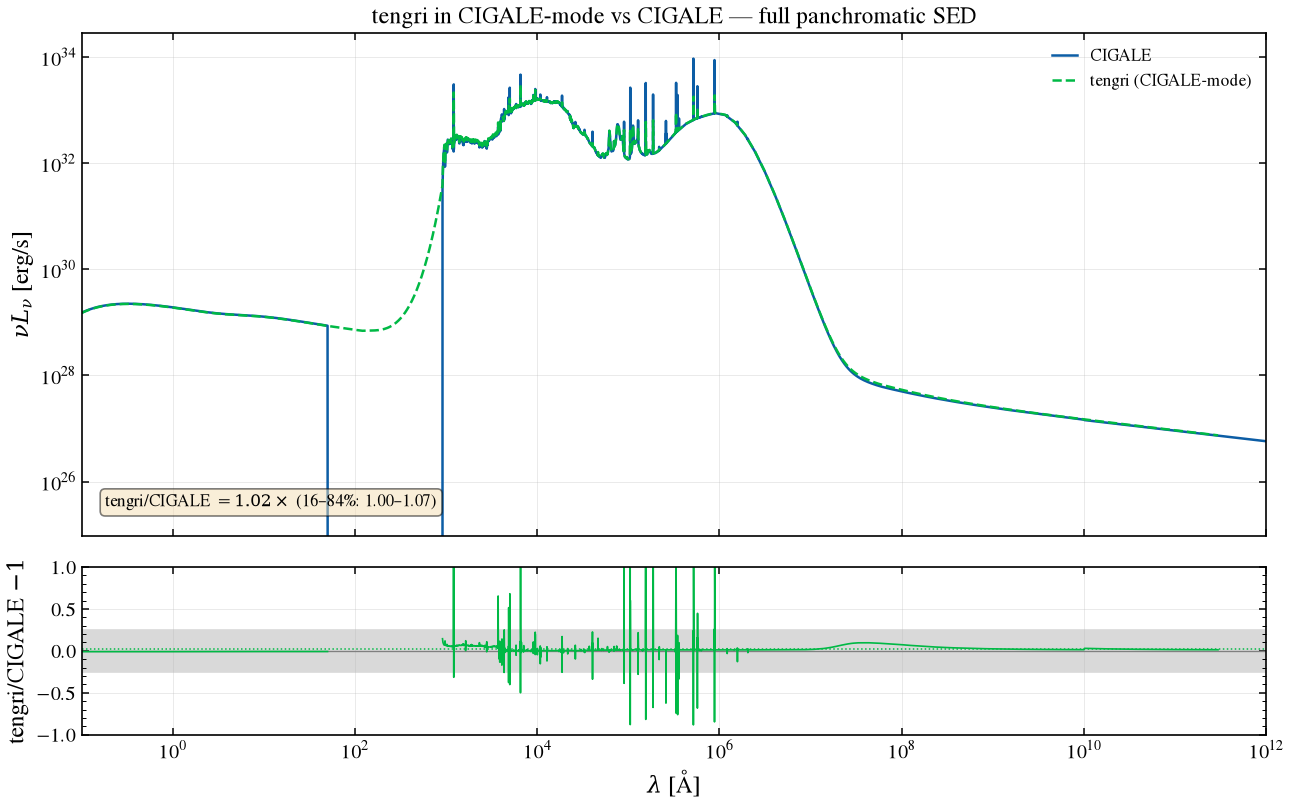
Summary¶
Section by section, tengri / CIGALE as printed above. A ratio is tengri over CIGALE; sweep sections quote the median across the swept cases and the worst printed case.
§ |
Block |
Agreement |
|---|---|---|
1 |
SSP |
median residual 2.0–2.2e-8 at every age (float32 round-trip) |
2 |
SFH |
|
3 |
stellar SED |
energy-weighted 912–1200 Å 1.063×, 1200–3000 Å 1.030×, 0.3–1 μm 1.007×, L_bol 1.017×, Q_H 1.150× (age convention: a continuous convolution gives 1.009× of tengri’s Q_H, and aging every star by 0.5 Myr gives 1.000× of CIGALE’s); §3b band medians 1.001–1.018×, worst band 1.055× (τ = 3 Gyr, age = 1 Gyr) |
4 |
attenuation laws |
max |Δ| 0.252 % (calzleit), 0.247 % (starburst + bump), 0.000 % (CF00); 0.000 % outside the 1500–1800 Å crossover |
5 |
attenuation applied |
energy-weighted 0.1–1 μm 1.0168× intrinsic and 0.9923× attenuated (912–1200 Å 1.0631×, 1.0571×); §5b band medians 0.997–1.000×; single-point maxima of 75–942 % over 0.1–1 μm sit on emission-line wings (line profile and grid sampling), not on the continuum |
6 |
dust IR |
10–100 μm energy-weighted 1.013×; |
6d |
dust IR, |
dust emission alone, 8–1000 μm medians 1.0108×, 1.0112×, 1.0114× at T = 25, 35, 50 K with |
7 |
panchromatic |
energy-weighted 1.0616× (912–1200 Å), 1.0614× (1250–3000 Å), 1.0125× (0.3–1 μm), 1.0081× (3–8 μm), 1.0127× (10–100 μm), 1.0118× (100–1000 μm) |
8 |
nebular |
Q_H 1.146× (shared SSP); raw Hα 1.12×, [O III] 0.96×, Hβ 1.12×, and per ionizing photon 0.974×, 0.834×, 0.978×; §8b at the six stable cases the largest ratio-of-ratios is 0.99× (Hα/Hβ), 2.06× ([O III]/Hβ) and 4.23× ([O II]/Hβ), with Z_gas = 0.041 degenerate in CIGALE’s grid (18.87× and 44.38×); Hβ/Q_H at f_esc = 0.5 over f_esc = 0 is 0.3851 (tengri) and 0.3862 (CIGALE) against (1 − f)/(1 + 0.597 f) = 0.3851; Cue’s [O III]/Hβ response to logU is 1.154 / 1.596 / 1.663 at the fitted shape and 3.416 / 5.499 / 6.085 at Cue’s default hard shape, for logU = −3 / −2 / −1.5 |
9 |
AGN, SKIRTOR |
disc 1.0101×, torus 1.0113×, polar dust 1.0120× (§9); 1.0076×, 1.0150×, 0.9998× with the SKIRTOR disc (§9b); 1500–3000 Å full SED 1.027×, of which host 1.061× and
disc 1.009×; §9d |
9 |
AGN, Fritz |
§9e band medians 1.011×, 1.009×, 1.010× (worst bands 0.975×, 0.974×, 0.974×; none of 12 bands outside 5 %): under |
9 |
AGN, tied disc edge |
step across the 10 Å library edge, F(10⁻)/[F(10⁺) T_X], 1.0000–1.0032 for Fritz and SKIRTOR at cos i = 0.94, 0.70, 0.30; pcigale |
9 |
AGN, SKIRTOR normalization |
agn_log_lbol = log10(P_acc / L_sun) with P_acc = 0.4931 L_intrin,disc agn_power; AGN-only NIR/V shape 0.960×, V 1.013×, 1.0–1.2 μm 0.972×, bolometric 1.062× at E(B−V) = 0.03, and 1.005×, 0.936×, 0.940×, 0.921× at E(B−V) = 0 |
10 |
X-ray |
1.010× at 2 keV and as a 0.5–10 keV median, at i = 0°, 30°, 60° and 80° |
10c |
X-ray, |
L_12μm 1.0115×, corona 1.0124× at 2 keV and as a 0.5–10 keV median for α_IRX = 0, 0.3, 0.6, corona over L_12μm 1.0009×; host (hot gas and binaries) 0.992× at 2 keV, 0.994× median |
11 |
radio |
synchrotron 1.0114× across 0.1–100 GHz against ×1.0114 predicted from the §6 energy balance alone, with |
11b |
free-free |
per ionizing photon Cue / CIGALE 1.04–1.08× (1.044× at 3 cm, 1.077× at 1 cm, 1.075× at 3 mm and 1 mm); against the analytic reference CIGALE 0.78–0.80× and Cue 0.83–0.86×; radio block / Cue 0.985–1.119× (0.985× at 3 and 1 cm, 1.043× at 3 mm, 1.119× at 1 mm); continuity through 1 mm: largest |
12 |
IGM |
max |ΔT| 4.4e-2, 4.6e-2, 2.0e-2 at z = 3, 5, 7; median |ΔT| 6.4e-4, 1.5e-4, 4.4e-7 (CIGALE evaluates the n ≥ 3 Lyman lines and the Lyα equation choice at the source redshift, tengri at each absorber’s, as Meiksin’s Table 1 defines); T(1730 Å, z = 5) is 0.003283 for tengri and 0.000909 for CIGALE against Meiksin’s Table 2 0.003277; redward of Lyβ the max |ΔT| is ≤ 2.8e-16 |
full |
CIGALE-mode SED |
optical 1.02× (16–84 %: 1.00–1.07×); X-ray 0.99× (1 keV), 0.99× (5 keV); radio 1.02× (1.4 GHz), 1.02× (150 MHz); 1 mm / 3 mm / 1 cm / 3 cm 1.02× / 1.09× / 1.07× / 1.04× |
tengri’s graybody, and not its optically thin mbb, is CIGALE’s mbb (§6d).
Four conventions account for most of the residuals and are stated where they are measured. The age convention (§3) is exact in tengri and a 1 Myr discrete sum, equivalent to aging every star by 0.5 Myr, in CIGALE; it sets the UV, Q_H and, through L_absorbed, the ~1 % offset under the dust IR and radio (§6, §11). The nebular emitter differs by design: per ionizing photon Cue’s Balmer lines are 2–3 % below CIGALE’s, its [O III] is lower because of the fitted ionizing shape and a different
definition of logU, and its free-free continuum is within about 10 % (§8, §11b). CIGALE’s own conventions are a polar-dust quadrature coarser than tengri’s (§9d) and an X-ray band normalization truncated on its wavelength grid (§10). The polar-dust extinction law must be set to polar_law="bongiorno" to match CIGALE (§9, §9d), and freefree: False makes radio_q_ir calibrate the synchrotron alone, as CIGALE’s qir_sf does (§11). tengri’s radio defaults are Bell (2003)’s 1.4 GHz and
the model’s own paper’s IR window; the CIGALE comparison sets 21 cm and the total dust luminosity explicitly (§11).
References¶
Bell 2003, ApJ 586, 794: IR–radio correlation
Boquien et al. 2019, A&A 622, A103: CIGALE
Bruzual & Charlot 2003, MNRAS 344, 1000: BC03 SSPs
Calzetti et al. 2000, ApJ 533, 682: starburst attenuation law
Charlot & Fall 2000, ApJ 539, 718: two-component dust
Condon 1992, ARA&A 30, 575: radio synchrotron / IR–radio correlation
Dale et al. 2014, ApJ 784, 83: IR dust templates
Dickinson, Davies & Davis 2003, MNRAS 341, 369: free-free Gaunt factors (Hummer 1988 values)
Draine 2011, Physics of the Interstellar and Intergalactic Medium (Princeton University Press): free-free Gaunt-factor fit
Fritz et al. 2006, MNRAS 366, 767: AGN torus
Gutkin, Charlot & Bruzual 2016, MNRAS 462, 1757: nebular grid, ionization parameter at the Strömgren radius
Hui & Gnedin 1997, MNRAS 292, 27: case B recombination coefficient fit
Inoue et al. 2014, MNRAS 442, 1805: IGM transmission
Li et al. 2025, ApJ, 986, 9 (Cue, arXiv:2405.04598): neural CLOUDY emulator
Madau 1995, ApJ 441, 18: original IGM transmission
Meiksin 2006, MNRAS 365, 807: updated IGM transmission
Murphy et al. 2011, ApJ 737, 67: free-free radio SFR calibration
Noll et al. 2009, A&A 507, 1793: modified Calzetti
Rybicki & Lightman 1979, Radiative Processes in Astrophysics (Wiley), §5.2, Eqs. 5.14a-b: thermal bremsstrahlung
Silva et al. 2004, MNRAS 355, 973: AGN torus
Stalevski et al. 2016, MNRAS 458, 2288: SKIRTOR
Yang et al. 2020, MNRAS 491, 740: X-ray CIGALE module