Note
Go to the end to download the full example code.
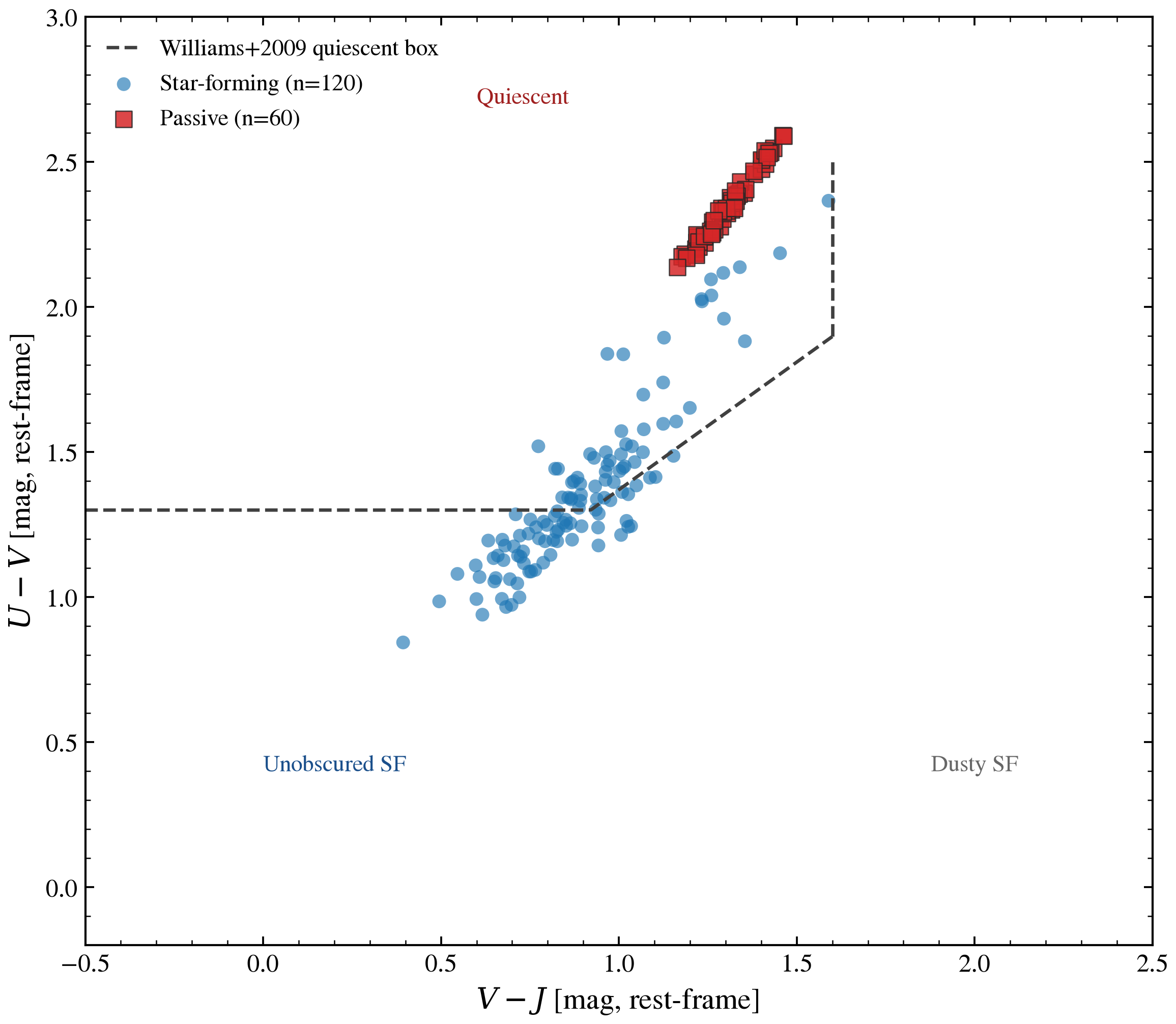
UVJ diagram: rest-frame colors separate star-forming from quiescent
Rest-frame U−V vs V−J colors separate star-forming from quiescent galaxies. The Williams+2009 quiescent wedge marks the boundary between dusty star-forming and passive systems.
Reference: Williams et al. 2009, ApJ, 691, 1879; Wuyts et al. 2007, ApJ, 655.
/tengri/src/tengri/forward/sed_model.py:13787: SFHBeyondOldestTemplateWarning: The SSP grid's oldest template is 12.589 Gyr but the universe is 13.643 Gyr old at redshift 0.01. Stars formed in that gap are older than every template, so both age kernels assign them to the oldest one: the formed mass is conserved, and those stars carry the colors of a 12.589 Gyr population. Use a grid whose oldest template reaches 13.643 Gyr (e.g. MIST) to remove the approximation.
  return cls(
/tengri/src/tengri/forward/sed_model.py:13787: YoungTopMetallicityWarning: met_logzsol reaches Z = 0.0565 (its upper bound, Z = 0.0283, plus 3 x the metallicity-scatter upper bound of 0.1 dex that the scatter kernel spans), above Z = 0.0497, where the metallicity weights start to use the Z = 0.0600 node of this SSP grid (its highest complete node is Z = 0.0400). The Z = 0.0600 node has no stars above ~12 Msun for log10(age/yr) <= 7.15: FSPS ISOCHRONES/PARSEC/isoc_z0.0600.dat: Mini capped at 12.01 Msun for every log age 5.50-7.15 (343 rows at 5.50; isoc_z0.0200.dat reaches 300 Msun); the PARSEC massive-star tracks stop at Z = 0.04 (Chen et al. 2015, MNRAS 452, 1068). The metallicity is therefore held at Z = 0.0400 for log10(age/yr) <= 7.15, and the top node's weight rises linearly with log age to 1 at 7.20; older populations use the top node unchanged. To use a MIST [Z/H] = +0.5 node (FSPS zlegend Z = 0.0449) at young ages instead, load the grid with top_z='mist': tengri.load_ssp(<name>, top_z='mist') or load_ssp_data(<path>, top_z='mist'). That node has MIST isochrones, so between Z = 0.0400 and 0.0449 the young population switches isochrone physics, not only metallicity.
  return cls(
/tengri/src/tengri/forward/sed_model.py:13787: SFHBeyondOldestTemplateWarning: The SSP grid's oldest template is 12.589 Gyr but the universe is 13.643 Gyr old at redshift 0.01. Stars formed in that gap are older than every template, so both age kernels assign them to the oldest one: the formed mass is conserved, and those stars carry the colors of a 12.589 Gyr population. Use a grid whose oldest template reaches 13.643 Gyr (e.g. MIST) to remove the approximation.
  return cls(
import os

os.environ["TF_CPP_MIN_LOG_LEVEL"] = "2"  # suppress XLA/PjRt C++ INFO+WARNING logs

import warnings

import jax
import matplotlib.pyplot as plt
import numpy as np

import tengri
from tengri.plot import setup_style

setup_style()
warnings.filterwarnings("ignore", message=".*BakedInBackend.*")


def _color(flux: np.ndarray) -> tuple[float, float]:
    """Return (U-V, V-J) AB-magnitude colors from f_nu."""
    f_u, f_v, f_j = float(flux[0]), float(flux[1]), float(flux[2])
    if f_u <= 0 or f_v <= 0 or f_j <= 0:
        return np.nan, np.nan
    uv = -2.5 * np.log10(f_u / f_v)
    vj = -2.5 * np.log10(f_v / f_j)
    return uv, vj


def _sample_population(model, spec, n: int, seed: int) -> np.ndarray:
    """Draw n galaxy parameter samples and compute UVJ colors."""
    out = np.full((n, 2), np.nan)
    for i in range(n):
        params = spec.sample(jax.random.fold_in(jax.random.PRNGKey(seed), i))
        flux = np.asarray(model.predict_photometry(params))
        out[i] = _color(flux)
    return out


ssp = tengri.load_ssp()

# Rest-frame UVJ: Johnson U/V + 2MASS J. z=0.01 keeps colors rest-frame
# (1% shift) while avoiding D_L → 0 singularity at z=0.
obs = tengri.Observation(
    photometry=tengri.Photometry.from_names(["johnson_u", "johnson_v", "2mass_j"]),
)

# Star-forming population: ongoing SF, modest dust, broad SFH
sf_model = tengri.SEDModel.build(
    ssp,
    observation=obs,
    sfh={
        "type": "tsnorm",
        "all_params": tengri.Fixed(tengri.DEFAULT),
        "log_total_mass": 10.0,
        "peak_lbt_frac": tengri.Uniform(0.0366, 0.2932),
        "width_gyr": tengri.Uniform(1.0, 4.0),
        "skew": tengri.Uniform(-0.5, 1.0),
        "trunc": tengri.Uniform(2.0, 6.0),
        "logzsol": tengri.Uniform(-0.5, 0.2),
    },
    dust_attenuation={
        "law": "power_law",
        "type": "two_component",
        "all_params": tengri.Fixed(tengri.DEFAULT),
        "tau_bc": tengri.Uniform(0.1, 1.5),
        "tau_diff": tengri.Uniform(0.1, 1.0),
        "slope": -0.7,
    },
    redshift=tengri.Fixed(0.01),
)

# Passive population: old assembly, narrow burst, minimal dust
passive_model = tengri.SEDModel.build(
    ssp,
    observation=obs,
    sfh={
        "type": "tsnorm",
        "all_params": tengri.Fixed(tengri.DEFAULT),
        "log_total_mass": 10.0,
        "peak_lbt_frac": tengri.Uniform(0.5131, 0.8062),
        "width_gyr": tengri.Uniform(0.5, 1.5),
        "skew": tengri.Uniform(-1.5, 0.0),
        "trunc": tengri.Uniform(1.5, 3.0),
        "logzsol": tengri.Uniform(-0.2, 0.3),
    },
    dust_attenuation={
        "law": "power_law",
        "type": "two_component",
        "all_params": tengri.Fixed(tengri.DEFAULT),
        "tau_bc": tengri.Uniform(0.0, 0.15),
        "tau_diff": tengri.Uniform(0.0, 0.1),
        "slope": -0.7,
    },
    redshift=tengri.Fixed(0.01),
)

sf_uvj = _sample_population(sf_model, sf_model.spec, n=120, seed=0)
passive_uvj = _sample_population(passive_model, passive_model.spec, n=60, seed=1)

# --- Plot ---
fig, ax = plt.subplots(figsize=(8, 7))

# Williams+2009 quiescent wedge (z<1): (U-V)>1.3, (V-J)<1.6, (U-V)>0.88*(V-J)+0.49
vj_grid = np.linspace(-0.5, 1.6, 100)
uv_diag = 0.88 * vj_grid + 0.49
ax.plot(
    vj_grid,
    np.maximum(uv_diag, 1.3),
    color="0.25",
    lw=1.6,
    ls="--",
    label="Williams+2009 quiescent box",
)
ax.plot([1.6, 1.6], [0.88 * 1.6 + 0.49, 2.5], color="0.25", lw=1.6, ls="--")

ax.scatter(
    sf_uvj[:, 1],
    sf_uvj[:, 0],
    s=42,
    alpha=0.65,
    edgecolor="none",
    color="#1f77b4",
    label=f"Star-forming (n={(~np.isnan(sf_uvj[:, 0])).sum()})",
)
ax.scatter(
    passive_uvj[:, 1],
    passive_uvj[:, 0],
    s=58,
    alpha=0.85,
    marker="s",
    edgecolor="0.15",
    linewidth=0.6,
    color="#d62728",
    label=f"Passive (n={(~np.isnan(passive_uvj[:, 0])).sum()})",
)

ax.set_xlim(-0.5, 2.5)
ax.set_ylim(-0.2, 3.0)
ax.set_xlabel(r"$V - J$ [mag, rest-frame]")
ax.set_ylabel(r"$U - V$ [mag, rest-frame]")
ax.legend(frameon=False, loc="upper left")

# Annotate the regions
ax.text(0.6, 2.7, "Quiescent", fontsize=11, color="#a02020", ha="left")
ax.text(2.0, 0.4, "Dusty SF", fontsize=11, color="#666666", ha="center")
ax.text(0.0, 0.4, "Unobscured SF", fontsize=11, color="#1a4f8b", ha="left")

fig.tight_layout()
plt.savefig("plot_usecase_uvj_diagram.png", dpi=150, bbox_inches="tight")
Total running time of the script: (0 minutes 7.420 seconds)