Note
Go to the end to download the full example code.
A morphological atlas: E, Sa, Sb, Sc, Im galaxy SEDs
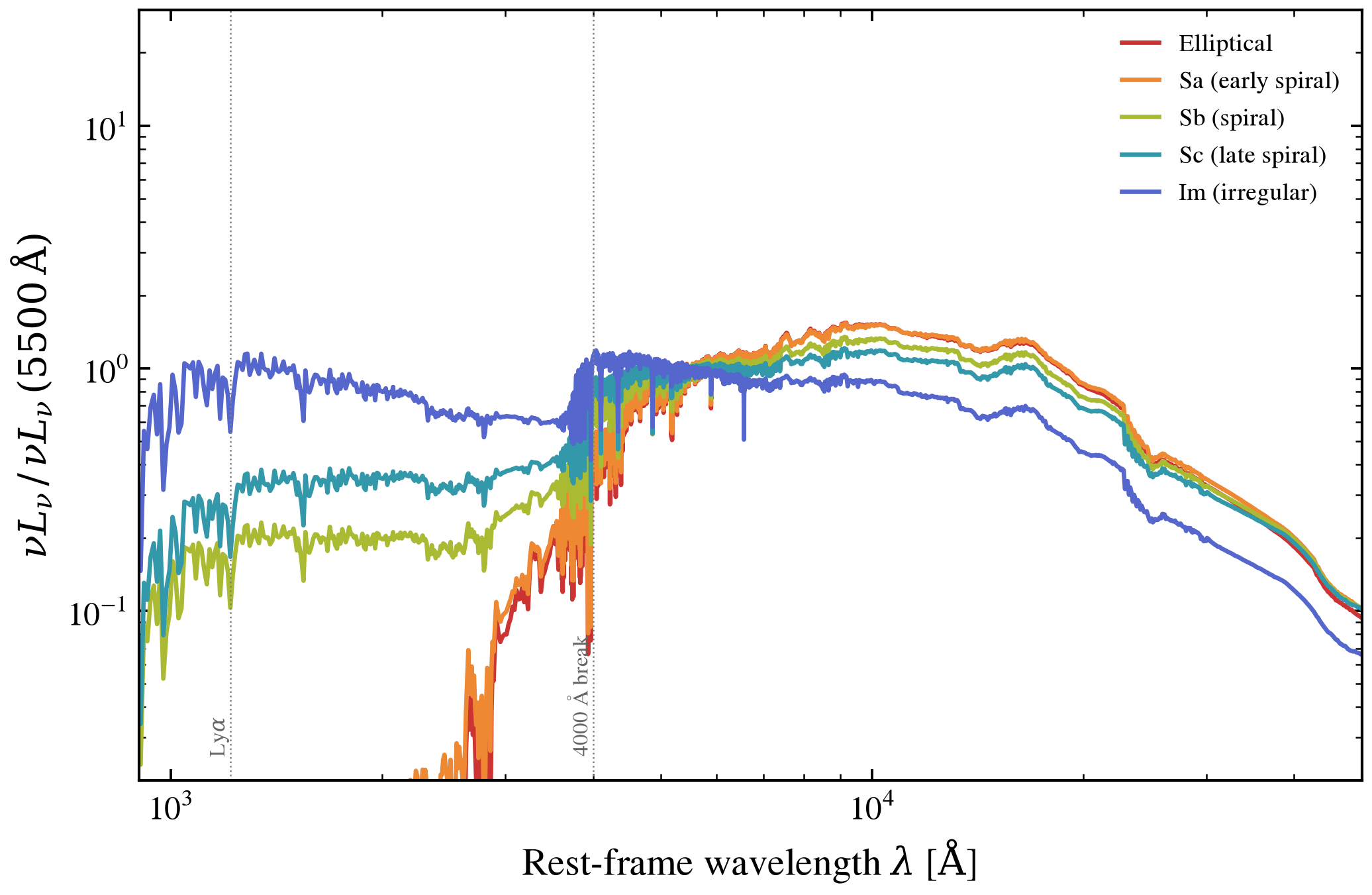
The Coleman, Wu & Weedman 1980 spectral templates remain the textbook illustration of how the integrated SED morphs along the Hubble sequence — from quiescent ellipticals with deep 4000 Å breaks to gas-rich irregulars dominated by ongoing star formation and nebular emission.
We synthesize the five canonical types within tengri using a single parametric SFH (truncated skew-normal) and tune three knobs per type: the SFH peak epoch, the SFH width, and the dust optical depth. The emerging atlas shows the same chromatic ordering as Coleman+1980: ellipticals are reddest at all wavelengths, irregulars dominate the UV.
References:
Coleman, Wu & Weedman 1980, ApJS, 43, 393
Kennicutt 1992, ApJS, 79, 255 (modern revision of the atlas)
/tengri/src/tengri/forward/sed_model.py:13787: SFHBeyondOldestTemplateWarning: The SSP grid's oldest template is 12.589 Gyr but the universe is 13.787 Gyr old at redshift 0. Stars formed in that gap are older than every template, so both age kernels assign them to the oldest one: the formed mass is conserved, and those stars carry the colors of a 12.589 Gyr population. Use a grid whose oldest template reaches 13.787 Gyr (e.g. MIST) to remove the approximation.
  return cls(
import os

from tengri.components.stellar.sfh.registry import SFH_REGISTRY

_PEAK_FRAC_LO, _PEAK_FRAC_HI = (
    SFH_REGISTRY["tsnorm"].params["sfh_tsnorm_peak_lbt_frac"].default.bounds
)

os.environ["TF_CPP_MIN_LOG_LEVEL"] = "2"  # suppress XLA/PjRt C++ INFO+WARNING logs

import warnings

import jax
import jax.numpy as jnp
import matplotlib.pyplot as plt
import numpy as np

import tengri
from tengri.plot import setup_style

setup_style()
warnings.filterwarnings("ignore", message=".*BakedInBackend.*")

# (label, peak_lbt_gyr, width_gyr, tau_diff, color)
ATLAS = [
    ("Elliptical", 9.0, 1.5, 0.05, "#cc3333"),
    ("Sa (early spiral)", 7.0, 2.0, 0.20, "#ee8833"),
    ("Sb (spiral)", 5.0, 2.5, 0.35, "#aabb33"),
    ("Sc (late spiral)", 3.0, 2.5, 0.50, "#3399aa"),
    ("Im (irregular)", 1.0, 2.0, 0.10, "#5566cc"),
]

ssp = tengri.load_ssp()
AGE_Z0 = float(tengri.cosmology.age_at_z0())  # Gyr, the age of the universe at z = 0
model = tengri.SEDModel.build(
    ssp,
    sfh={
        "type": "tsnorm",
        "all_params": tengri.Fixed(tengri.DEFAULT),
        "peak_lbt_frac": tengri.Uniform(_PEAK_FRAC_LO, _PEAK_FRAC_HI),
        "width_gyr": tengri.Uniform(0.1, 5.0),
        "log_total_mass": 10.0,
        "skew": 0.0,
        "trunc": 13.5,
    },
    dust_attenuation={
        "law": "power_law",
        "type": "two_component",
        "all_params": tengri.Fixed(tengri.DEFAULT),
        "tau_diff": tengri.Uniform(0.0, 2.0),
        "tau_bc": 0.3,
        "slope": -0.7,
    },
    redshift=tengri.Fixed(0.0),
)
baseline = dict(model.spec.sample(jax.random.PRNGKey(0)))

C_AA_PER_S = 2.998e18
fig, ax = plt.subplots(figsize=(7.2, 4.8))
for label, peak, width, tau, color in ATLAS:
    params = {
        **baseline,
        "sfh_tsnorm_peak_lbt_frac": jnp.float64(peak / AGE_Z0),
        "sfh_tsnorm_width_gyr": jnp.float64(width),
        "dust_tau_diff": jnp.float64(tau),
    }
    out = model.predict(params)
    wave = np.asarray(model.wavelengths)
    nu = C_AA_PER_S / wave
    nu_l_nu = nu * np.asarray(out.rest_sed())
    # Normalize each spectrum to its 5500 Å value so the chromatic
    # ordering — not the absolute luminosity — reads cleanly.
    norm = nu_l_nu[np.argmin(np.abs(wave - 5500.0))]
    ax.loglog(wave, nu_l_nu / norm, color=color, lw=1.6, label=label)

ax.axvline(4000, color="0.5", lw=0.6, ls=":")
ax.text(4000, 0.025, "4000 Å break", color="0.4", fontsize=8, rotation=90, va="bottom", ha="right")
ax.axvline(1216, color="0.5", lw=0.6, ls=":")
ax.text(1216, 0.025, r"Ly$\alpha$", color="0.4", fontsize=8, rotation=90, va="bottom", ha="right")
ax.set_xlim(900, 5e4)
ax.set_ylim(2e-2, 30.0)
ax.set_xlabel(r"Rest-frame wavelength $\lambda$ [$\mathrm{\AA}$]")
ax.set_ylabel(r"$\nu L_\nu\,/\,\nu L_\nu\,(5500\,\mathrm{\AA})$")
ax.legend(frameon=False, fontsize=9, loc="upper right")

fig.tight_layout()
plt.savefig("plot_usecase_hubble_sequence.png", dpi=150, bbox_inches="tight")