Note
Go to the end to download the full example code.
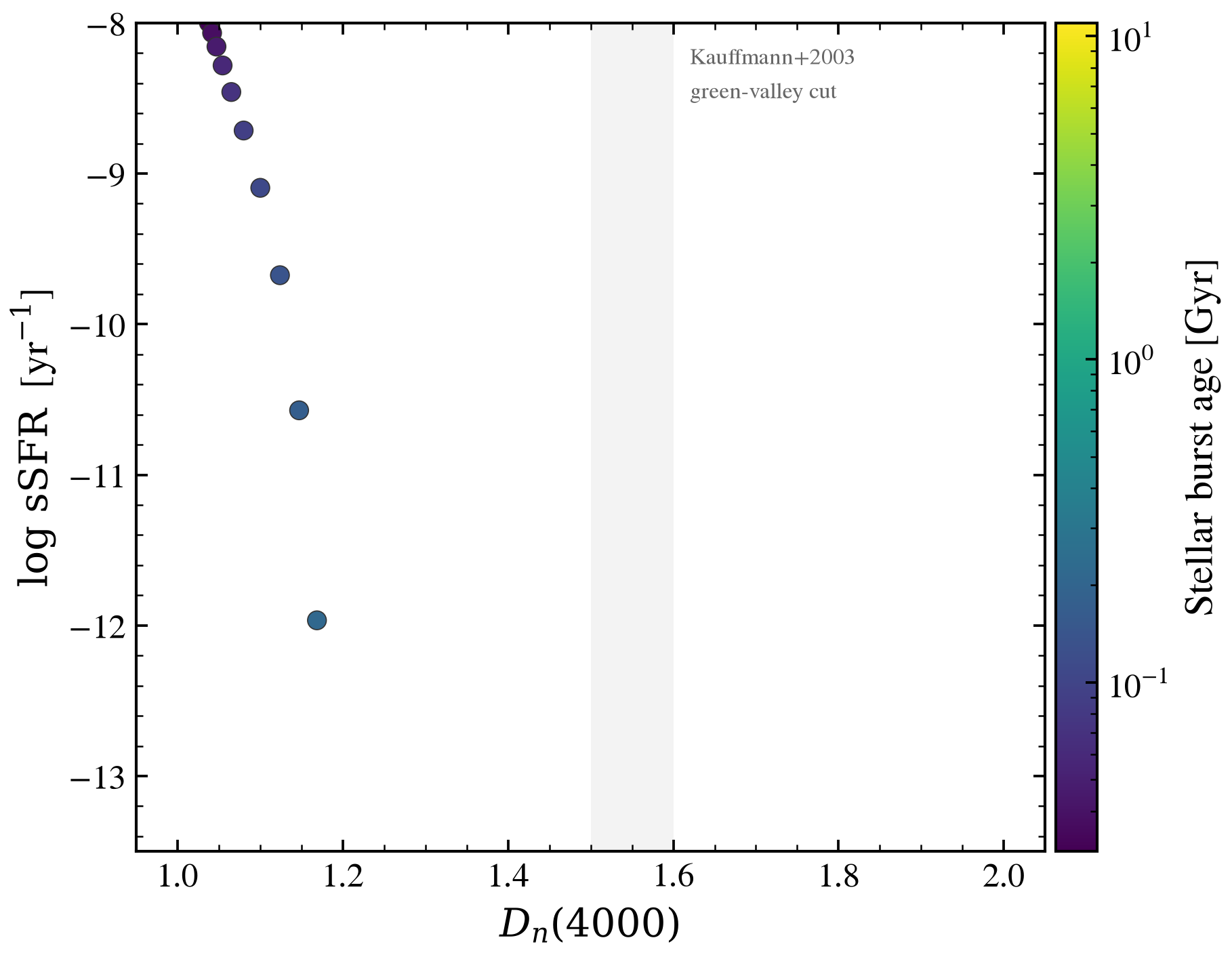
D_n(4000) – specific SFR: the Kauffmann+2003 sequence
The Kauffmann+2003 separation of star-forming and quiescent SDSS
galaxies plotted as a sample track: stellar-burst age varied from
30 Myr to 11 Gyr (single-burst SSP), with each model giving a
(D_n(4000), sSFR) pair.
Young bursts have D_n(4000) ≲ 1.2 and log sSFR ≳ −9 (active
star formation, weak break). Old populations climb to
D_n(4000) ≈ 1.9 and log sSFR ≲ −12 (quenched, deep break).
The Kauffmann+2003 green-valley cut at D_n(4000) ≈ 1.5 is the
horizontal divider.
/tengri/src/tengri/forward/sed_model.py:13787: SFHBeyondOldestTemplateWarning: The SSP grid's oldest template is 12.589 Gyr but the universe is 13.090 Gyr old at redshift 0.05. Stars formed in that gap are older than every template, so both age kernels assign them to the oldest one: the formed mass is conserved, and those stars carry the colors of a 12.589 Gyr population. Use a grid whose oldest template reaches 13.090 Gyr (e.g. MIST) to remove the approximation.
  return cls(
import os

from tengri.components.stellar.sfh.registry import SFH_REGISTRY

_PEAK_FRAC_LO, _PEAK_FRAC_HI = (
    SFH_REGISTRY["tsnorm"].params["sfh_tsnorm_peak_lbt_frac"].default.bounds
)

os.environ["TF_CPP_MIN_LOG_LEVEL"] = "2"  # suppress XLA/PjRt C++ INFO+WARNING logs

import warnings

import jax
import jax.numpy as jnp
import matplotlib.pyplot as plt
import numpy as np

import tengri
from tengri.plot import setup_style

setup_style()
warnings.filterwarnings("ignore", message=".*BakedInBackend.*")

C_AA_PER_S = 2.998e18


def _d4000(wave, l_nu):
    blue = (wave >= 3850) & (wave <= 3950)
    red = (wave >= 4000) & (wave <= 4100)
    return float(np.mean(l_nu[red]) / np.mean(l_nu[blue]))


ssp = tengri.load_ssp()
model = tengri.SEDModel.build(
    ssp,
    sfh={
        "type": "tsnorm",
        "all_params": tengri.Fixed(tengri.DEFAULT),
        "peak_lbt_frac": tengri.Uniform(_PEAK_FRAC_LO, _PEAK_FRAC_HI),
        "width_gyr": 0.05,
        "log_total_mass": 10.0,
        "skew": 0.0,
        "trunc": 13.0,
    },
    dust_attenuation={
        "law": "power_law",
        "type": "two_component",
        "all_params": tengri.Fixed(tengri.DEFAULT),
        "tau_diff": 0.0,
        "tau_bc": 0.0,
    },
    redshift=tengri.Fixed(0.05),
)
baseline = dict(model.spec.sample(jax.random.PRNGKey(0)))
AGE_Z = float(tengri.cosmology.age_at_z(0.05))  # Gyr

ages = np.geomspace(0.03, 11.0, 28)
d4000 = np.empty_like(ages)
ssfr = np.empty_like(ages)

for i, age in enumerate(ages):
    p = {**baseline, "sfh_tsnorm_peak_lbt_frac": jnp.float64(age / AGE_Z)}
    out = model.predict(p)
    wave = np.asarray(model.wavelengths)
    l_nu = np.asarray(out.rest_sed())
    d4000[i] = _d4000(wave, l_nu)
    sfh = model.predict_sfh(p)
    t = np.asarray(sfh["t_gyr"])
    sfr = np.asarray(sfh["sfr_mean"])
    m_star = float(np.trapezoid(sfr, t * 1e9))
    # current sSFR: SFR at t=0 / M_star
    sfr_now = float(sfr[0]) if sfr[0] > 0 else 1e-15
    ssfr[i] = sfr_now / max(m_star, 1e-30)

fig, ax = plt.subplots(figsize=(6.4, 5.0))
sc = ax.scatter(
    d4000,
    np.log10(np.maximum(ssfr, 1e-15)),
    c=ages,
    cmap="viridis",
    s=44,
    lw=0.4,
    edgecolor="0.2",
    norm=plt.matplotlib.colors.LogNorm(),
)

ax.axvspan(1.5, 1.6, color="0.92", alpha=0.6, lw=0)
ax.text(1.62, -8.5, "Kauffmann+2003\ngreen-valley cut", fontsize=8, color="0.4")

ax.set(
    xlabel=r"$D_n(4000)$",
    ylabel=r"$\log\,\mathrm{sSFR}$  [yr$^{-1}$]",
    xlim=(0.95, 2.05),
    ylim=(-13.5, -8.0),
)
cb = fig.colorbar(sc, ax=ax, pad=0.01)
cb.set_label("Stellar burst age [Gyr]")

fig.tight_layout()
plt.savefig("plot_usecase_d4000_vs_ssfr.png", dpi=150, bbox_inches="tight")
Total running time of the script: (0 minutes 7.728 seconds)