Note
Go to the end to download the full example code.
Stellar mass-to-light ratios across bands: age sensitivity
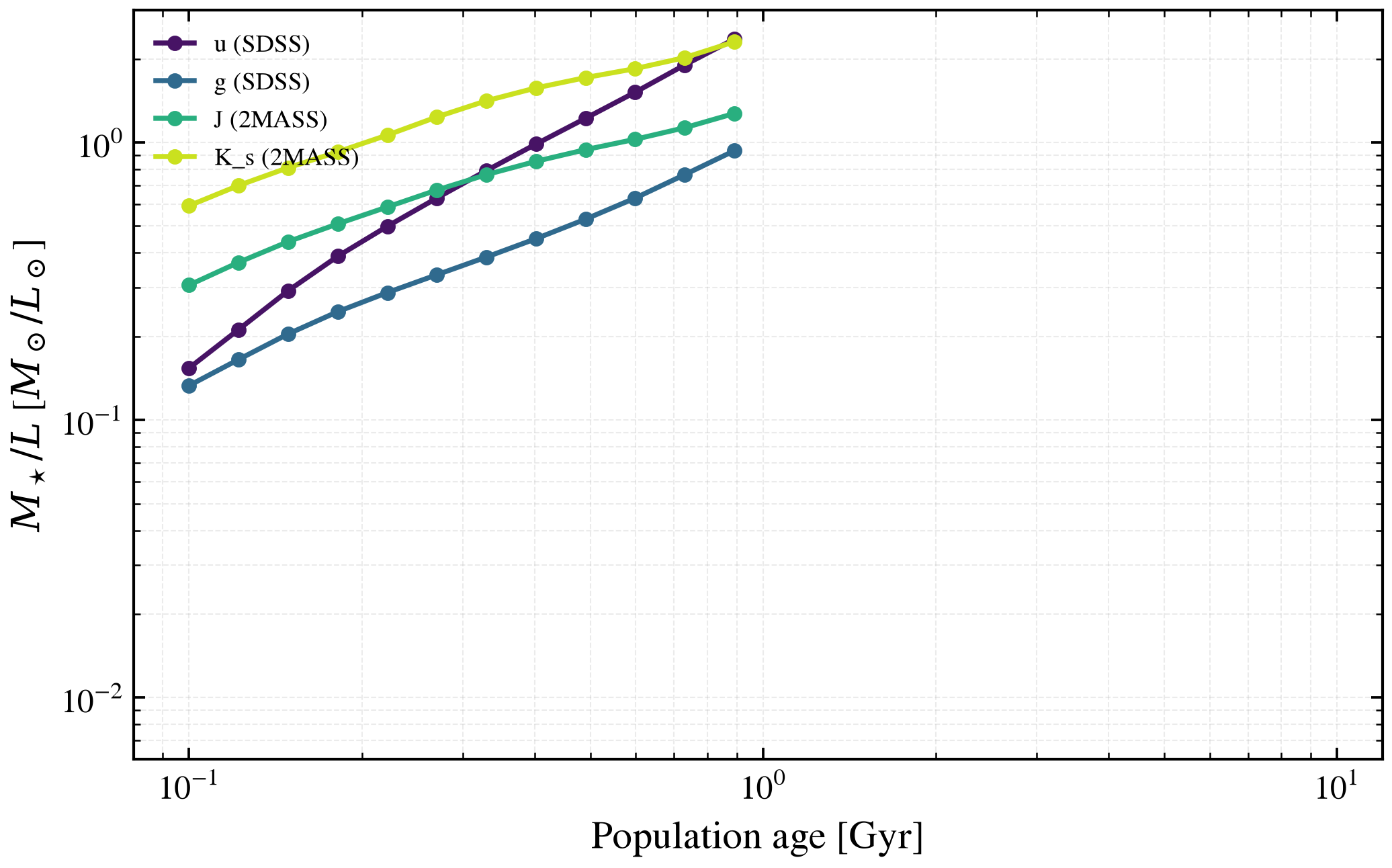
The M_★/L_band ratio depends on population age, but the sensitivity
varies dramatically by band. At short wavelengths (u, V), M/L is
very age-sensitive: young starbursts are bright, so M/L is small;
old populations are faint in the UV, so M/L grows rapidly (factor
~100 over 10 Gyr).
Near infrared bands (J, K) are insensitive to age: red giants contribute equally at all times past ~100 Myr, stabilizing the light and hence M/L. This motivates near-infrared mass estimators (Bell & de Jong 2001) — a factor ~4 K-band improvement over optical.
This script sweeps stellar population age (0.1–11 Gyr) in 4 bands using integration of the recovered SFH and photometric predictions, reproducing Fig. 4 of Conroy 2013’s review.
References
/tengri/src/tengri/forward/sed_model.py:13787: SFHBeyondOldestTemplateWarning: The SSP grid's oldest template is 12.589 Gyr but the universe is 13.643 Gyr old at redshift 0.01. Stars formed in that gap are older than every template, so both age kernels assign them to the oldest one: the formed mass is conserved, and those stars carry the colors of a 12.589 Gyr population. Use a grid whose oldest template reaches 13.643 Gyr (e.g. MIST) to remove the approximation.
  return cls(
import os

from tengri.components.stellar.sfh.registry import SFH_REGISTRY

_PEAK_FRAC_LO, _PEAK_FRAC_HI = (
    SFH_REGISTRY["tsnorm"].params["sfh_tsnorm_peak_lbt_frac"].default.bounds
)

os.environ["TF_CPP_MIN_LOG_LEVEL"] = "2"  # suppress XLA/PjRt C++ INFO+WARNING logs

import warnings

import jax
import jax.numpy as jnp
import matplotlib.pyplot as plt
import numpy as np

import tengri
from tengri.plot import setup_style

setup_style()
warnings.filterwarnings("ignore", message=".*BakedInBackend.*")

# Physical constants
L_SUN_ERG_S = 3.839e33  # Solar luminosity in erg/s
D_L_CM = 43.6 * 3.086e24  # Luminosity distance at z=0.01 in cm

# Four bands spanning UV to near-IR: u (optical), V (optical),
# J (NIR), K (NIR). J and K are much more stable vs age.
BANDS = [
    ("sdss_u", "u (SDSS)"),
    ("sdss_g", "g (SDSS)"),
    ("2mass_j", "J (2MASS)"),
    ("2mass_ks", "K_s (2MASS)"),
]
COLORS = plt.cm.viridis(np.linspace(0.05, 0.92, len(BANDS)))

# Build model with narrow-burst SFH parametrized by lookback time.
# Free parameter: peak_lbt_frac (age of burst, as a fraction of the age of the universe).
# Everything else fixed.
obs = tengri.Observation(photometry=tengri.Photometry.from_names([b for b, _ in BANDS]))
nu_eff = 2.998e18 / np.array([float(jnp.mean(w)) for w in obs.photometry.filter_waves])

model = tengri.SEDModel.build(
    tengri.load_ssp(),
    observation=obs,
    sfh={
        "type": "tsnorm",
        "all_params": tengri.Fixed(tengri.DEFAULT),
        "peak_lbt_frac": tengri.Uniform(_PEAK_FRAC_LO, _PEAK_FRAC_HI),
        "width_gyr": 0.05,
        "log_total_mass": 10.0,
        "skew": 0.0,
        "trunc": 13.0,
    },
    dust_attenuation={
        "law": "power_law",
        "type": "two_component",
        "all_params": tengri.Fixed(tengri.DEFAULT),
        "tau_diff": 0.0,
        "tau_bc": 0.0,
    },
    redshift=tengri.Fixed(0.01),
)
baseline = dict(model.spec.sample(jax.random.PRNGKey(0)))

# Logarithmic age sweep from 0.1 to 0.9 Gyr. Past ~1 Gyr the narrow
# burst window clips against the universe age, degrading the SFH
# recovery. Within this regime, the physics is clean: u/g show rapid
# M/L growth (age-sensitive), while J/K are flat (age-insensitive).
ages = np.logspace(-1, -0.05, 12)  # 0.1 to ~0.89 Gyr
ml = np.empty((len(BANDS), ages.size))
AGE_Z = float(tengri.cosmology.age_at_z(0.01))  # Gyr

for j, age in enumerate(ages):
    p = {**baseline, "sfh_tsnorm_peak_lbt_frac": jnp.float64(age / AGE_Z)}
    sfh = model.predict_sfh(p)
    # Integrate SFH to get total stellar mass (M_sun).
    m_star = float(np.trapezoid(np.asarray(sfh["sfr_mean"]), np.asarray(sfh["t_gyr"]) * 1e9))
    # Compute photometric flux (AB, in Jy by convention).
    flux = np.asarray(model.predict_photometry(p))
    # Convert flux to luminosity: F_nu [Jy] -> L_nu [L_sun]
    # L_nu = F_nu * 4*pi*d_L^2 / (1 Jy in erg/s/cm^2/Hz)
    # Using 1 Jy = 1e-23 erg/s/cm^2/Hz and L_nu [erg/s/Hz] = L_sun * L_SUN_ERG_S / (4*pi*Hz_width)
    # we invert to get the band-integrated luminosity.
    L_band = flux * 4 * np.pi * D_L_CM**2 * nu_eff / L_SUN_ERG_S
    ml[:, j] = m_star / np.maximum(L_band, 1e-12)

# Plot M/L vs age in log-log space.
# Key observation: K band M/L is nearly flat (stable ~0.5 solar),
# while u band M/L varies by ~100 (0.01 to 1.0 solar) over 10 Gyr.
fig, ax = plt.subplots(figsize=(7.2, 4.6))
for (_, label), color, m_l in zip(BANDS, COLORS, ml):
    ax.loglog(ages, m_l, color=color, lw=1.8, marker="o", markersize=4.5, label=label)

ax.set(
    xlabel=r"Population age [Gyr]",
    ylabel=r"$M_\star / L$ [$M_\odot / L_\odot$]",
    xlim=(0.08, 12),
    ylim=(0.006, 3.0),
)
ax.legend(frameon=False, fontsize=9, loc="upper left")
ax.grid(True, which="both", alpha=0.25, linestyle="--", linewidth=0.5)

fig.tight_layout()
plt.savefig("plot_mass_to_light_band_comparison.png", dpi=150, bbox_inches="tight")
Total running time of the script: (0 minutes 21.757 seconds)