Note
Go to the end to download the full example code.
Stellar absorption bandheads: age and metallicity anti-correlation
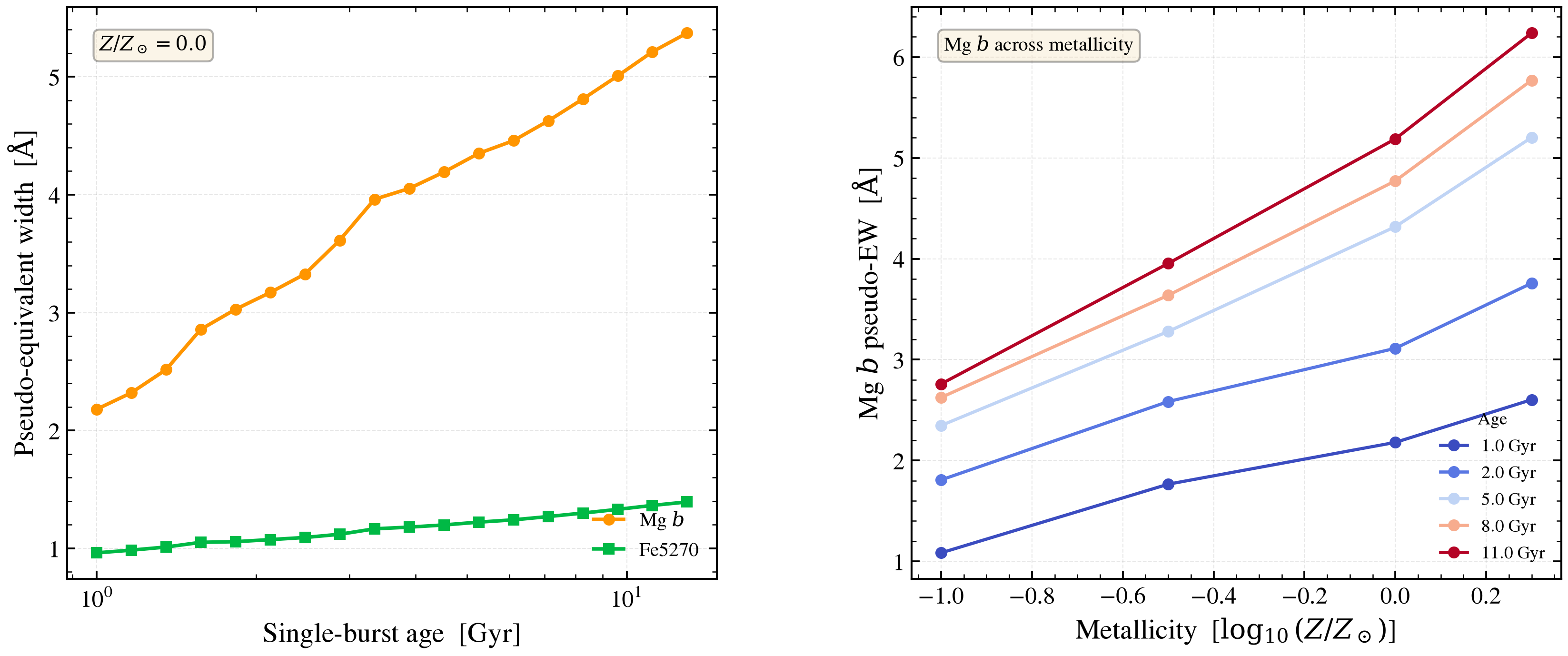
Stellar absorption features, especially the Mg b and Fe5270 line strengths, encode both age and metallicity in a classical anti-correlation pattern: at fixed metallicity, both features strengthen with age (population becomes older, cooler); at fixed age, increasing metallicity also strengthens the features (enhanced α-element abundances + stronger metal absorption).
This two-panel comparison shows:
Left panel: Mg b and Fe5270 equivalent widths (pseudo-EW in Ångströms) versus single-burst age at solar metallicity (Z/Z☉ = 0.0 dex).
Right panel: same age range but across metallicities (Z/Z☉ = -1.0, -0.5, 0.0, +0.3 dex), illustrating the strength of the age–metallicity degeneracy.
Both indices are computed from high-resolution spectra (R=2000) in the 5050–5350 Å rest-frame optical window using Trager+1998 and Worthey+1994
line definitions. Reproduces the cluster age-dating diagnostics of Trager+2000 [1].
References
/tengri/src/tengri/forward/sed_model.py:13787: SFHBeyondOldestTemplateWarning: The SSP grid's oldest template is 12.589 Gyr but the universe is 13.090 Gyr old at redshift 0.05. Stars formed in that gap are older than every template, so both age kernels assign them to the oldest one: the formed mass is conserved, and those stars carry the colors of a 12.589 Gyr population. Use a grid whose oldest template reaches 13.090 Gyr (e.g. MIST) to remove the approximation.
  return cls(
/tengri/src/tengri/forward/sed_model.py:3401: SFHBurstAliasingWarning: SFH burst width sfh_tsnorm_width_gyr=0.05 Gyr is narrower than the SSP grid spacing 0.122 Gyr at peak sfh_tsnorm_peak_lbt_gyr=1 Gyr. Predictions will show a non-physical staircase as the burst peak crosses SSP grid boundaries (#299). Widen the burst to at least width_gyr ≳ 0.122 for smooth behavior.
  param_map_deltas.append(self._init_sfh(spec))
/tengri/src/tengri/forward/sed_model.py:13787: YoungTopMetallicityWarning: met_logzsol reaches Z = 0.0896 (its upper bound, Z = 0.0449, plus 3 x the metallicity-scatter upper bound of 0.1 dex that the scatter kernel spans), above Z = 0.0497, where the metallicity weights start to use the Z = 0.0600 node of this SSP grid (its highest complete node is Z = 0.0400). The Z = 0.0600 node has no stars above ~12 Msun for log10(age/yr) <= 7.15: FSPS ISOCHRONES/PARSEC/isoc_z0.0600.dat: Mini capped at 12.01 Msun for every log age 5.50-7.15 (343 rows at 5.50; isoc_z0.0200.dat reaches 300 Msun); the PARSEC massive-star tracks stop at Z = 0.04 (Chen et al. 2015, MNRAS 452, 1068). The metallicity is therefore held at Z = 0.0400 for log10(age/yr) <= 7.15, and the top node's weight rises linearly with log age to 1 at 7.20; older populations use the top node unchanged. To use a MIST [Z/H] = +0.5 node (FSPS zlegend Z = 0.0449) at young ages instead, load the grid with top_z='mist': tengri.load_ssp(<name>, top_z='mist') or load_ssp_data(<path>, top_z='mist'). That node has MIST isochrones, so between Z = 0.0400 and 0.0449 the young population switches isochrone physics, not only metallicity.
  return cls(
/tengri/src/tengri/forward/sed_model.py:13787: SFHBeyondOldestTemplateWarning: The SSP grid's oldest template is 12.589 Gyr but the universe is 13.090 Gyr old at redshift 0.05. Stars formed in that gap are older than every template, so both age kernels assign them to the oldest one: the formed mass is conserved, and those stars carry the colors of a 12.589 Gyr population. Use a grid whose oldest template reaches 13.090 Gyr (e.g. MIST) to remove the approximation.
  return cls(
/tengri/src/tengri/forward/sed_model.py:3401: SFHBurstAliasingWarning: SFH burst width sfh_tsnorm_width_gyr=0.05 Gyr is narrower than the SSP grid spacing 0.273 Gyr at peak sfh_tsnorm_peak_lbt_gyr=2 Gyr. Predictions will show a non-physical staircase as the burst peak crosses SSP grid boundaries (#299). Widen the burst to at least width_gyr ≳ 0.273 for smooth behavior.
  param_map_deltas.append(self._init_sfh(spec))
/tengri/src/tengri/forward/sed_model.py:13787: YoungTopMetallicityWarning: met_logzsol reaches Z = 0.0896 (its upper bound, Z = 0.0449, plus 3 x the metallicity-scatter upper bound of 0.1 dex that the scatter kernel spans), above Z = 0.0497, where the metallicity weights start to use the Z = 0.0600 node of this SSP grid (its highest complete node is Z = 0.0400). The Z = 0.0600 node has no stars above ~12 Msun for log10(age/yr) <= 7.15: FSPS ISOCHRONES/PARSEC/isoc_z0.0600.dat: Mini capped at 12.01 Msun for every log age 5.50-7.15 (343 rows at 5.50; isoc_z0.0200.dat reaches 300 Msun); the PARSEC massive-star tracks stop at Z = 0.04 (Chen et al. 2015, MNRAS 452, 1068). The metallicity is therefore held at Z = 0.0400 for log10(age/yr) <= 7.15, and the top node's weight rises linearly with log age to 1 at 7.20; older populations use the top node unchanged. To use a MIST [Z/H] = +0.5 node (FSPS zlegend Z = 0.0449) at young ages instead, load the grid with top_z='mist': tengri.load_ssp(<name>, top_z='mist') or load_ssp_data(<path>, top_z='mist'). That node has MIST isochrones, so between Z = 0.0400 and 0.0449 the young population switches isochrone physics, not only metallicity.
  return cls(
/tengri/src/tengri/forward/sed_model.py:13787: SFHBeyondOldestTemplateWarning: The SSP grid's oldest template is 12.589 Gyr but the universe is 13.090 Gyr old at redshift 0.05. Stars formed in that gap are older than every template, so both age kernels assign them to the oldest one: the formed mass is conserved, and those stars carry the colors of a 12.589 Gyr population. Use a grid whose oldest template reaches 13.090 Gyr (e.g. MIST) to remove the approximation.
  return cls(
/tengri/src/tengri/forward/sed_model.py:3401: SFHBurstAliasingWarning: SFH burst width sfh_tsnorm_width_gyr=0.05 Gyr is narrower than the SSP grid spacing 0.612 Gyr at peak sfh_tsnorm_peak_lbt_gyr=5 Gyr. Predictions will show a non-physical staircase as the burst peak crosses SSP grid boundaries (#299). Widen the burst to at least width_gyr ≳ 0.612 for smooth behavior.
  param_map_deltas.append(self._init_sfh(spec))
/tengri/src/tengri/forward/sed_model.py:13787: YoungTopMetallicityWarning: met_logzsol reaches Z = 0.0896 (its upper bound, Z = 0.0449, plus 3 x the metallicity-scatter upper bound of 0.1 dex that the scatter kernel spans), above Z = 0.0497, where the metallicity weights start to use the Z = 0.0600 node of this SSP grid (its highest complete node is Z = 0.0400). The Z = 0.0600 node has no stars above ~12 Msun for log10(age/yr) <= 7.15: FSPS ISOCHRONES/PARSEC/isoc_z0.0600.dat: Mini capped at 12.01 Msun for every log age 5.50-7.15 (343 rows at 5.50; isoc_z0.0200.dat reaches 300 Msun); the PARSEC massive-star tracks stop at Z = 0.04 (Chen et al. 2015, MNRAS 452, 1068). The metallicity is therefore held at Z = 0.0400 for log10(age/yr) <= 7.15, and the top node's weight rises linearly with log age to 1 at 7.20; older populations use the top node unchanged. To use a MIST [Z/H] = +0.5 node (FSPS zlegend Z = 0.0449) at young ages instead, load the grid with top_z='mist': tengri.load_ssp(<name>, top_z='mist') or load_ssp_data(<path>, top_z='mist'). That node has MIST isochrones, so between Z = 0.0400 and 0.0449 the young population switches isochrone physics, not only metallicity.
  return cls(
/tengri/src/tengri/forward/sed_model.py:13787: SFHBeyondOldestTemplateWarning: The SSP grid's oldest template is 12.589 Gyr but the universe is 13.090 Gyr old at redshift 0.05. Stars formed in that gap are older than every template, so both age kernels assign them to the oldest one: the formed mass is conserved, and those stars carry the colors of a 12.589 Gyr population. Use a grid whose oldest template reaches 13.090 Gyr (e.g. MIST) to remove the approximation.
  return cls(
/tengri/src/tengri/forward/sed_model.py:3401: SFHBurstAliasingWarning: SFH burst width sfh_tsnorm_width_gyr=0.05 Gyr is narrower than the SSP grid spacing 1.09 Gyr at peak sfh_tsnorm_peak_lbt_gyr=8 Gyr. Predictions will show a non-physical staircase as the burst peak crosses SSP grid boundaries (#299). Widen the burst to at least width_gyr ≳ 1.09 for smooth behavior.
  param_map_deltas.append(self._init_sfh(spec))
/tengri/src/tengri/forward/sed_model.py:13787: YoungTopMetallicityWarning: met_logzsol reaches Z = 0.0896 (its upper bound, Z = 0.0449, plus 3 x the metallicity-scatter upper bound of 0.1 dex that the scatter kernel spans), above Z = 0.0497, where the metallicity weights start to use the Z = 0.0600 node of this SSP grid (its highest complete node is Z = 0.0400). The Z = 0.0600 node has no stars above ~12 Msun for log10(age/yr) <= 7.15: FSPS ISOCHRONES/PARSEC/isoc_z0.0600.dat: Mini capped at 12.01 Msun for every log age 5.50-7.15 (343 rows at 5.50; isoc_z0.0200.dat reaches 300 Msun); the PARSEC massive-star tracks stop at Z = 0.04 (Chen et al. 2015, MNRAS 452, 1068). The metallicity is therefore held at Z = 0.0400 for log10(age/yr) <= 7.15, and the top node's weight rises linearly with log age to 1 at 7.20; older populations use the top node unchanged. To use a MIST [Z/H] = +0.5 node (FSPS zlegend Z = 0.0449) at young ages instead, load the grid with top_z='mist': tengri.load_ssp(<name>, top_z='mist') or load_ssp_data(<path>, top_z='mist'). That node has MIST isochrones, so between Z = 0.0400 and 0.0449 the young population switches isochrone physics, not only metallicity.
  return cls(
/tengri/src/tengri/forward/sed_model.py:13787: SFHBeyondOldestTemplateWarning: The SSP grid's oldest template is 12.589 Gyr but the universe is 13.090 Gyr old at redshift 0.05. Stars formed in that gap are older than every template, so both age kernels assign them to the oldest one: the formed mass is conserved, and those stars carry the colors of a 12.589 Gyr population. Use a grid whose oldest template reaches 13.090 Gyr (e.g. MIST) to remove the approximation.
  return cls(
/tengri/src/tengri/forward/sed_model.py:3401: SFHBurstAliasingWarning: SFH burst width sfh_tsnorm_width_gyr=0.05 Gyr is narrower than the SSP grid spacing 1.37 Gyr at peak sfh_tsnorm_peak_lbt_gyr=11 Gyr. Predictions will show a non-physical staircase as the burst peak crosses SSP grid boundaries (#299). Widen the burst to at least width_gyr ≳ 1.37 for smooth behavior.
  param_map_deltas.append(self._init_sfh(spec))
/tengri/src/tengri/forward/sed_model.py:13787: YoungTopMetallicityWarning: met_logzsol reaches Z = 0.0896 (its upper bound, Z = 0.0449, plus 3 x the metallicity-scatter upper bound of 0.1 dex that the scatter kernel spans), above Z = 0.0497, where the metallicity weights start to use the Z = 0.0600 node of this SSP grid (its highest complete node is Z = 0.0400). The Z = 0.0600 node has no stars above ~12 Msun for log10(age/yr) <= 7.15: FSPS ISOCHRONES/PARSEC/isoc_z0.0600.dat: Mini capped at 12.01 Msun for every log age 5.50-7.15 (343 rows at 5.50; isoc_z0.0200.dat reaches 300 Msun); the PARSEC massive-star tracks stop at Z = 0.04 (Chen et al. 2015, MNRAS 452, 1068). The metallicity is therefore held at Z = 0.0400 for log10(age/yr) <= 7.15, and the top node's weight rises linearly with log age to 1 at 7.20; older populations use the top node unchanged. To use a MIST [Z/H] = +0.5 node (FSPS zlegend Z = 0.0449) at young ages instead, load the grid with top_z='mist': tengri.load_ssp(<name>, top_z='mist') or load_ssp_data(<path>, top_z='mist'). That node has MIST isochrones, so between Z = 0.0400 and 0.0449 the young population switches isochrone physics, not only metallicity.
  return cls(
/tengri/src/tengri/forward/sed_model.py:13787: SFHBeyondOldestTemplateWarning: The SSP grid's oldest template is 12.589 Gyr but the universe is 13.090 Gyr old at redshift 0.05. Stars formed in that gap are older than every template, so both age kernels assign them to the oldest one: the formed mass is conserved, and those stars carry the colors of a 12.589 Gyr population. Use a grid whose oldest template reaches 13.090 Gyr (e.g. MIST) to remove the approximation.
  return cls(
import os

from tengri.components.stellar.sfh.registry import SFH_REGISTRY

_PEAK_FRAC_LO, _PEAK_FRAC_HI = (
    SFH_REGISTRY["tsnorm"].params["sfh_tsnorm_peak_lbt_frac"].default.bounds
)

os.environ["TF_CPP_MIN_LOG_LEVEL"] = "2"  # suppress XLA/PjRt C++ INFO+WARNING logs

import warnings

import jax
import jax.numpy as jnp
import matplotlib.pyplot as plt
import numpy as np

import tengri
from tengri import Fixed, Observation, Spectroscopy
from tengri.plot import setup_style

setup_style()
warnings.filterwarnings("ignore", message=".*BakedInBackend.*")
warnings.filterwarnings("ignore", message=".*deprecated.*")

C_AA_PER_S = 2.998e18


def mgb_pseudo_ew(wave: np.ndarray, f_lambda: np.ndarray) -> float:
    r"""
    Mg b equivalent width using Trager+1998 line/continuum windows.

    The Mg b feature is measured as the equivalent width in the 5100–5300 Å
    region. Line core: 5150–5200 Å. Continuum anchors: 5100–5150 Å (blue),
    5200–5300 Å (red).

    Parameters
    ----------
    wave : ndarray, shape (n_wave,)
        Rest-frame wavelengths [Å].
    f_lambda : ndarray, shape (n_wave,)
        Specific flux density [erg/s/cm^3/Å], converted from L_nu.

    Returns
    -------
    ew : float
        Pseudo-equivalent width [Å] (positive for absorption).
    """
    line = (wave >= 5150.0) & (wave <= 5200.0)
    blue = (wave >= 5100.0) & (wave <= 5150.0)
    red = (wave >= 5200.0) & (wave <= 5300.0)

    cont_blue = np.mean(f_lambda[blue]) if blue.sum() > 0 else 1.0
    cont_red = np.mean(f_lambda[red]) if red.sum() > 0 else 1.0

    # Linear interpolation of continuum across line window
    lam_blue = 0.5 * (5100.0 + 5150.0)
    lam_red = 0.5 * (5200.0 + 5300.0)
    slope = (cont_red - cont_blue) / (lam_red - lam_blue)
    cont = cont_blue + slope * (wave[line] - lam_blue)

    delta = wave[line][1] - wave[line][0] if line.sum() > 1 else 1.0
    return float(np.sum(np.maximum(1.0 - f_lambda[line] / np.maximum(cont, 1e-30), 0.0)) * delta)


def fe5270_pseudo_ew(wave: np.ndarray, f_lambda: np.ndarray) -> float:
    r"""
    Fe5270 equivalent width using Worthey+1994 window.

    The Fe5270 feature is measured in the 5235–5285 Å region (narrow core).
    Continuum anchors: 5245–5275 Å (approximately symmetric).

    Parameters
    ----------
    wave : ndarray, shape (n_wave,)
        Rest-frame wavelengths [Å].
    f_lambda : ndarray, shape (n_wave,)
        Specific flux density [erg/s/cm^3/Å], converted from L_nu.

    Returns
    -------
    ew : float
        Pseudo-equivalent width [Å] (positive for absorption).
    """
    line = (wave >= 5235.0) & (wave <= 5285.0)
    cont = (wave >= 5245.0) & (wave <= 5275.0)

    cont_level = np.mean(f_lambda[cont]) if cont.sum() > 0 else 1.0
    delta = wave[line][1] - wave[line][0] if line.sum() > 1 else 1.0
    fe_ew = 1.0 - f_lambda[line] / np.maximum(cont_level, 1e-30)
    return float(np.sum(np.maximum(fe_ew, 0.0)) * delta)


# ============================================================================
# Left panel: age vs indices at fixed solar metallicity
# ============================================================================

ssp = tengri.load_ssp()
REDSHIFT = 0.05

# Wavelength range for bandhead measurements (observer frame)
wave_obs_min = 5050.0 * (1.0 + REDSHIFT)
wave_obs_max = 5350.0 * (1.0 + REDSHIFT)
wave_obs = np.linspace(wave_obs_min, wave_obs_max, 600)

# Create observation object with spectroscopy
obs = Observation(spectroscopy=Spectroscopy(wave_obs=wave_obs))

# Age grid for left panel
ages_gyr = np.geomspace(1.0, 13.0, 18)
mgb_at_age = np.empty_like(ages_gyr)
fe5270_at_age = np.empty_like(ages_gyr)

# Build model at fixed parameters, then vary age
model_solar = tengri.SEDModel.build(
    ssp,
    sfh={
        "type": "tsnorm",
        "all_params": tengri.Fixed(tengri.DEFAULT),
        "peak_lbt_frac": tengri.Uniform(_PEAK_FRAC_LO, _PEAK_FRAC_HI),
        "width_gyr": 0.05,
        "log_total_mass": 10.0,
        "skew": 0.0,
        "trunc": 13.0,
    },
    dust_attenuation={
        "law": "power_law",
        "type": "two_component",
        "all_params": tengri.Fixed(tengri.DEFAULT),
        "tau_diff": 0.0,
        "tau_bc": 0.0,
    },
    redshift=Fixed(REDSHIFT),
    observation=obs,
)
baseline_solar = dict(model_solar.spec.sample(jax.random.PRNGKey(0)))
AGE_Z = float(tengri.cosmology.age_at_z(REDSHIFT))  # Gyr

# Predict spectra across ages
for i, age in enumerate(ages_gyr):
    params = {**baseline_solar, "sfh_tsnorm_peak_lbt_frac": jnp.float64(age / AGE_Z)}

    pred = model_solar.predict(params)
    wave_rest = np.asarray(model_solar.wavelengths)
    l_nu = np.asarray(pred.rest_sed())
    f_lambda = l_nu * C_AA_PER_S / (wave_rest**2)

    mgb_at_age[i] = mgb_pseudo_ew(wave_rest, f_lambda)
    fe5270_at_age[i] = fe5270_pseudo_ew(wave_rest, f_lambda)

# ============================================================================
# Right panel: metallicity grid at multiple ages
# ============================================================================

ages_multimet = np.array([1.0, 2.0, 5.0, 8.0, 11.0])
met_dex = np.array([-1.0, -0.5, 0.0, 0.3])

mgb_grid = np.empty((len(ages_multimet), len(met_dex)))
fe5270_grid = np.empty((len(ages_multimet), len(met_dex)))

for j, age in enumerate(ages_multimet):
    for k, met in enumerate(met_dex):
        # Build model with fixed age, variable metallicity
        # The nested-dict builder supports met_logzsol as a direct parameter
        model_met = tengri.SEDModel.build(
            ssp,
            sfh={
                "type": "tsnorm",
                "all_params": tengri.Fixed(tengri.DEFAULT),
                "peak_lbt_gyr": age,
                "width_gyr": 0.05,
                "log_total_mass": 10.0,
                "skew": 0.0,
                "trunc": 13.0,
            },
            dust_attenuation={
                "law": "power_law",
                "type": "two_component",
                "all_params": tengri.Fixed(tengri.DEFAULT),
                "tau_diff": 0.0,
                "tau_bc": 0.0,
            },
            # ``met_logzsol`` is overridden below (#2296: a params-dict key
            # the spec declared Fixed is refused), so it must be free; no
            # ``met=`` group was declared before, defaulting the whole group
            # to ``Fixed(DEFAULT)``. Bounds cover met_dex.
            met={"logzsol": tengri.Uniform(-2.0, 0.5)},
            redshift=Fixed(REDSHIFT),
            observation=obs,
        )
        baseline_met = dict(model_met.spec.sample(jax.random.PRNGKey(0)))

        # Set metallicity
        params_met = {**baseline_met, "met_logzsol": jnp.float64(met)}

        pred = model_met.predict(params_met)
        wave_rest = np.asarray(model_met.wavelengths)
        l_nu = np.asarray(pred.rest_sed())
        f_lambda = l_nu * C_AA_PER_S / (wave_rest**2)

        mgb_grid[j, k] = mgb_pseudo_ew(wave_rest, f_lambda)
        fe5270_grid[j, k] = fe5270_pseudo_ew(wave_rest, f_lambda)

# ============================================================================
# Plot
# ============================================================================

fig, (ax_age, ax_met) = plt.subplots(1, 2, figsize=(13.5, 5.2), gridspec_kw={"wspace": 0.30})

# Left: age at fixed metallicity
ax_age.plot(ages_gyr, mgb_at_age, "o-", color="C2", lw=1.8, markersize=5, label=r"Mg $b$")
ax_age.plot(ages_gyr, fe5270_at_age, "s-", color="C1", lw=1.8, markersize=5, label=r"Fe5270")
ax_age.set_xscale("log")
ax_age.set_xlabel(r"Single-burst age  [Gyr]")
ax_age.set_ylabel(r"Pseudo-equivalent width  [$\mathrm{\AA}$]")
ax_age.text(
    0.05,
    0.95,
    r"$Z/Z_\odot = 0.0$",
    transform=ax_age.transAxes,
    fontsize=10,
    verticalalignment="top",
    bbox=dict(boxstyle="round", facecolor="wheat", alpha=0.3),
)
ax_age.legend(loc="lower right", fontsize=10)
ax_age.grid(True, alpha=0.3, linestyle="--")

# Right: metallicity at multiple fixed ages
cmap = plt.get_cmap("coolwarm")
norm = plt.Normalize(vmin=ages_multimet.min(), vmax=ages_multimet.max())

for j, age in enumerate(ages_multimet):
    color = cmap(norm(age))
    ax_met.plot(
        met_dex,
        mgb_grid[j, :],
        "o-",
        color=color,
        lw=1.6,
        markersize=5,
        label=f"{age:.1f} Gyr",
    )

ax_met.set_xlabel(r"Metallicity  [$\log_{10}(Z/Z_\odot)$]")
ax_met.set_ylabel(r"Mg $b$ pseudo-EW  [$\mathrm{\AA}$]")
ax_met.text(
    0.05,
    0.95,
    "Mg $b$ across metallicity",
    transform=ax_met.transAxes,
    fontsize=10,
    verticalalignment="top",
    bbox=dict(boxstyle="round", facecolor="wheat", alpha=0.3),
)
ax_met.legend(loc="lower right", fontsize=9, title="Age", title_fontsize=9)
ax_met.grid(True, alpha=0.3, linestyle="--")

plt.savefig("plot_bandheads_age_metallicity.png", dpi=150, bbox_inches="tight")
Total running time of the script: (0 minutes 8.501 seconds)