Note
Go to the end to download the full example code.
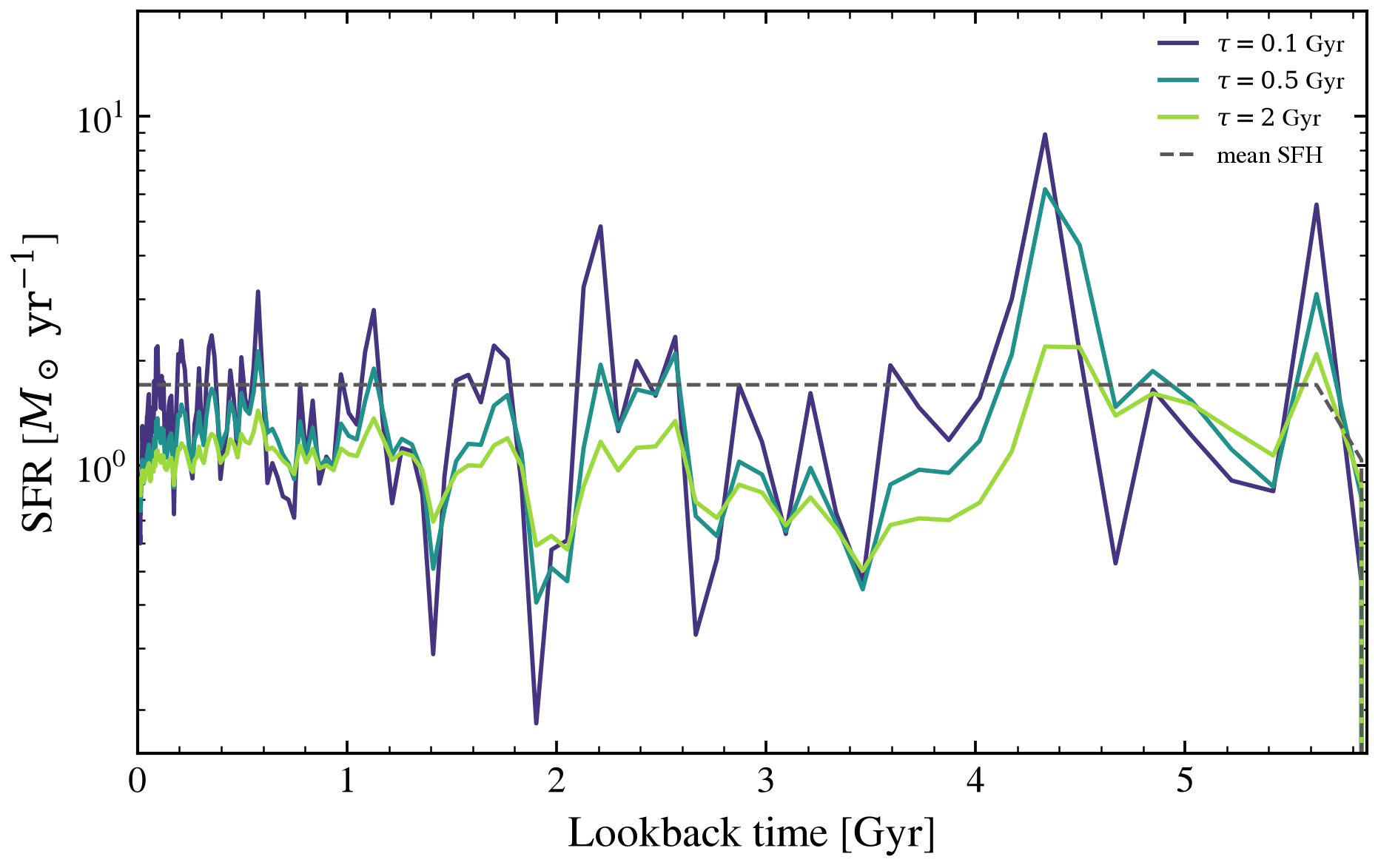
Correlation timescale τ sets how bursty a stochastic SFH looks at fixed σ
The field compositor multiplies any mean SFH by a damped random walk in
log SFR, C(Δt) = σ² exp(-|Δt|/τ) in dex². Amplitude and timescale are
separate knobs: every curve here carries the same σ = 0.3 dex and the same
latent draw, so the three differ only in how long the walk remembers.
psd_sigma is the standard deviation of log₁₀(SFR) in dex, not in
natural log, and psd_tau_myr is the e-folding lag of the autocovariance
itself — not a corner frequency, so no factor of 2π enters. tengri also
applies the log-normal correction exp(x - K(0)/2), which keeps the
ensemble mean linear SFR equal to the mean SFH; at σ = 0.3 dex, dropping it
would put the mean 27 % high.
The latent sfh_field_xi is an N(0, I) vector, one entry per SFH grid node,
drawn by model.spec.sample(key) along with every other free parameter.
Reusing one draw across the three models is what makes this a controlled
comparison rather than three unrelated realizations.
Reference: Iyer+2024 (arXiv:2208.05938); Caplar & Tacchella 2019.
import os

os.environ["TF_CPP_MIN_LOG_LEVEL"] = "2"  # suppress XLA/PjRt C++ INFO+WARNING logs

import warnings

import jax
import matplotlib.pyplot as plt
import numpy as np

import tengri
from tengri.cosmology import age_at_z
from tengri.plot import setup_style

setup_style()
warnings.filterwarnings("ignore", message=".*BakedInBackend.*")

REDSHIFT = 1.0
SIGMA_DEX = 0.3
TAUS_GYR = (0.1, 0.5, 2.0)

# Star formation runs from the Big Bang to the epoch of observation, so the
# walk spans the same baseline the galaxy has actually existed for.
T_UNIV_GYR = float(age_at_z(REDSHIFT))

ssp = tengri.load_ssp()


def build(tau_gyr=None):
    """A flat mean SFH at z = 1, optionally modulated by the GP field."""
    const = {
        "log_total_mass": tengri.Fixed(10.0),
        "start_gyr": tengri.Fixed(T_UNIV_GYR),
        "end_gyr": tengri.Fixed(0.0),
    }
    sfh = {"type": "const", **const, "all_params": tengri.Fixed(tengri.DEFAULT)}
    if tau_gyr is not None:
        sfh = {
            "type": ["const", "field"],
            **const,
            "psd_sigma": tengri.Fixed(SIGMA_DEX),
            "psd_tau_myr": tengri.Fixed(1e3 * tau_gyr),
            "all_params": tengri.Fixed(tengri.DEFAULT),
        }
    return tengri.SEDModel.build(
        ssp_data=ssp,
        sfh=sfh,
        dust_attenuation={
            "law": "power_law",
            "type": "two_component",
            "tau_bc": tengri.Fixed(0.0),
            "tau_diff": tengri.Fixed(0.0),
            "all_params": tengri.Fixed(tengri.DEFAULT),
        },
        redshift=tengri.Fixed(REDSHIFT),
        n_grid=256,
    )


def sfr_history(model, params):
    """SFR and its lookback grid, straight off the built model."""
    derived = model.predict_state(params).derived
    return (
        np.asarray(derived["sfh_grid_lbt_yr"]) / 1e9,
        np.asarray(derived["sfr_history"]),
    )


models = {tau: build(tau) for tau in TAUS_GYR}
mean_model = build()

# One latent draw, shared by all three: the seed is the field realization.
xi = models[TAUS_GYR[0]].spec.sample(jax.random.PRNGKey(42))["sfh_field_xi"]

t_gyr, sfr_mean = sfr_history(mean_model, {})

fig, ax = plt.subplots(figsize=(6.5, 4.2))
cmap = plt.get_cmap("viridis")

for i, tau in enumerate(TAUS_GYR):
    _, sfr = sfr_history(models[tau], {"sfh_field_xi": xi})
    ax.semilogy(
        t_gyr,
        sfr,
        color=cmap(0.15 + 0.7 * i / (len(TAUS_GYR) - 1)),
        lw=1.4,
        label=rf"$\tau = {tau:g}$ Gyr",
    )

ax.semilogy(t_gyr, sfr_mean, color="0.35", ls="--", lw=1.2, label="mean SFH")

# Star formation is switched on only between the Big Bang and z = 1; outside
# that window the SFR is zero and has no place on a log axis.
ax.set_xlim(0, T_UNIV_GYR)
ax.set_ylim(1.5e-1, 2e1)
ax.set_xlabel("Lookback time [Gyr]")
ax.set_ylabel(r"SFR [$M_\odot\ \mathrm{yr}^{-1}$]")
ax.legend(frameon=False, fontsize=8)

fig.tight_layout()
plt.savefig("plot_stochastic_sfh_tau_sweep.png", dpi=150, bbox_inches="tight")
Total running time of the script: (0 minutes 4.836 seconds)