Note
Go to the end to download the full example code.
GRAHSP Fig. 7 reproduction: attenuation of the galaxy model
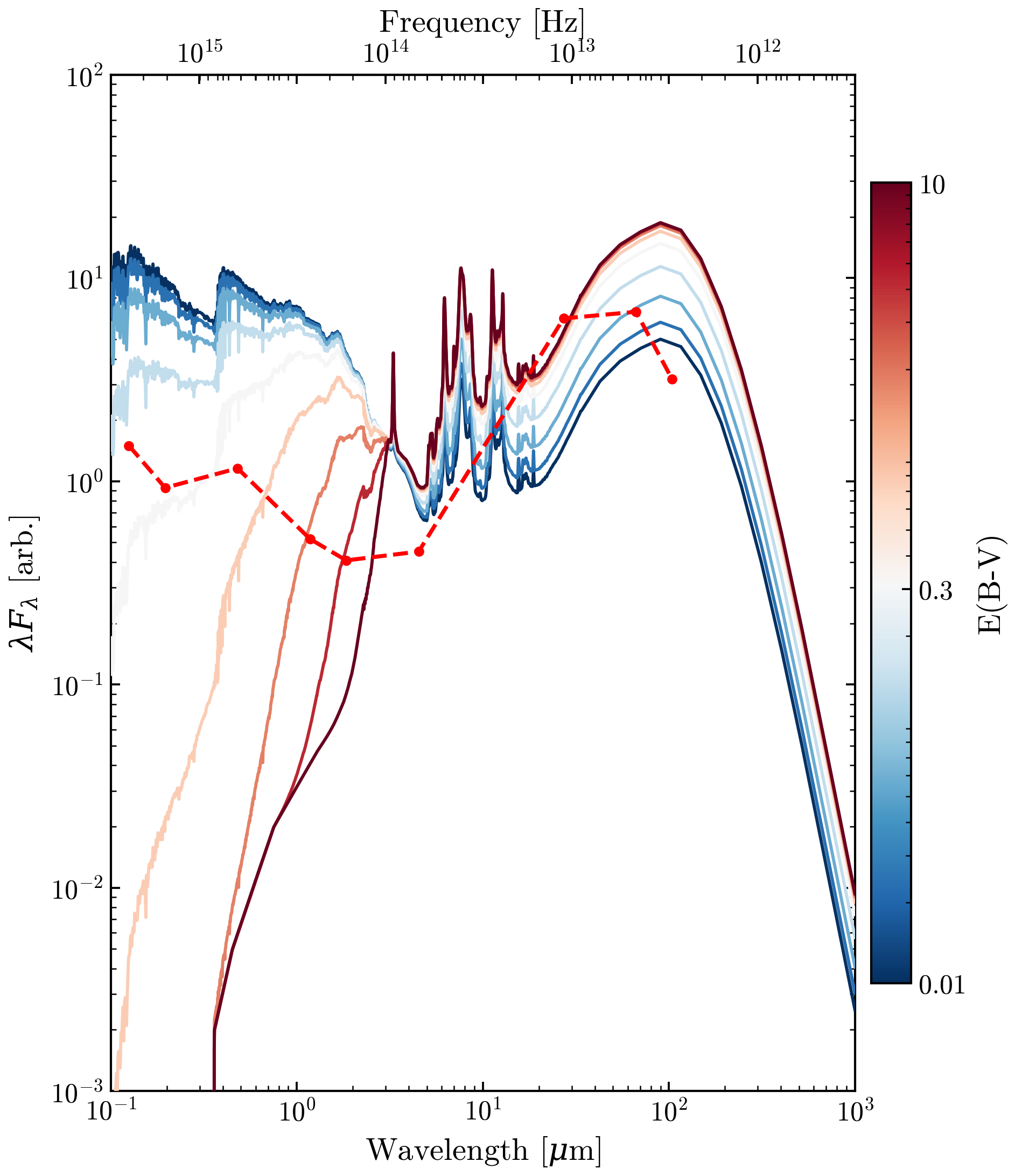
Reproduction of Fig. 7 of Buchner et al. (2024, GRAHSP): a star-forming galaxy SED from intrinsic (dark blue) to strongly attenuated (dark red) as the diffuse color excess E(B-V) is swept from 0.01 to 10. Energy balance routes the attenuated UV/optical light into the far-IR dust bump (Dale 2014), so the curves pivot about the FIR peak while the UV is progressively suppressed.
The extremely attenuated, low-metallicity starbursting galaxy Haro 11 (photometry from NED, mirroring Lyu et al. 2016) is overplotted as a dashed red curve for reference.
/tengri/examples/dust_attenuation/plot_grahsp_paper_fig7_galaxy_attenuation.py:156: RuntimeWarning: divide by zero encountered in divide
  "top", functions=(lambda x: C_NM_HZ / 1e3 / x, lambda nu: C_NM_HZ / 1e3 / nu)
import os

os.environ["TF_CPP_MIN_LOG_LEVEL"] = "2"

import itertools
import warnings
from pathlib import Path

import jax.numpy as jnp
import matplotlib.pyplot as plt
import numpy as np
from matplotlib import cm, colors

import tengri
from tengri import DEFAULT, FREE, Fixed, SEDModel
from tengri.plot import setup_style

setup_style()
warnings.filterwarnings("ignore", message=".*BakedInBackend.*")

C_NM_HZ = 2.99792458e17
R_V = 4.05  # Calzetti: A_V = R_V * E(B-V); tau_V = A_V / 1.086

# Resolve the committed Haro 11 NED SED next to this script. sphinx-gallery
# executes the example without a ``__file__`` in scope, so fall back to the
# repo-anchored path via the installed tengri package (editable layout).
if "__file__" in dir():
    _data_dir = Path(__file__).resolve().parent / "data"
else:
    _repo = Path(tengri.__file__).resolve().parents[2]
    _data_dir = _repo / "examples" / "dust_attenuation" / "data"
HARO11 = _data_dir / "haro11_ned_sed.txt"

# No-arg load_ssp() auto-discovers the bundled PARSEC/MILES/Chabrier wNE grid
# regardless of the working directory (sphinx-gallery executes from elsewhere).
ssp = tengri.load_ssp()
wave_aa = jnp.logspace(np.log10(800.0), np.log10(1.0e7), 3000)  # 0.08 - 1000 um
wave_um = np.asarray(wave_aa) / 1e4

ebv_grid = np.logspace(np.log10(0.01), np.log10(10.0), 9)
norm = colors.LogNorm(vmin=0.01, vmax=10.0)
cmap = plt.get_cmap("RdBu_r")


def nu_Lnu(lnu):
    return np.asarray(lnu) * (C_NM_HZ / (np.asarray(wave_aa) * 0.1))


fig, ax = plt.subplots(figsize=(6.6, 7.6))

# Build the SED model ONCE; the diffuse-screen optical depth ``dust_tau_diff``
# is declared FREE (not Fixed), so the E(B-V) sweep only ever names that one
# key in a fresh params dict and re-runs the (already-compiled) forward pass.
# A params dict may not carry a Fixed key at all (#2296) -- including to
# re-pin it per loop iteration -- so sweeping a parameter this way requires
# building it free. Rebuilding the full stellar+dust model inside the loop
# would recompile the SSP pipeline on every iteration and accumulate XLA
# buffers — the gallery-OOM anti-pattern.
model = SEDModel.build(
    ssp_data=ssp,
    sfh={
        "type": "delayed",
        "all_params": Fixed(DEFAULT),
        "tau_gyr": 5.0,
        "age_gyr": 3.0,
        "log_total_mass": 10.0,
    },
    dust_attenuation={
        "type": "two_component",
        "law": "calzetti",
        "all_params": Fixed(DEFAULT),
        "tau_bc": 0.3,  # fixed birth-cloud baseline (stabilizes the FIR peak)
        "tau_diff": FREE,  # swept per E(B-V) below; not read from its prior
    },
    dust_emission={"type": "dale2014", "all_params": Fixed(DEFAULT)},
    redshift=Fixed(0.01),
)

norm_ref = None
for ebv in ebv_grid:
    tau_diff = R_V * ebv / 1.086  # diffuse screen scales with E(B-V)
    params = {"dust_tau_diff": tau_diff}
    rest = model.predict(params)
    lnu = np.asarray(rest.rest_sed(np.asarray(wave_aa)))
    lflam = nu_Lnu(lnu)
    if norm_ref is None:
        # Normalize so the FIR dust peak sits near ~5 (paper scaling).
        fir = (wave_um > 30) & (wave_um < 300)
        norm_ref = lflam[fir].max() / 5.0
    ax.plot(wave_um, lflam / norm_ref, color=cmap(norm(ebv)), lw=1.4, zorder=3)

# Haro 11 overlay: raw NED photometry has many measurements per band (plus
# radio + upper limits), so bin into log-wavelength medians for a smooth,
# representative SED (cf. the Lyu+ 2016 model curve in the paper).
if HARO11.exists():
    h = np.loadtxt(HARO11)
    hw, hf = h[:, 0], h[:, 1]
    good = np.isfinite(hf) & (hf > 0) & (hw > 0.1) & (hw < 500.0)
    hw, hf = hw[good], hf[good]
    edges = np.logspace(np.log10(0.1), np.log10(500.0), 20)
    centers, meds = [], []
    for lo, hi in itertools.pairwise(edges):
        sel = (hw >= lo) & (hw < hi)
        if sel.sum() >= 2:  # require >=2 measurements to suppress single outliers
            centers.append(np.sqrt(lo * hi))
            meds.append(np.median(hf[sel]))
    centers, meds = np.array(centers), np.array(meds)
    # Despike: 2 passes dropping bins >0.5 dex from a 3-point rolling median.
    for _ in range(2):
        logm = np.log10(meds)
        roll = np.array([np.median(logm[max(0, i - 1) : i + 2]) for i in range(len(logm))])
        keep = np.abs(logm - roll) < 0.5
        centers, meds = centers[keep], meds[keep]
    fir = (centers > 40) & (centers < 200)
    if fir.any():
        meds = meds / (np.median(meds[fir]) / 5.0)
    # Final guard: in lambda*F_lambda a dusty starburst cannot exceed its FIR
    # bump, so drop residual NED outlier bins above 3x the FIR peak (~5).
    ok = meds < 15.0
    centers, meds = centers[ok], meds[ok]
    ax.plot(
        centers,
        meds,
        color="red",
        ls="--",
        lw=1.8,
        marker="o",
        ms=3.5,
        label="Haro 11 (NED)",
        zorder=5,
    )

ax.set_xscale("log")
ax.set_yscale("log")
ax.set_xlim(0.1, 1000.0)
ax.set_ylim(1e-3, 1e2)
ax.set_xlabel(r"Wavelength [$\mu$m]")
ax.set_ylabel(r"$\lambda F_\lambda$ [arb.]")

secax = ax.secondary_xaxis(
    "top", functions=(lambda x: C_NM_HZ / 1e3 / x, lambda nu: C_NM_HZ / 1e3 / nu)
)
secax.set_xlabel("Frequency [Hz]")

sm = cm.ScalarMappable(norm=norm, cmap=cmap)
cbar = fig.colorbar(sm, ax=ax, fraction=0.05, pad=0.02)
cbar.set_label("E(B-V)")
cbar.set_ticks([0.01, 0.3, 10.0])
cbar.set_ticklabels(["0.01", "0.3", "10"])

fig.tight_layout()
plt.savefig("plot_grahsp_paper_fig7_galaxy_attenuation.png", dpi=150, bbox_inches="tight")
Total running time of the script: (0 minutes 11.443 seconds)