Note
Go to the end to download the full example code.
Rest-frame SED Redshift Invariance
The rest-frame SED depends only on intrinsic galaxy properties (SFH, dust,
metallicity, nebular, AGN) and is independent of redshift. Redshift only
enters via the observation (wavelength shift, distance dimming, IGM
attenuation). This diagnostic verifies that Prediction.rest_sed() returns
bit-identical SEDs across a range of redshifts for identical intrinsic
parameters. Age-of-the-Universe constraints at high-z may truncate the SFH
legitimately, producing smooth variation; any non-smooth jump signals a
coupling bug.
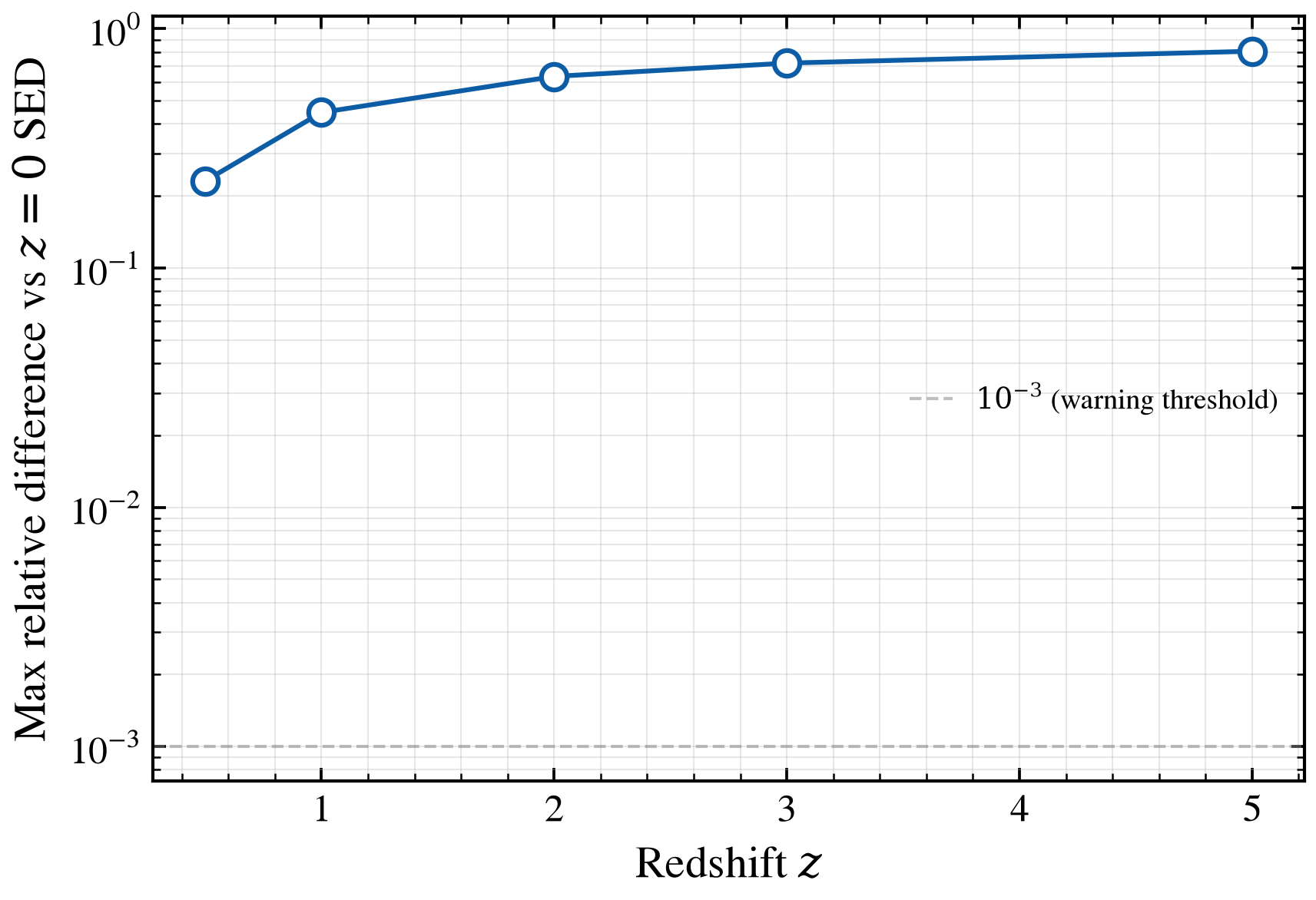
/tengri/src/tengri/forward/orchestrator.py:951: SFHBeforeBigBangWarning: Star formation history forms 41% of its stellar mass before the Big Bang at z=0.50 (cosmic age 8.61 Gyr). That mass is truncated, so the prediction does not reflect the requested SFH: bound the SFH age parameter or the redshift to keep star formation within cosmic time.
  state = component.apply(state, sliced, ssp_data=ssp_data, template_data=template_data)
/tengri/src/tengri/forward/orchestrator.py:951: SFHBeforeBigBangWarning: Star formation history forms 68% of its stellar mass before the Big Bang at z=1.00 (cosmic age 5.87 Gyr). That mass is truncated, so the prediction does not reflect the requested SFH: bound the SFH age parameter or the redshift to keep star formation within cosmic time.
  state = component.apply(state, sliced, ssp_data=ssp_data, template_data=template_data)
/tengri/src/tengri/forward/orchestrator.py:951: SFHBeforeBigBangWarning: Star formation history forms 86% of its stellar mass before the Big Bang at z=2.00 (cosmic age 3.29 Gyr). That mass is truncated, so the prediction does not reflect the requested SFH: bound the SFH age parameter or the redshift to keep star formation within cosmic time.
  state = component.apply(state, sliced, ssp_data=ssp_data, template_data=template_data)
/tengri/src/tengri/forward/orchestrator.py:951: SFHBeforeBigBangWarning: Star formation history forms 92% of its stellar mass before the Big Bang at z=3.00 (cosmic age 2.15 Gyr). That mass is truncated, so the prediction does not reflect the requested SFH: bound the SFH age parameter or the redshift to keep star formation within cosmic time.
  state = component.apply(state, sliced, ssp_data=ssp_data, template_data=template_data)
/tengri/src/tengri/forward/orchestrator.py:951: SFHBeforeBigBangWarning: Star formation history forms 96% of its stellar mass before the Big Bang at z=5.00 (cosmic age 1.18 Gyr). That mass is truncated, so the prediction does not reflect the requested SFH: bound the SFH age parameter or the redshift to keep star formation within cosmic time.
  state = component.apply(state, sliced, ssp_data=ssp_data, template_data=template_data)
import warnings

import jax
import matplotlib.pyplot as plt
import numpy as np

import tengri
from tengri.plot import setup_style

setup_style()
warnings.filterwarnings("ignore", message=".*BakedInBackend.*")

# Build model with free redshift parameter
ssp = tengri.load_ssp("fsps_prsc_miles_chabrier")
obs = tengri.Observation(photometry=tengri.Photometry.from_names(["sdss_g"]))

model = tengri.SEDModel.build(
    ssp,
    observation=obs,
    sfh={
        "type": "dpl",
        "all_params": tengri.Fixed(tengri.DEFAULT),
        "alpha": 2.0,
        "beta": 1.5,
        "tau_gyr": 5.0,
    },
    dust_attenuation={
        "law": "power_law",
        "type": "two_component",
        "all_params": tengri.Fixed(tengri.DEFAULT),
        "tau_bc": 0.3,
    },
    neb={"type": "cue", "all_params": tengri.Fixed(tengri.DEFAULT)},
    redshift=tengri.Uniform(0.0, 5.0),
)

# Sample baseline parameters at z=0
key = jax.random.PRNGKey(0)
baseline = model.spec.sample(key)

# Redshifts to test
z_vals = np.array([0.0, 0.5, 1.0, 2.0, 3.0, 5.0])

# Compute rest-frame SEDs, varying only redshift
max_rel_diffs = []
for z in z_vals:
    params_z = {**baseline, "redshift": float(z)}
    sed_z = model.predict(params_z)

    # Compare to z=0 baseline
    if z == 0.0:
        sed_0 = sed_z.rest_sed()
    else:
        # Max relative difference (exclude zeros)
        with np.errstate(divide="ignore", invalid="ignore"):
            rel_diff = np.abs(sed_z.rest_sed() - sed_0) / np.abs(sed_0)
            rel_diff = rel_diff[np.isfinite(rel_diff)]
            max_rel_diff = np.max(rel_diff) if len(rel_diff) > 0 else 0.0
            max_rel_diffs.append(max_rel_diff)

max_rel_diffs = np.array(max_rel_diffs)

# Plot: max relative difference vs redshift
fig, ax = plt.subplots(figsize=(6, 4.2))
ax.semilogy(
    z_vals[1:],
    max_rel_diffs,
    marker="o",
    markersize=8,
    lw=1.5,
    color="C0",
    markerfacecolor="white",
    markeredgewidth=1.5,
)
ax.axhline(
    1e-3, color="gray", linestyle="--", lw=1, alpha=0.5, label=r"$10^{-3}$ (warning threshold)"
)
ax.set_xlabel(r"Redshift $z$")
ax.set_ylabel(r"Max relative difference vs $z=0$ SED")
ax.legend(frameon=False, fontsize=9)
ax.grid(True, alpha=0.3, which="both")

fig.tight_layout()
plt.savefig("plot_diag_redshift_rest_invariance.png", dpi=150, bbox_inches="tight")